The rock is real, the identification is anchored across four independent lines of evidence, and the ground under the church still shows what the Gospels described.
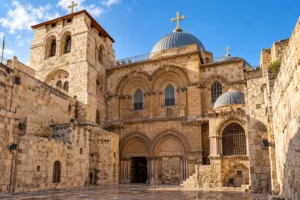
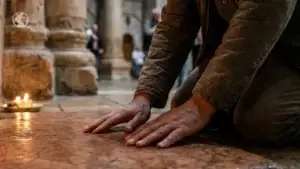
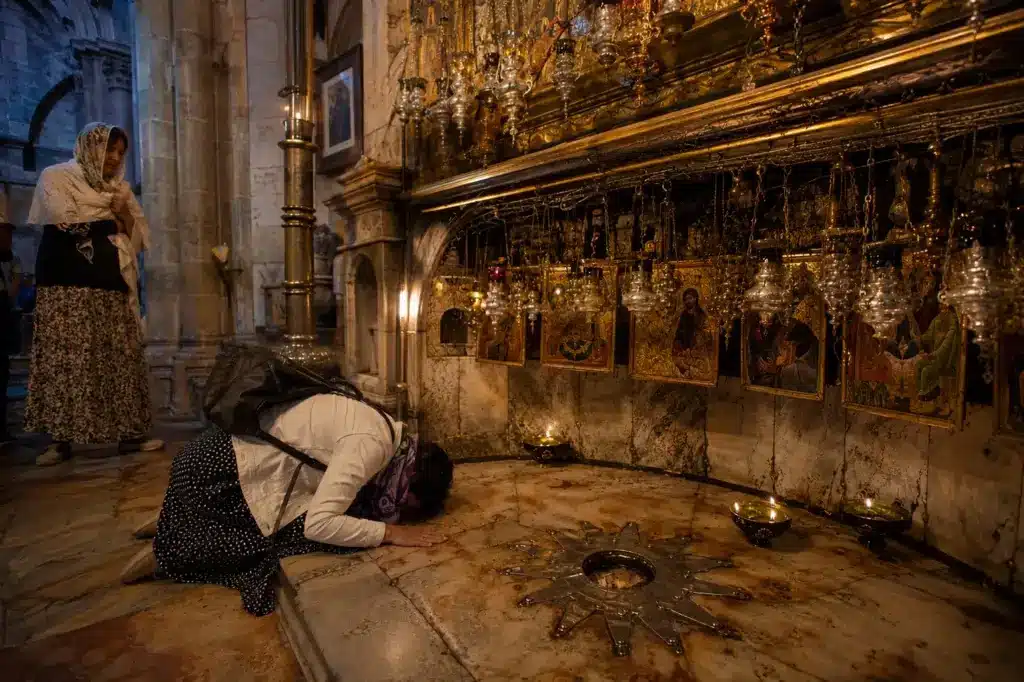
The rock is seven meters long, three meters wide, and rises four and a half meters above the floor of the basilica. A narrow staircase to the right of the entrance to the Church of the Holy Sepulchre climbs to it, and at the top there is a Greek Orthodox altar with a silver disk set into the marble beneath it. The disk has a hole in the center. Pilgrims kneel down, reach through, and their hand touches the limestone of Golgotha.
The chapel around it is small. On most mornings there is a queue. A few people at a time move up the stairs, do the same thing, and move back down. Each of them, in the moments they are on their knees, is doing what pilgrims have done at this spot for at least seventeen hundred years. Some know the archaeology, some don’t. Nobody up there is confused about what they think is under their hand.
Whether the rock beneath the silver disk is the actual hill on which our Lord was crucified is a question that has been asked in every century since Constantine’s builders opened the ground. The strongest answer serious archaeology, textual evidence, and the memory of the local church can give is that it very probably is. That answer isn’t a hedge. It holds up under scrutiny in ways that most pilgrim materials don’t bother to lay out.
| Fact | Detail |
| Aramaic name | Golgotha, from gulgalta, meaning place of the skull |
| Location | About 415 meters west of the Temple Mount, in the Christian Quarter of the Old City |
| At the summit | Greek Orthodox Chapel of the Crucifixion (twelfth Station of the Cross), Latin Chapel of the Nailing to the Cross (eleventh Station), and Chapel of Our Lady of Sorrows between them |
| Distance to the Tomb of Christ | About 40 meters, both enclosed under the same roof |
| Church shared by | Six Christian communities under the Status Quo, formalized in 1852 |
| Feast day for the site | Exaltation of the Holy Cross, September 14, observed by Eastern and Latin churches alike |
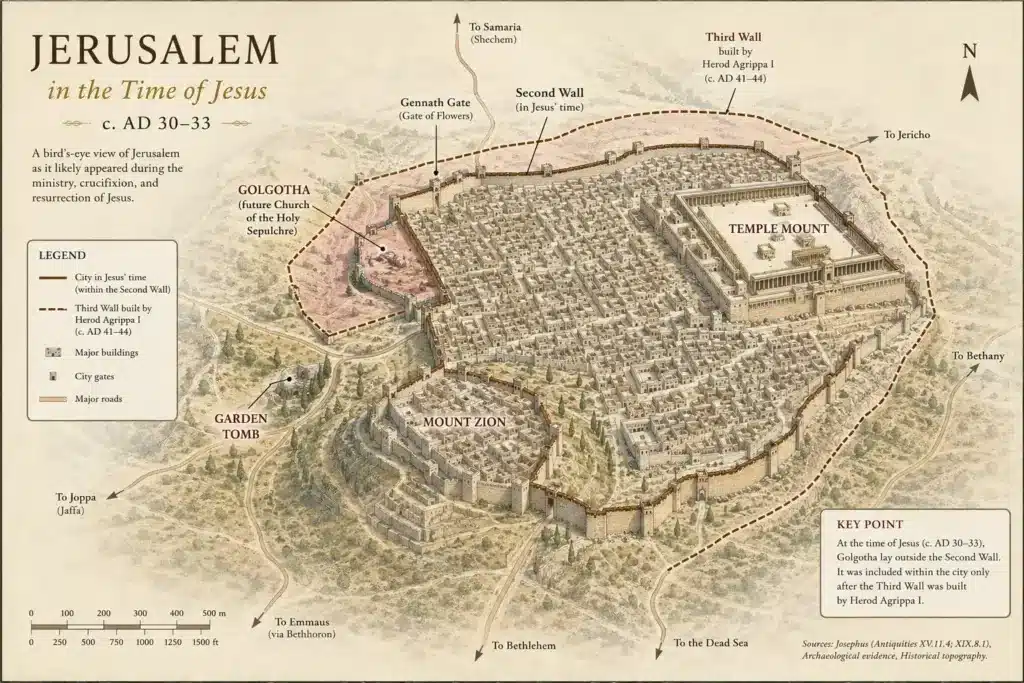
The site had to be outside the walls, and this one was
The Gospels are specific about location. Our Lord was crucified outside the city, near a garden, close enough to a road that passersby could read the inscription over the cross. Roman practice and Jewish law both required executions outside inhabited areas, and any candidate for the site has to meet that condition first.
The walls of Jerusalem in the first century have been reconstructed by generations of archaeologists, working from Josephus, the excavated Gennath Gate, and the surveyed remains near the Church of the Redeemer a short distance from the Holy Sepulchre. The relevant wall for the year of the Crucifixion is the Second Wall, whose line placed the current Church of the Holy Sepulchre just outside the city. Herod Agrippa expanded the boundary between 41 and 44 AD by building the Third Wall further north, which brought the site inside the city where it has remained ever since. The Old City walls a visitor sees today are largely Ottoman, built centuries later on top of that expanded perimeter.
That change of position matters. By the time the earliest recorded Christian pilgrim visited Jerusalem in 333 AD, the site was already inside the city, which meant it couldn’t be identified by simply looking for a spot outside the walls. It had to be preserved by memory. If the Christian community had lost the exact location, no observer of the fourth century could have recovered it by reading Josephus and pacing the streets.
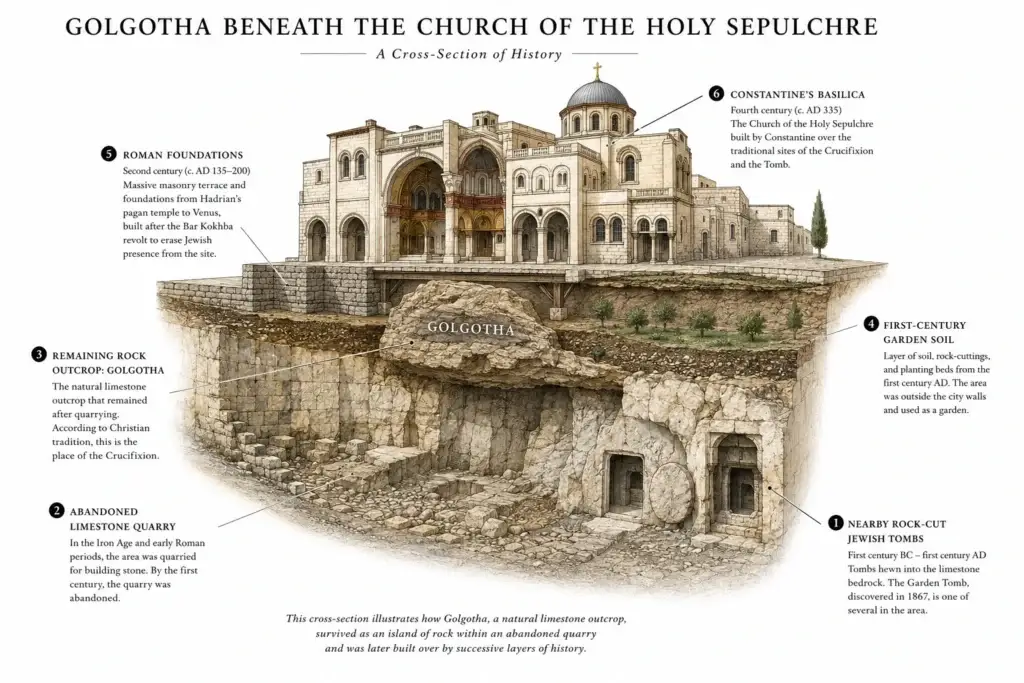
The topography the Gospels describe, meanwhile, does match what the ground under the church actually is. John 19:41 speaks of a garden in the place where our Lord was crucified, and in the garden a new tomb hewn from rock. The area under the current basilica was an abandoned quarry filled with soil for garden use in the first century, with rock outcrops rising above the fill and tombs cut into the surrounding stone. That isn’t a coincidence anyone has to strain for.
The identification is older than Constantine’s church
The tradition that identifies this location as Golgotha reaches at least a century and a half before Constantine’s engineers arrived. It isn’t a fourth century invention.
Melito of Sardis, an early Christian bishop from Asia Minor, traveled to Palestine around 160 to 170 AD for what he described as an inquiry into the places where the events of the Gospel had happened. His writings survive only in fragments, but Eusebius of Caesarea, writing in the following century, quotes his purpose directly and lists him among those who had come to see the sites for themselves. Melito came home with answers, which means somebody in Jerusalem had shown him the spot.
The Bordeaux Pilgrim, whose 333 AD account is the earliest surviving Christian travelogue written in the first person from the Holy Land, describes the site in one sentence. Walking through Jerusalem from the direction of Mount Zion toward what is now the Damascus Gate, the pilgrim writes: “On the left hand is the little hill of Golgotha, where the Lord was crucified.” That description dates to the exact years Constantine’s basilica was under construction. The pilgrim didn’t need to explain what Golgotha was, or ask where it was. It was already a stop on the standard Jerusalem pilgrim route.
Between Melito and the Bordeaux Pilgrim runs the century and a half during which Christians were periodically persecuted, Jerusalem itself was still Aelia Capitolina, and no monumental Christian structure marked any of the Gospel sites. That is the period when a physical marker would have been most vulnerable, and when continuous community memory did the work of the marker. Bishop Macarius, when he stood next to Constantine’s engineers in 326 AD and identified the ground under the pagan temple as the true location, was drawing on that memory. Eusebius, writing about the discovery, is clear that the local church, not the imperial court, supplied the identification.
What the ground under the church shows
The area under the Church of the Holy Sepulchre has been more thoroughly excavated than most sites in the Holy Land, and what has been found is the exact topography the Gospels describe.
Father Virgilio Corbo, a Franciscan archaeologist entrusted with the site by the three principal Christian communities in 1963, spent seventeen years excavating what could be reached under and around the church. His work identified the Constantinian foundations, mapped several tombs cut into the rock still standing within the church compound, and confirmed that the whole area sat on an abandoned quarry in use as early as the eighth or ninth century BC. Corbo’s monograph on the archaeology of the site remains the standard reference.
Magen Broshi and Gabriel Barkay’s excavations in the Chapel of St. Vartan, on the north side of the rotunda between 1975 and 1985, added a further layer. They found Iron Age II pottery and floor surfaces above the quarry fill, meaning the area had been residential in the late eighth century BC before the city expanded and the ground was abandoned. By the time of our Lord, the quarry was long out of use. The ground had been filled with soil for garden use, which is what John describes.
The current excavation, led by Professor Francesca Romana Stasolla of Sapienza University of Rome and coordinated with the Franciscans, the Greek Orthodox Patriarchate, and the Armenian Apostolic Patriarchate, has been running since 2022. Stasolla’s team retraced Corbo’s 1960s trenches with contemporary methods, documented the Roman temple foundations that Constantine’s crew removed, and confirmed that the ancient quarry had irregular deep cuts, some more than two meters below the current floor. Constantine’s builders had to level the terrain with soil and ceramic fill to construct the basilica on top of the rock.
None of this proves the identification in any final sense. Archaeology cannot prove that a specific rock was the specific rock on which a specific man was crucified in the spring of the year 30 or 33 AD. What it can prove is the physical setting. A quarry, filled and turned into garden and tomb ground, with rock outcrops rising above the fill. That setting is what the Gospels describe, and it is where the local church always said the Crucifixion happened.
Why the Garden Tomb doesn’t compete on the historical question
The Garden Tomb, a short distance north of the current Damascus Gate, has been proposed as an alternative site since 1883, when British general Charles Gordon suggested that a nearby rocky escarpment resembled a skull face. The tomb has since been dated by archaeologists to the Iron Age, roughly the eighth or seventh century BC, which is centuries earlier than the new tomb described in John 19:41. A burial in the first century in an Iron Age tomb would have violated the ritual purity requirements the Gospel accounts are explicit about.
The Garden Tomb site has genuine value as a place of quiet Protestant prayer, and many visitors find it more visually evocative of the Gospel scenes than the ornate interior of the Church of the Holy Sepulchre. Those responses are honest and worth honoring. On the historical question of where the Crucifixion took place, though, the Garden Tomb is a candidate proposed against seventeen centuries of continuous local tradition, without any Christian identification before the nineteenth century, and with archaeological evidence that its own tomb doesn’t fit what the Gospels describe.
Serious Protestant archaeologists working on the topography of first century Jerusalem, including Dan Bahat, have largely arrived at the same conclusion the Eastern and Catholic traditions have always held. The Church of the Holy Sepulchre carries the identification. The Garden Tomb carries a devotional purpose. Both readings can hold at once.
Frequently asked questions
Can you actually touch the rock?
Yes. The Greek Orthodox altar at the summit of the Golgotha chapel has a silver disk set into the floor beneath it with a hole in the center. Pilgrims kneel to reach through, and the limestone underneath is the top of the outcrop that Constantine’s engineers exposed by cutting away the surrounding hillside. The space in front of the altar can only hold a few people at a time, so on busy mornings the queue moves slowly. On a Wednesday morning in the quieter weeks between the major feasts, you may have the chapel to yourself for a few minutes.
Is the crack in the rock the one Matthew describes at the Crucifixion?
Christian tradition holds that the visible vertical fissure in the rock is the one caused by the earthquake in Matthew 27:51, when “the earth shook, and the rocks were split.” The crack is visible through a glass panel on the right side of the altar and runs a considerable distance down the outcrop. Geologists have observed that the limestone in this part of Jerusalem is prone to natural fracturing, so the crack cannot be scientifically attributed to any specific event. Whether the visitor takes it as the Gospel split or as one of many fractures the rock has weathered over the centuries, it is real and it is there.
How can we be sure the rock hasn’t been reconstructed or replaced?
The rock is bedrock. It couldn’t have been moved by Constantine’s builders or by anyone since. What Constantine’s engineers did in 326 AD was cut away the surrounding hillside to leave the outcrop and the nearby tomb standing free, then build the basilica around both. The outcrop visible today is the original stone of the ridge, minus the material that used to attach it to the higher ground behind. Corbo’s excavations, the Broshi and Barkay work in the Chapel of St. Vartan, and the current Sapienza project have all confirmed the geological continuity between the outcrop and the surrounding quarry floor.
Do the different Christian traditions agree on the identification?
Broadly yes. All of the Eastern communities that have worshipped at the Church of the Holy Sepulchre for centuries treat the identification as settled, and the Roman Catholic Church holds the same view through the Franciscan Custody of the Holy Land. Some Protestant Christians, particularly evangelicals, have historically preferred the Garden Tomb for devotional visits, but Protestant archaeologists working on the topography of first century Jerusalem have largely converged with the Eastern and Catholic view. Where the traditions differ isn’t on whether this is the site, but on how the site should be liturgically honored.
Is there a way to keep this memory close after coming home?
Yes, in a way worth thinking about. Christians know that the presence of God is not in a stone or a pendant or anything carried out of the Holy Land, that He is given directly to every believer through the Holy Spirit and reached through prayer offered in the name of our Lord, and none of that depends on owning anything at all. But a Melior Mundus Gold Cross Pendant is a strange object to hold, because it carries an authentic Jerusalem stone and was blessed on the Tomb of Christ inside the very church that encloses the rock of Golgotha. It is made by a Christian artisan family in Bethlehem whose workshop stays alive on work like this, and meaningful proceeds move through local Christian leaders to the families, parishes, and traditions keeping Christianity rooted where the faith began. The person who wears one becomes part of that chain. It is not a relic in the sacramental sense. It carries no power of its own. What it carries is the memory that the rock is real, the church is still open every morning, and the story keeps going whether you are there to see it or not.