The Immovable Ladder gets its name from a legend that isn’t quite true. It has been stolen, hidden, and shifted from one side of the window to the other, and the widely repeated line that it symbolizes Christian division comes from a single papal remark in 1964 that every writer since has quietly copied. The real story is stranger, and honestly more interesting.
| Location | Ledge below the right-hand upper window, front facade of the Church of the Holy Sepulchre, Old City of Jerusalem |
| First depicted | 1728 engraving by the Franciscan friar Elzearius Horn |
| Under whose rights | The window and ledge fall under the Armenian Apostolic Church |
| Governed by | The Status Quo of the Holy Places (1757 Ottoman firman, reaffirmed 1852) |
| Custodian communities | Greek Orthodox, Armenian Apostolic, Roman Catholic, Coptic, Syriac, Ethiopian |
| Times it has moved | At least twice (hidden by a tourist in 1997; reportedly taken around 1981) |
| Is it the original? | Almost certainly not. Wood, three centuries, Jerusalem weather. |
| Free to see | Yes. Visible from the courtyard without entering the church. |
What Is the Immovable Ladder?
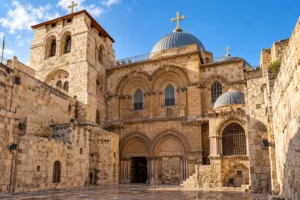
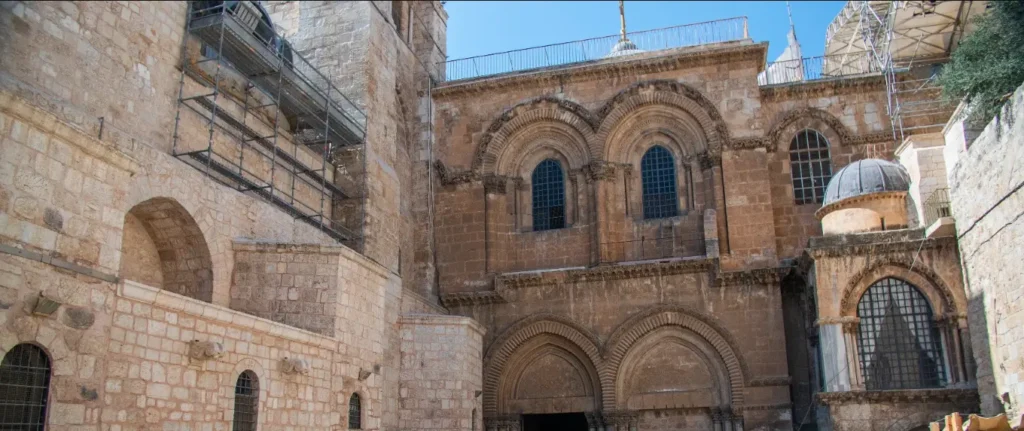
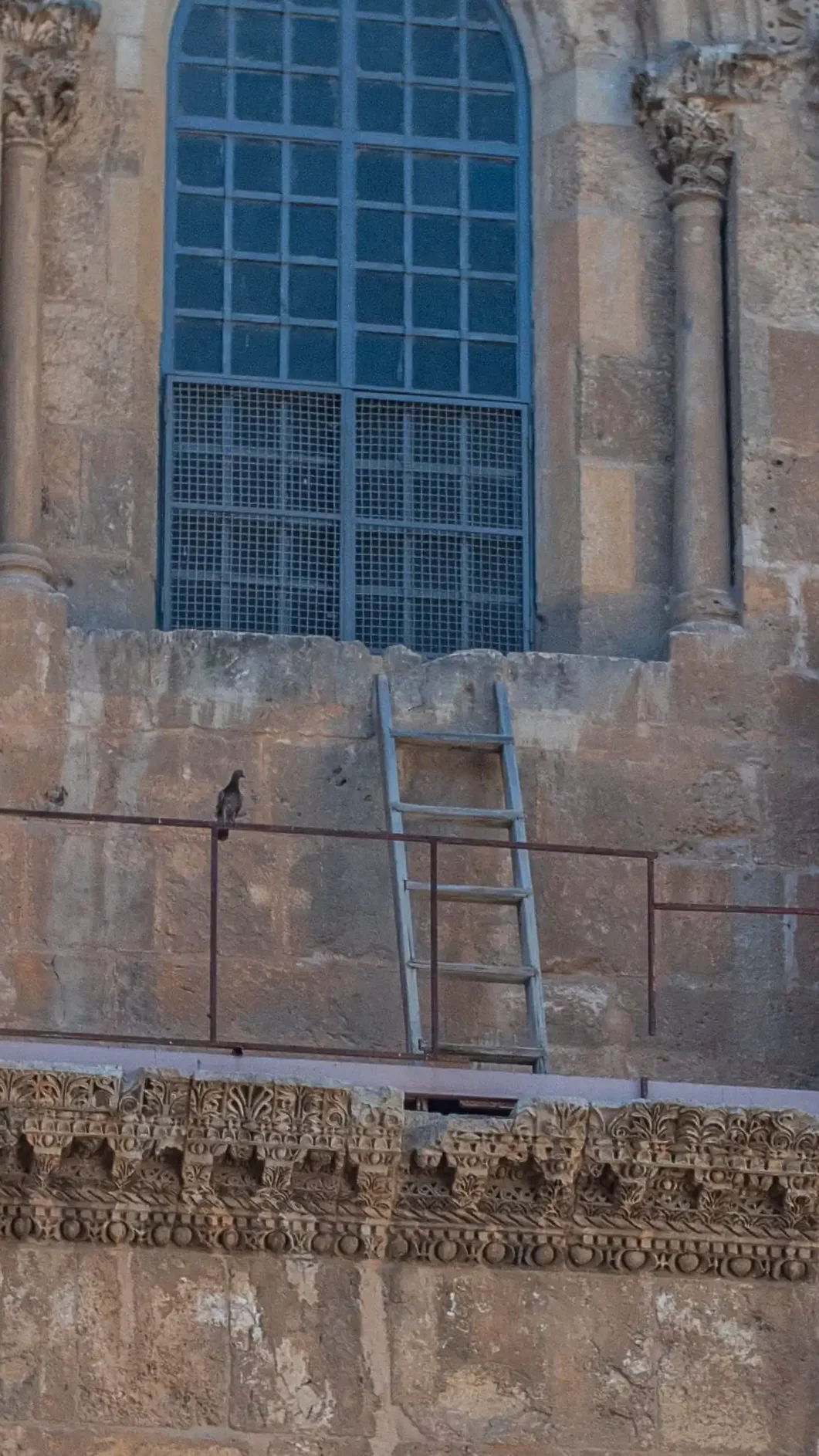
The Immovable Ladder is a wooden ladder that sits on a narrow stone ledge beneath the right-hand upper window on the front of the Church of the Holy Sepulchre, in the Old City of Jerusalem, and it has been there in one form or another since at least 1728, when it appears in an engraving by the Franciscan friar Elzearius Horn. The window and ledge fall under the rights of the Armenian Apostolic Church, one of the six Christian communities that share custody of the building. You can see the ladder from the courtyard outside, no ticket needed.
The Ladder Is Not Immovable
The word “immovable” is a nickname, not a description of what has actually happened to the ladder over the centuries.
The 1997 Incident
In 1997, a tourist climbed up and hid the ladder somewhere inside the church, apparently as a bit of theater at the expense of the whole idea of an untouchable object at the heart of the world’s most contested Christian site. Church staff found it and put it back on the ledge, and life carried on much as before.
The 1981 Theft
Around 1981, the ladder was reportedly taken and then recovered by police shortly after. [VERIFY: sources disagree on whether this was an attempted or completed theft. Confirm or soften the wording before publication.]
It Has Been Repositioned
At some point during the twentieth century, the ladder was moved from one side of the window to the other and simply left there. Nobody objected loudly enough to reverse it.
What actually keeps the ladder in place isn’t physics or law or some special immovability. It’s that nobody with the authority to move it permanently has ever quite wanted to.
Why the Ladder Was Really Put There
The ladder started life as a piece of maintenance equipment for avoiding a tax. Under Ottoman rule, Christian clergy were charged each time they left and re-entered the Church of the Holy Sepulchre, which meant that a monk stepping outside for bread or water could easily cost his community money on every trip. The practical solution was to stay inside for extended stretches, sometimes months at a time, and to have supplies handed up from the courtyard through the outer windows.
That’s what the ledge was for. It was a working surface. Monks are said to have grown vegetables on the cornice, and the ladder was how you reached the ledge to haul provisions up, tend the plants, or work on the balcony during festivals. It wasn’t a religious object and it wasn’t put there for meaning. It was equipment, left leaning against the wall the way any working ladder gets left leaning somewhere after you’ve used it enough times.
The Rule That Trapped It
In 1757, an Ottoman sultan issued a firman, a decree, that divided rights within the Church of the Holy Sepulchre among the Christian communities who had been feuding over the space for centuries. The decree was reaffirmed in 1852 and became known as the Status Quo of the Holy Places. Its rule is unbending: nothing inside or attached to the church may be moved, repaired, or altered without the consent of all six custodian communities, the Greek Orthodox, the Armenian Apostolic, the Roman Catholic, the Coptic, the Syriac, and the Ethiopian.
The ladder is specifically named in both documents. That’s the quiet mechanism that turned an ordinary piece of maintenance equipment into a monument. It was mundane enough that nobody thought twice about it when the decrees were being drawn up, and specific enough that it got written down anyway. Being written down is what made it permanent.
Where “Symbol of Division” Actually Came From
The reading of the ladder as a symbol of Christian division comes from Pope Paul VI. During his Holy Land pilgrimage in 1964, he described it, in passing, as a visible sign of the churches’ inability to agree with one another. That line traveled. Every subsequent article, blog post, and travel guide picked it up and treated it as though it were the ladder’s own meaning, an interpretation the object had been carrying on its back all along.
It wasn’t. Before 1964, it was a ladder.
The Case That the Status Quo Is Working
The usual take on the ladder is that it proves Christians can’t get along. There’s a different way to look at the same evidence. Six historically hostile denominations, some of which have thrown punches inside the church within living memory, have shared a single building for nearly 270 years without any of them destroying it or seizing it from the others. When they do argue, and they do, the arguments get settled through paperwork and old firmans rather than through violence.
The rigidity of the Status Quo isn’t a bug. It’s the whole point. Nobody can take an inch of advantage because nobody is allowed to change anything, and that stalemate is what has protected the site through Ottoman rule, British Mandate, wars, and every regime that has come through Jerusalem in the meantime. Seen from that angle, the ladder isn’t proof that the system failed. It’s the small, visible price of the system quietly doing its job.
Is It Even the Same Ladder?
There’s no clean documented answer, but reasoning gets you fairly close. The earliest depiction of the ladder is from 1728. Wood that sits exposed on a stone ledge in Jerusalem, through nearly three centuries of sun, rain, and the occasional wet winter storm, doesn’t survive intact. It rots, splits, and eventually has to come down and be replaced by something visually similar. What’s been preserved, in other words, isn’t the specific ladder that a monk once climbed to fetch water. It’s the position of a ladder in that exact spot. That’s a subtler kind of continuity, but it’s still continuity.
Seeing the Ladder Today
The ladder is on the front of the church and visible from the courtyard, so you don’t have to go inside or queue for the tomb to see it. Stand roughly in the center of the courtyard, look up at the front facade, and it’s on the ledge beneath the right-hand upper window. There’s no plaque, no signage, no admission. If you didn’t already know to look for it, you’d probably walk right past it.
If you do step inside, the Stone of Anointing sits just past the entrance, and Golgotha is up a short staircase to the right, so the ladder is worth a minute on the way in or out.
Carrying a Piece of That Building Home
Something worth sitting with here is that the ladder, whether or not it’s the same piece of wood from 1728, has quietly kept its place on that ledge through nearly every upheaval Jerusalem has seen, which is more or less what the whole building has done too. The Church of the Holy Sepulchre is still standing. The families who hold its keys, the Joudehs and the Nuseibehs, still open its door every morning the way their ancestors did for centuries before them. And the living Christian community around it, in Bethlehem and Nazareth as well as in Jerusalem, is still there, still shaping things by hand from the stone and olive wood of these hills.
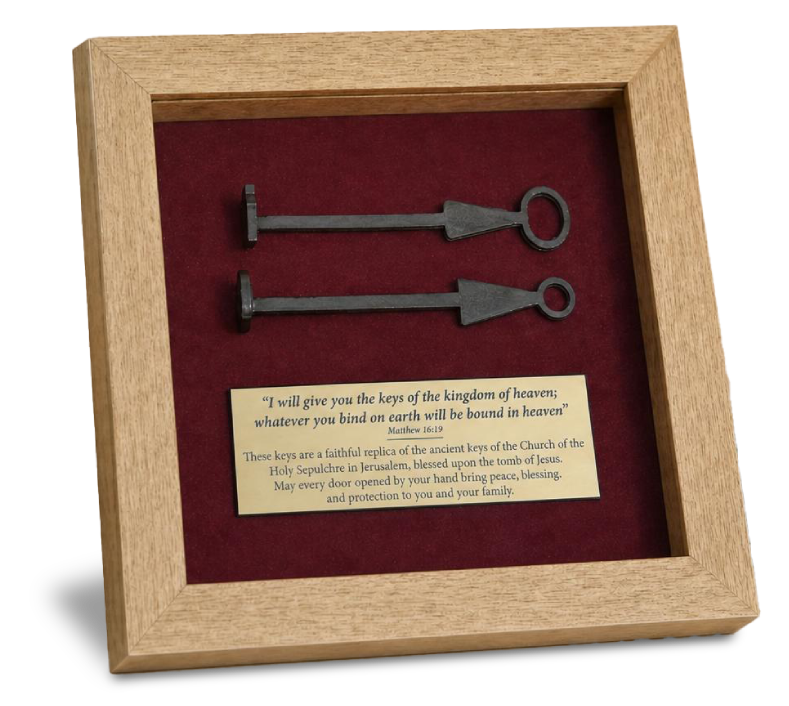
Owning something physical from that place doesn’t change your faith or make prayers land more clearly. But it can keep a small, quiet thread between your daily life and a site that’s been holding its ground, ladder and all, for a very long time. A stone from these hills, a set of miniature keys of the Holy Sepulchre, a piece of olive wood shaped in Bethlehem, isn’t a channel to God. It’s closer to a bookmark, holding your attention on a story you’ve already decided matters.
Frequently Asked Questions
Is the immovable ladder still there?
Yes. As of the most recent visits and photographs, the ladder is still on its ledge beneath the right-hand upper window on the front of the Church of the Holy Sepulchre. It’s visible from the courtyard outside the church, day and night, and can be seen without entering the building or paying anything.
Why can’t the immovable ladder be moved?
Because of a 1757 Ottoman decree, reaffirmed in 1852, called the Status Quo of the Holy Places. That agreement forbids any change inside or on the church without unanimous consent of the six Christian communities that share custody of the building. The ladder is specifically named in both documents, which locks it in place.
Has the immovable ladder ever been moved?
Yes, at least twice. In 1997, a tourist hid it inside the church as an apparent prank on the whole Status Quo idea, and it was found and put back. Around 1981 it was reportedly taken and recovered by police shortly after. It has also been shifted between sides of the window during the twentieth century.
What happens if you move the immovable ladder?
Nothing legal happens to you directly, but you’d be violating the Status Quo, which the six custodian communities enforce through the church’s own governance rather than through civil law. Practically, the ladder gets returned to its position quickly and without much drama, the way it has been every previous time someone tried.
Is the immovable ladder the original one?
Almost certainly not. Wood that sits exposed on a stone ledge in Jerusalem for nearly three centuries doesn’t survive intact, so the current ladder is very likely a replacement, or one of several replacements over the years. There’s no official documentation either way. What’s been preserved is the position, not the physical object.
Who owns the window the ladder leans against?
The window and the ledge beneath it fall under the rights of the Armenian Apostolic Church, one of the six communities that share custody of the Church of the Holy Sepulchre under the Status Quo. The window immediately to the left is Greek Orthodox territory. Those boundaries are enforced with the same seriousness as international borders.