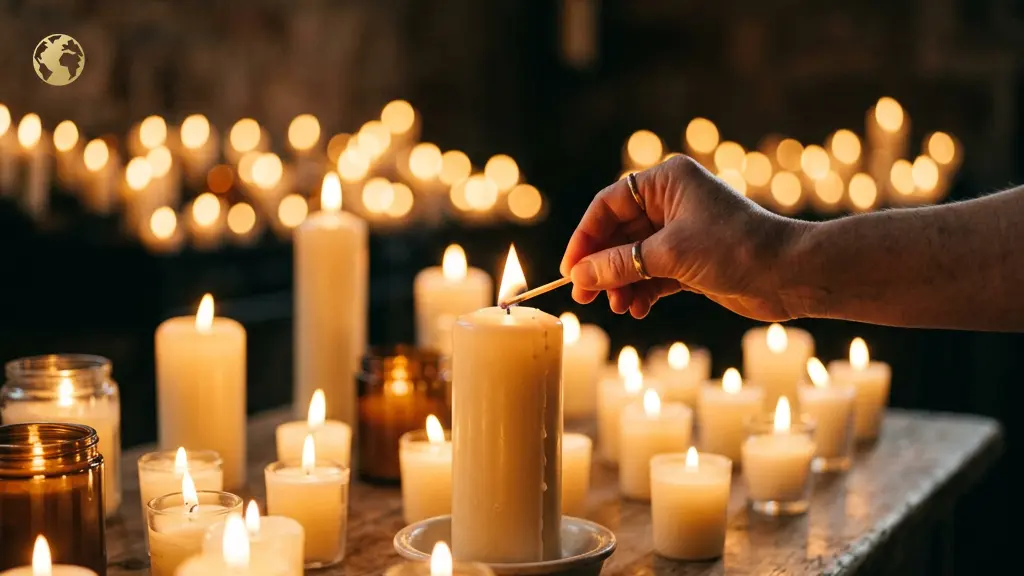
If you’ve been feeling the pull to set aside a corner of your home for prayer, here’s the short answer. A Catholic prayer corner is a small, fixed place in your house set apart for prayer, usually a crucifix at the center with a candle, an image of Our Lady or a saint you love, a Bible, and a rosary, on a shelf or a table you walk past every day. You don’t need a spare room. You don’t need matching things. A single cleared shelf on your bookcase is a real prayer corner, and if you rent, or share a room, or don’t have wall space, the top of your dresser or a lidded box that opens into a small shrine works just as well.
The Church even has a name for a household that keeps one. Yours is called the domestic church.
And here’s the thing nobody selling you a Mary statue is going to tell you. There are four Catholic things you can do with your prayer corner that no shopping list is going to mention, and they start with the cloth.
| What | Answer |
|---|---|
| The Church’s name for it | Ecclesia domestica, the domestic church (CCC 1656) |
| Traditional name for the space | The little oratory |
| What you’ll want on it | Crucifix, Bible, image of Our Lady or a saint, candle, rosary, holy water, prayer book, cloth |
| Honest starter cost | Around $60 if you build it from scratch, less if you already own the basics |
| Best location | Somewhere you already walk past every day |
| Cloth color | Changes with the liturgical season |
| Blessing | Ask your parish. The rite is in the Church’s book of blessings |
| Broken or old blessed items | Burn or bury, never the bin |
| What people add later | A piece from the Holy Land, blessed at a named holy site |
What Goes in Your Prayer Corner
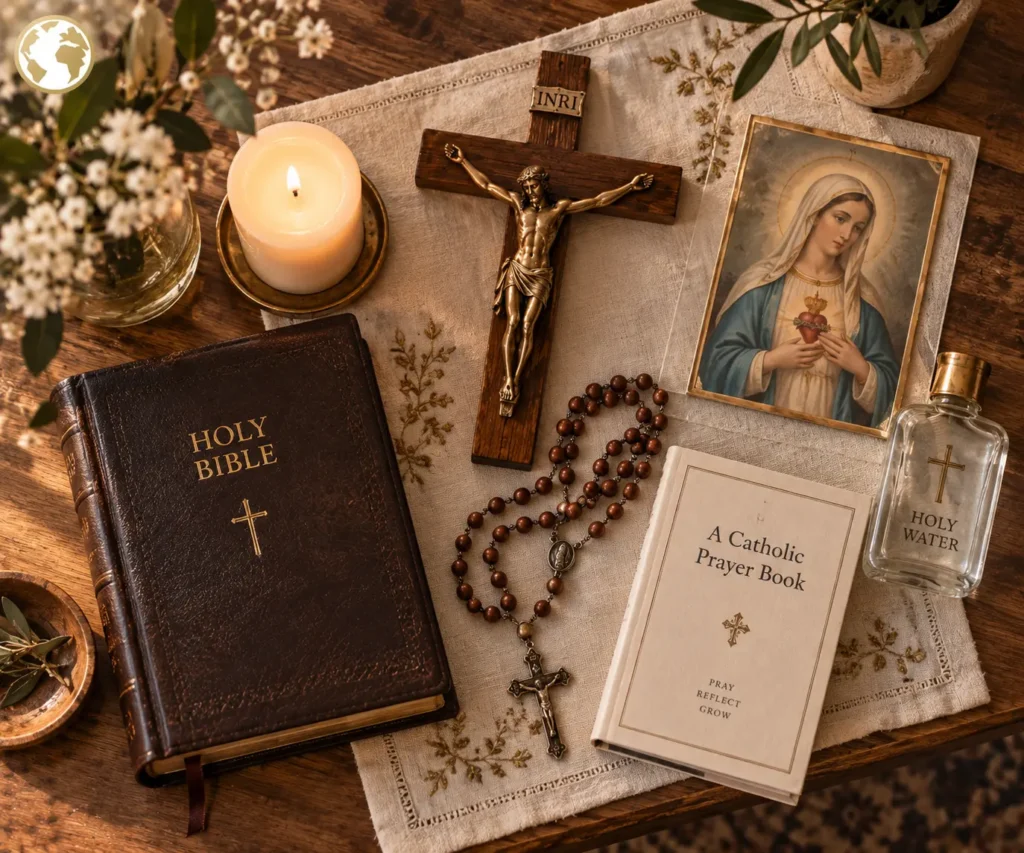
The essentials you’ll want are a crucifix, a Bible, an image or statue of Our Lady, Saint Joseph, or your patron saint, a candle, a rosary, a small bottle of holy water, a prayer book or devotional, and a cloth. If you have room to kneel, a cushion or a small kneeler helps, and the traditional Catholic kneeler has a name, the prie-dieu.
Your crucifix is the focal point and everything else arranges around it. That’s why almost every guide puts it first. It’s what your eyes rest on when you sit down. A wooden crucifix runs about $15 to $30. A small Bible you’ll actually read from is around $25, and if you already own one, use the one you already have. An image or statue of Our Lady, Saint Joseph, or your patron saint can be a framed print for around $10, or a small statue in the $20 to $40 range. A candle in a glass jar is $5 to $10, and it does more than you’d expect. Lighting it tells your body that you’re praying now, before your mind catches up. A rosary can be $10, or free, since you probably already have the one you were given at First Communion or Confirmation. Your holy water is filled at your parish for nothing. A prayer book or devotional runs $15 to $25. The cloth costs almost nothing but does more than you’d think, and we’ll get to that.
So a good starter corner runs about $60, and honestly you probably already own half of it. Don’t feel bad about the small budget. That’s how a starter corner is supposed to look. You’re not building a shrine to impress your friends. You’re building a place you’ll actually come back to.
If you’d like a kneeler, the traditional one is a prie-dieu, a small wooden bench with a padded rest for your elbows and a low kneeler underneath. A folded cushion on the floor does the same job at a fraction of the cost, and your prayer isn’t worse for it.
Where to Put It
Where you put your corner matters more than what goes in it, because the whole point of a prayer corner is that you actually see it. Four kinds of spaces work.
The first is an actual corner of your living room or bedroom, with a small table, a low chest, or a chair to hold your crucifix and everything around it. That’s the classic setup, and the reason the name stuck. The second, and probably the most common in real homes, is a single shelf on your bookcase, cleared of everything else. The third is a whole table or a small dedicated room, which is lovely if you’ve got the space, but most of us don’t. And the fourth is a shared or rented room, where your corner lives on your windowsill, on top of your dresser, or inside a lidded box that opens into a small shrine when you sit down to pray. If you’re a student, or renting, or sharing a room, your corner is just as real as anyone else’s. Every shopping-list article online seems to forget you exist. You don’t need a house to have a domestic church.
Put your corner somewhere you already walk past every day. That beats somewhere beautiful you have to make a trip to. The best prayer corner is the one you catch out of the corner of your eye on the way to the kitchen, not the one hidden in the back room where it slowly gathers dust.
There’s an old custom of praying toward the east, and older churches were often built facing that way, but it’s a tradition, not a rule. If your corner faces west because that’s where your shelf is, your corner is still a prayer corner.

Why Catholics Keep a Prayer Corner
Because your home is meant to be a church in miniature. That’s not sentiment. It’s what the Church actually teaches, and it’s ancient.
The technical name is the ecclesia domestica, the domestic church. The Second Vatican Council picked the phrase up in Lumen Gentium 11, and the Catechism carried it into paragraph 1656, calling your family the domestic church. The very next paragraph, CCC 1657, goes further, saying that in your home the father, the mother, children, and every member of the family exercise the priesthood of the baptized in a privileged way, and calling your home the first school of Christian life.
That’s a strong claim, and it’s worth sitting with. Your house isn’t just where your family happens to live. It’s a place where the Church is actually present, at a small scale, in the ordinary rhythms of your meals and your evenings and your bedtime prayers.
Your prayer corner is what makes that visible. There’s a traditional name for the space itself, the little oratory, and it’s worth using because it says exactly what the thing is. A little oratory is a place of prayer. Small, but real. If you’ve ever paused to say a prayer before a family meal, you’ve already been doing the work of the domestic church without giving it that name.
None of this is decoration. None of it is a private devotional hobby. That shelf with a crucifix on it is the physical sign of something the Church actually teaches about your household, which is why your plain corner in the living room belongs to a much older tradition than anything you’ll find on Pinterest.
Change the Cloth With the Season
The single most useful thing you can do with your corner, and the thing almost nobody mentions online, is change the cloth with the liturgical year.
You put a small piece of fabric under your crucifix, or across the front of your shelf, and change its color with the season of the Church calendar. The colors are the same ones you already see the priest wearing at Mass.
| Season or feast | Cloth color |
|---|---|
| Ordinary Time | Green |
| Advent and Lent | Violet |
| Christmas and Easter, feasts of Our Lord and Our Lady | White or gold |
| Pentecost, Good Friday, feasts of martyrs and apostles | Red |
| Gaudete Sunday and Laetare Sunday (optional) | Rose |
That’s all it is. Five colors, changed maybe six or seven times a year, and it costs you almost nothing. Fabric offcuts work. An old scarf works. A piece cut from a larger cloth you already own works.
The payoff is quiet but real. Your kids watch violet appear a few weeks before Christmas, and white on Christmas morning, and they’re learning the shape of the Church’s year without anyone having to teach them. You change your cloth at the start of Lent and you get a small, physical reminder that the season has actually begun. Your corner starts to move with the year, instead of sitting still on the shelf.
If you do only one thing on this list, do this one.
Having Your Corner Blessed
Your priest can bless your home and the prayer corner in it, and most Catholics don’t realize how simple this is. Walk up to the sacristy after Mass and ask. The Church’s official book of blessings has a specific rite for blessing a home, and priests use it all the time, especially around Epiphany when a lot of families have their houses blessed for the new year.
Ask for it. It’s a good thing to do, and most parishes will say yes without a second thought. What that blessing does is set your corner apart, formally, as a place your household has given to God. It doesn’t make the objects magic. Sacramentals, the blessed things that surround Catholic life, are helps to your prayer, not substitutes for it. But being helped matters. Kneeling in a corner your priest has formally set apart changes how you show up to it, and you’ll notice that the first time you do.
What to Do With a Broken Rosary or Old Blessed Items
Burn or bury, never the bin. But before we get into it, one thing you need to hear plainly. It is not a sin if you’ve thrown a blessed object away. A lot of us carry quiet guilt about this, and the answer should relieve it before it instructs. If you’ve done it, you’re fine. God isn’t holding it against you. Reverence asks for a little better going forward, that’s all.
The principle behind the practice is simple. What has been dedicated to God is returned to God, which in practice means returned to the earth or to the fire, not to the trash collection.
Blessed palms from Palm Sunday get burned, and the ashes go into the ground. Your parish probably collects them every year and burns them for the following year’s Ash Wednesday. Your broken rosary or your chipped statue gets buried, disassembled first if it comes apart cleanly, so the metal, the beads, the wood, and the plaster return to the ground separately rather than tangled together. The ashes of anything you burn also go into the ground. Church grounds are a good place if your parish will let you, a Catholic cemetery is another, and a quiet corner of your garden works too.
If the object is still usable and you just don’t want it any more, give it to your parish or to another Catholic before you think about burying it. Most rosaries end their lives in someone else’s hands, not in the ground.
A Piece from the Holy Land
Once your corner exists, and you’ve been praying there long enough that you actually miss it when you skip a day, a lot of Catholics eventually add a single piece from the Holy Land at the center of it, so the corner is connected to the actual ground where all of this happened. If that’s where you’re headed, bringing the Holy Land home is where we come in.
Both pieces below are handcrafted in Bethlehem by Christian families still living in the same town where Jesus was born, placed for blessing at the holy sites in Holy Land before they ship, and arrive with a numbered certificate signed by a member of the local Church. If you want to see how they’re made, and by whom, the making of has the workshop and the families.

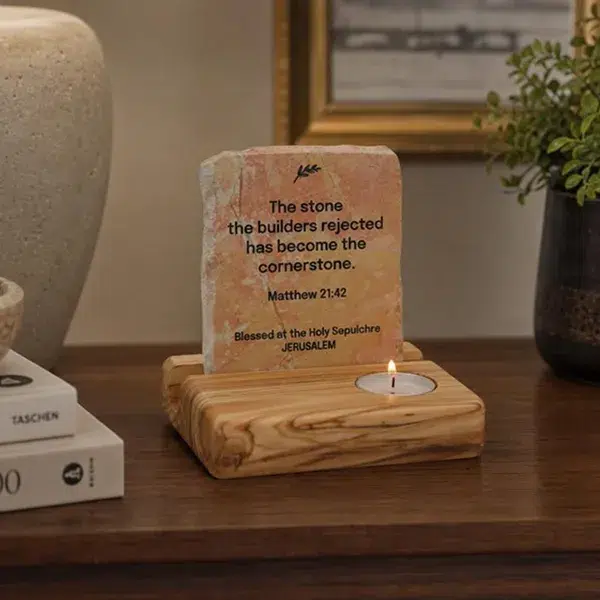
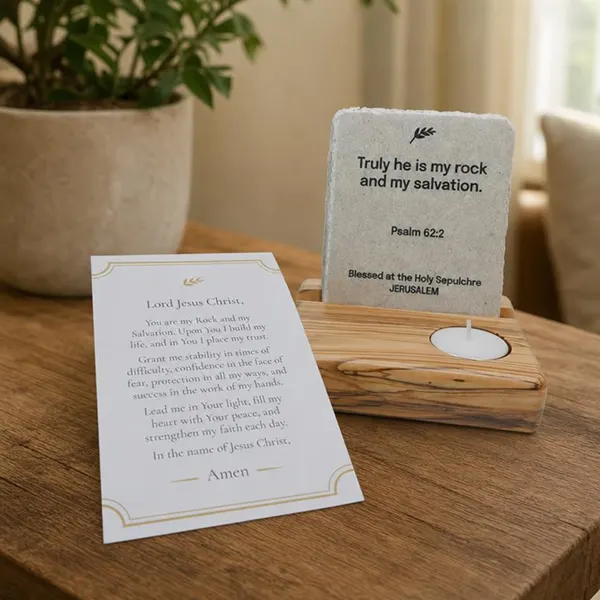
The Holy Land Prayer Stone, $350, is a piece of Holy Land stone on a base of Holy Land olive wood, with a candle holder built into it, so the stone, the light, and the verse sit together as one piece. It’s engraved with your choice of Psalm 62:2 or Matthew 21:42.
The Holy Land Prayer Altar, $650, is the larger piece. Scripture on parchment, an olive wood crucifix, and a Jerusalem stone framed together.
Frequently Asked Questions
Can Catholics have prayer corners?
Yes, and there’s a strong tradition behind it. The Catechism calls your family the domestic church (CCC 1656) and calls your home the first school of Christian life (CCC 1657). Your prayer corner is what makes that theology visible inside your actual house, and Catholics have kept them in one form or another for centuries.
What do you put in a Catholic prayer corner?
Your crucifix at the center, then a Bible, an image or statue of Our Lady or your patron saint, a candle, a rosary, a small bottle of holy water, and a prayer book. A cloth on the surface, ideally one you change with the liturgical season, ties it all together and gives your corner something to do across the year.
Is a home altar the same as a prayer corner?
For practical purposes, yes, and most Catholics use the terms interchangeably. Little oratory is the traditional name and probably the most accurate one, since a real altar is where Mass is celebrated and your home prayer space isn’t that. Home shrine is another term you’ll hear used for the same thing.
Does a prayer corner need to face east?
No. Praying toward the east is an ancient custom, and older churches were often built that way, but there’s no rule about the direction of a domestic prayer space. Put your corner where you’ll actually use it, whichever way it happens to face.
Does a prayer corner need to be blessed by a priest?
No, but you should ask anyway. Your priest can bless your home and the space in it using the rite in the Church’s book of blessings. Walk up to the sacristy after Mass and ask. Most parishes will say yes without a second thought, and having your corner formally set apart matters, even if your corner is already a real prayer corner the moment you start praying at it.
How do I dispose of a broken rosary or a chipped statue?
Bury it, ideally on church grounds, in a Catholic cemetery, or in a quiet part of your garden. If it comes apart cleanly, take it apart first so the parts return to the earth separately. Blessed palms get burned instead, and their ashes go into the ground. It is not a sin if you’ve already thrown one away. Going forward, burn or bury.
How much does a Catholic prayer corner cost?
You can start one for around $60, and most people already own half of what goes in it. That’s a real starter corner, not a compromise. The essentials are inexpensive on purpose, because the whole tradition is built on ordinary households keeping a small holy space at home.
What is a prie-dieu?
A prie-dieu is a small wooden kneeler, traditionally with a padded shelf for resting your arms and a low bench underneath for your knees. It’s the classic Catholic kneeling furniture. Nice to have if you can find one, but a folded cushion on the floor works just as well for most people.
The corner isn’t the point. The ten minutes you spend kneeling there are. Start with a shelf, a crucifix, a candle, and a cloth that changes color with the season, and put it somewhere you already walk past every day. That’s a domestic church.