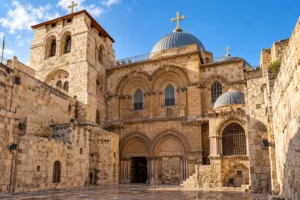
How two Muslim families came to hold the keys of Christianity’s holiest church, and why that arrangement has kept the peace inside it since the year 1187.
The keys to the Church of the Holy Sepulchre are not kept inside the church.
They are kept in a house in the Christian Quarter of Jerusalem, in a wooden box, by a man named Adeeb Joudeh Alhusseini. He is Muslim. His family has held those keys for over eight hundred years. Every morning before four in the winter, before five in the summer, he takes the working key out of the box, walks the ten minutes through the empty streets to the church, and hands it to a member of another Muslim family, the Nuseibehs, who opens the doors of the place where our Lord was crucified, buried, and rose.
This is not a symbolic ceremony. It is how the door of the Holy Sepulchre gets opened, every day, and how it has been opened, without a break of more than a few hours, since Saladin took Jerusalem back from the Crusaders in the twelfth century.
For most Christians the story stops there. Two Muslim families, eight centuries, that’s the interesting bit. But the arrangement itself, why it exists, how it works, who paid for it, what the keys look like, and what has happened to it over the centuries, is one of the strangest and quietest peace agreements in the history of the Christian world. This is the whole story.
Quick reference
| Key holding family | Joudeh Alhusseini, since 1187 |
| Door opening family | Nuseibeh, since 1187 (some accounts trace the role to 638) |
| Number of keys | Two, one from 1187 and one about five hundred years old |
| Founding arrangement | Established by Saladin in 1187 after his reconquest of Jerusalem |
| Reconfirmed under | The Ottoman firman of Sultan Suleiman the Magnificent (1517) and the Status Quo of 1852 |
| Present key holder | Adeeb Joudeh Alhusseini |
| Present doorkeeper | Wajeeh Nuseibeh (since 1986) |
| Daily opening time | Before 4 AM in winter, before 5 AM in summer |
| Interruptions in the record | Black Death (1349) and COVID (March 2020) |
How did this happen in the first place?
Before Saladin, the doors of the Holy Sepulchre were opened by whichever Christian community happened to be strongest at the time.
Under the Crusaders, from 1099 to 1187, that meant the Latin Church controlled the church absolutely. Every other denomination present in the city, the Greek Orthodox, the Armenian Apostolic, the Syriac Orthodox, and the Coptic Orthodox communities that had all been praying in the church since before the Muslim conquest of 638, held whatever access the Crusader kings allowed them, which was often very little. When Saladin defeated the Crusaders at the Battle of Hattin in 1187 and marched into Jerusalem four months later, he faced a problem the Christians had not been able to solve for themselves. Six different Christian communities all claimed rights to the same building, and any decision he made about the keys was going to be read as a decision about which of them owned it.
His solution was to take the question out of Christian hands entirely.
In 1187 Saladin entrusted the keys of the church to a Jerusalem notable named Ghanim ibn Ali al-Ansari, whose descendants would take the family name Joudeh Alhusseini. Ghanim’s line has held them ever since. The daily duty of opening and closing the doors he gave to another Jerusalem family, the Nuseibehs, whose presence in the city predated the Crusader arrival by centuries. Some Nuseibeh accounts trace the family’s role at the church all the way back to the caliph Umar in 638, when the second caliph of Islam refused to pray inside the church for fear his followers would later claim the site.
Whether the Nuseibeh role began under Umar or under Saladin, the arrangement Saladin fixed in place has held. Two Muslim families, one to guard the keys and one to work them, chosen because they were not on any side of the Christian dispute inside the building.
What the keys actually are
There are two of them.
The older one is roughly twelve inches long, hand forged iron, with a triangular handle and a square tip designed for the medieval lock in the lower door. It is eight hundred and fifty years old and it broke sometime along the way. The Joudeh family still has it, kept in the same wooden box they use for the working key. They show it to visiting journalists and historians. It is the key Saladin’s officials would have handed to Ghanim in 1187.
The one Adeeb walks with every morning is about five hundred years old. It is shorter and heavier, and it was forged to fit the current locks, which date to the Mamluk or early Ottoman period. Both keys are unrepaired. The older key has not been touched since it broke. Nobody in the family has considered restoring it, because the point of the older key is that it was the original one.
Alongside the keys, the Joudeh family also keeps the original Ottoman firman, the imperial contract that reconfirmed their custodianship after the Ottoman conquest of Jerusalem in 1517. It is a large sheet of parchment, sealed in golden ink with the tughra of Sultan Suleiman the Magnificent, and it is one of the oldest continuously honored contracts in the Middle East. Every subsequent authority in the city, Ottoman, British, Jordanian, Israeli, has recognized the same arrangement.
The morning ritual
The daily opening happens in almost exactly the same sequence every day.
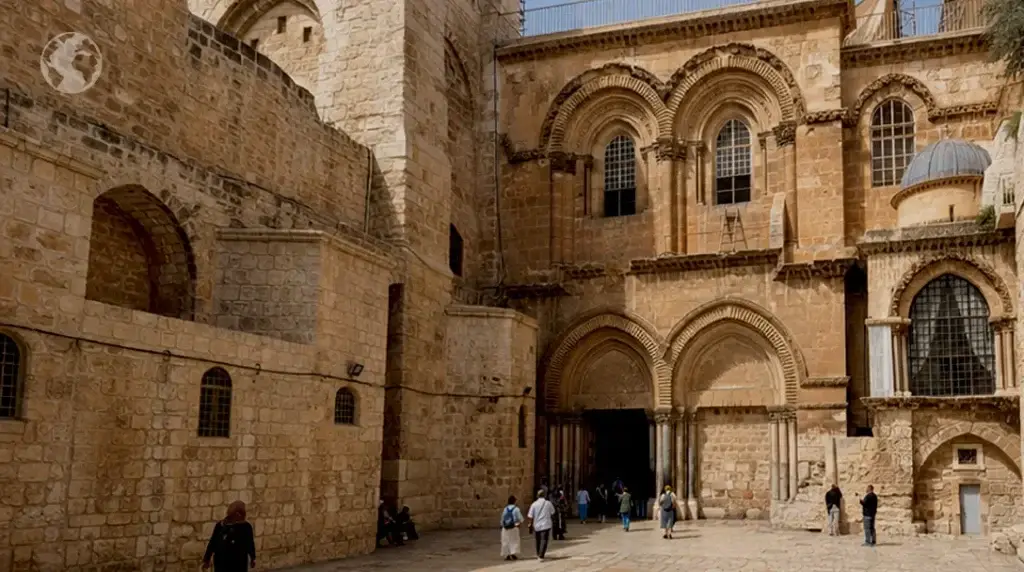
Adeeb Joudeh leaves his house before dawn, carrying the key. The route runs through the Muslim Quarter and into the Christian Quarter, past shuttered shops and quiet stones. At the church, he meets Wajeeh Nuseibeh, who has been the doorkeeper of the church since 1986, when he took over the role from his father. A small ladder is brought forward. Wajeeh climbs it, unlocks the upper lock, steps down, unlocks the lower lock, and pushes the great wooden doors inward. Adeeb stays until the doors are open, then takes the key back and returns home. Wajeeh remains, sometimes greeting the first pilgrims, sometimes praying briefly himself in the courtyard.
At the end of the day, sometime after seven in the evening, they reverse the process. The final Christian who leaves the church, usually a Franciscan brother of the Custody of the Holy Land, hands out a small hooked pole through the door. Wajeeh climbs the ladder, locks the upper lock, steps down, locks the lower lock, and returns the key to Adeeb. The pole is used from the outside because the doors have no external handles.
For over eight hundred years, that has been the day. There have been only two known interruptions. The Black Death of 1349, when Jerusalem itself was largely emptied. And the day COVID reached Jerusalem in March 2020, when the doors were closed for a matter of weeks. In every other war, siege, riot, plague, revolution, and change of empire the church has passed through, the doors have opened at the appointed hour.
Why did the Christians accept this
The obvious question a Christian reader asks is why the six denominations sharing the church allowed the arrangement to hold. The honest answer is that they welcomed it, most of the time. Under the Ottoman period especially, the neutrality of the Joudeh and Nuseibeh families was one of the few things every Christian community inside the church could agree on. When the Status Quo agreement of 1852 froze the custodial rights inside the church at their nineteenth century state, the Muslim custody of the doors was carried through into the Status Quo unchanged. Every subsequent negotiation, including the ones after the 1967 war and the various late twentieth century restoration projects, has left the arrangement in place.
Wajeeh Nuseibeh has put it as plainly as anyone can. The Christians can’t agree, so the Muslims keep the peace. He does not mean this cruelly. He means it as a family who has worked next to Greek Orthodox, Franciscan, and Armenian clergy every day of his adult life, and who understands what it costs when six ancient communities try to share the same walls.
The relationship goes further than door duty. During Holy Week, when tens of thousands of pilgrims fill the church for the Holy Fire ceremony on Holy Saturday and the Easter liturgies on Sunday, the Joudeh and Nuseibeh families coordinate closely with the Greek Orthodox Patriarchate, the Franciscan Custody of the Holy Land, and the Armenian Apostolic Church on security and access. Family members are present in the courtyard during major processions. When a Latin Patriarch of Jerusalem or a Custos of the Holy Land is installed, the Joudeh family attends. When funerals for elders of the two families are held, senior clergy from the three primary custodial denominations attend in turn.
The families today
Adeeb Joudeh’s son is being trained to succeed him. So is Wajeeh Nuseibeh’s. The transmission from father to son has never been broken, though in every generation there is a moment when the incoming son shadows the outgoing father for months or years before the key changes hands. Wajeeh has said publicly that he took over from his father in 1986 only after years of walking the route with him and learning the movement of the locks in his hands.
Both families live modest lives. Neither is paid to hold the office. What they receive is what the churches inside the building give them at the major feasts, and what the wider community of Jerusalem still recognizes as a debt of respect. They speak Arabic first, English or Hebrew when they need to, and often some Greek learned from years around the Orthodox clergy inside the church. They are Muslim believers who have spent their lives inside the most Christian place in the world, and they speak of it with the plain reverence of people who know exactly what they are guarding.
A word on carrying it home
You might, at some point, want to keep something of this story near you.
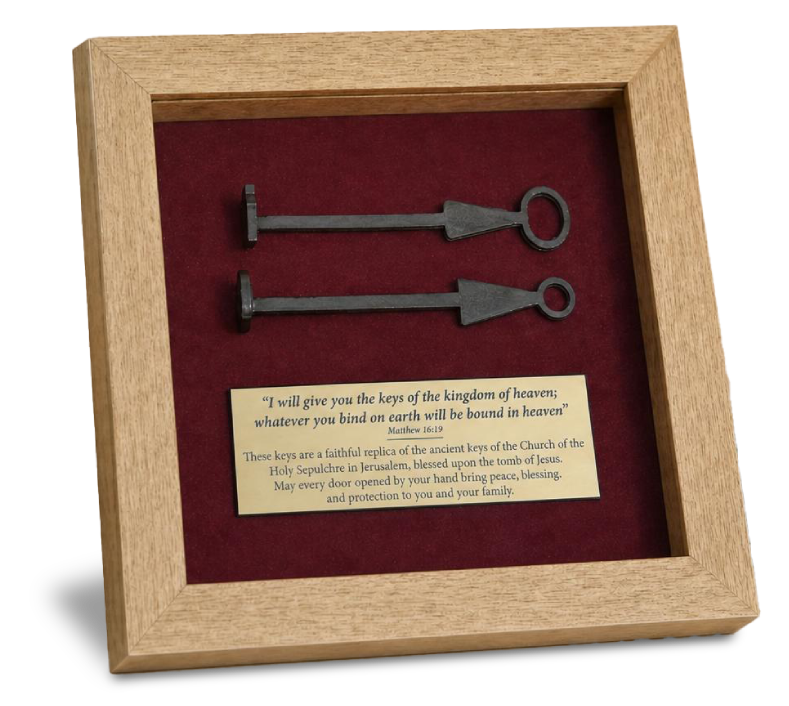
If you do, there is an honest reason to. The Holy Sepulchre replica keys that MeliorMundus offers were forged in Bethlehem, in workshops run by Christian artisan families whose olive wood carving and metalwork have kept sacred craft alive in the Holy Land for generations. Their livelihoods depend on the community staying. Holding a replica is not the same as holding the twelfth century original, and it doesn’t do what the Joudeh family’s key has done every morning for eight hundred years. But it does carry the story with you. The story of a door that still opens in Jerusalem, of two families who have kept the promise unbroken for over eight centuries, and of a Church that has never stopped remembering where Christ was buried. If you keep it near your own front door, that is a fine place for it.
FAQs
Who holds the keys of the Holy Sepulchre?
Two Muslim families, both from Jerusalem. The Joudeh Alhusseini family has held the keys themselves since 1187, when Saladin entrusted them to Ghanim ibn Ali al-Ansari. The Nuseibeh family holds the daily duty of opening and closing the doors. Some Nuseibeh family accounts trace their role at the church back to the caliph Umar in 638.
Why do Muslims hold the keys of a Christian church?
Because in the twelfth century the Christian communities sharing the church could not agree, and giving the keys to any one of them would have been read as giving them the whole building. Saladin’s solution was to put the keys in the hands of a neutral Muslim family, which has kept the peace between the denominations for eight centuries and has been honored under every subsequent government of the city.
How many keys are there?
Two. The original twelfth century key, roughly eight hundred and fifty years old, hand forged iron, kept in the Joudeh family home. It broke sometime in the centuries of use and has not been repaired. The working key, about five hundred years old, was forged to fit the current locks and is what Adeeb Joudeh walks with every morning.
Has the door ever failed to open?
Twice in over eight hundred years. During the Black Death of 1349, when Jerusalem itself was largely emptied, and briefly during the COVID lockdown of March 2020. Both times the daily opening resumed as soon as it could.
Are the Joudeh and Nuseibeh families paid?
No. What they receive is what the custodial denominations give them at the major feasts, and the respect of the wider community of Jerusalem. They hold the office because their families have always held it.