The Urim and Thummim only show up seven times in the whole Old Testament, and one of those mentions is honestly kind of devastating once you slow down on it. A king is staring down an army that scares him to death, he asks God for an answer through these exact objects, and he just doesn’t get one. Nothing. Before we even get into what these things were, I think that moment deserves a second look, because it tells you something about how God’s guidance actually works that most explanations of this topic never quite touch.
| Hebrew meaning | “Urim” likely means lights; “Thummim” likely means perfections or truths |
| First mentioned | Exodus 28:30, as part of the high priest’s breastplate |
| Total Old Testament mentions | Seven passages, ending with Ezra and Nehemiah |
| Likely physical form | Two stones or gems, possibly kept in a pouch behind the breastplate |
| Who could use them | The high priest, on behalf of the king or the nation |
| Last mention | Ezra 2:63 and Nehemiah 7:65, after the Babylonian exile |
| According to Josephus | The oracle had already gone silent 200 years before his own time |
| New Testament mentions | None |
What the Names Actually Mean, and Why That Matters
In Hebrew, Urim probably means lights, and Thummim probably means perfections or truths, and people have argued for centuries about what you’re supposed to make of those two words once you put them side by side. Some take it as pointing toward “perfect light,” basically God handing down flawless truth. Others, looking at the old Greek translations and how similar words get used elsewhere, lean toward something more like “guilt” and “innocence.” That second reading actually fits pretty well if these stones were giving a kind of yes or no verdict rather than spelling out detailed instructions.
And here’s the part that catches a lot of people off guard: the Bible never bothers describing what these things actually looked like. Not the shape, not the size, not even how many there were. Every picture you’ve ever had in your head, two polished stones, a couple of engraved gems, strips of parchment with God’s name on them, that’s all later tradition trying to fill in a blank that Scripture left open on purpose. I don’t think that’s a flaw in the text. It says something on its own, that God left this much mystery even for the people standing closest to him.
Where They Lived, and Who Was Allowed to Use Them
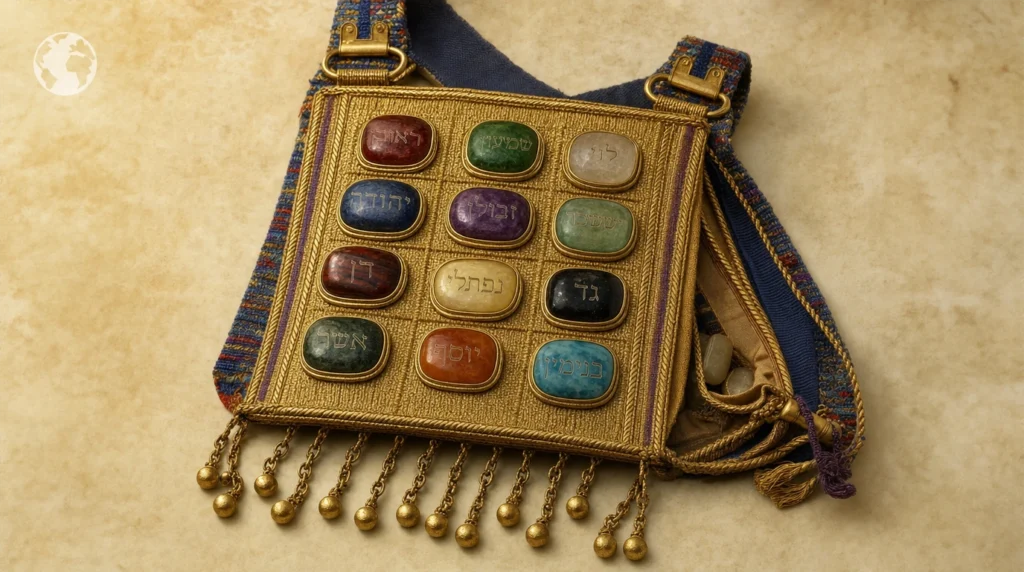
God told Moses exactly where these things belonged. “You shall put in the breastpiece of judgment the Urim and the Thummim, and they shall be over Aaron’s heart when he goes in before the Lord,” is how Exodus 28:30 puts it, and Aaron was supposed to carry the judgment of Israel over his heart constantly. That wasn’t just a nice turn of phrase. The breastplate actually sat against the high priest’s chest, holding twelve stones for the twelve tribes, and somewhere in or behind that same breastplate sat the Urim and Thummim. Leviticus 8:8 just confirms Moses did what he was told, putting them into the breastplate when Aaron was consecrated as Israel’s first high priest.
And this wasn’t something anyone could just grab when they had a question for heaven. When Joshua took over from Moses, Numbers 27:21 lays out exactly how that worked: Joshua wasn’t a priest, so he had to stand in front of Eleazar the high priest, and only Eleazar could ask the Urim on his behalf. The guidance ran through one appointed channel. Not through anyone who showed up with a question and a hopeful heart. That tells you how seriously God treated the whole thing.
The Verse That Changes How You Should Read All the Others
And this is the part most articles on this topic gloss right over. First Samuel 28:6 shows King Saul, terrified of a Philistine army bearing down on him, turning to God for direction and getting nothing. “When Saul inquired of the Lord, the Lord did not answer him, either by dreams or by Urim or by prophets.” The Urim and Thummim weren’t a vending machine you could count on. God could choose, and clearly sometimes did choose, to just not respond, even through the exact thing he himself had set up for that purpose.
If you’ve ever prayed hard about something and felt nothing but silence afterward, you’re in the same place Saul was three thousand years ago, holding access to a sacred, God-appointed line of communication and still hearing nothing back. The silence was part of how God dealt with his people, not a glitch. Deuteronomy 33:8 makes a similar point from another angle, with Moses blessing the tribe of Levi and tying the Urim and Thummim back to Massah and Meribah, the places in the wilderness where Israel had pushed God’s patience about as far as it would go. Guidance through the Urim and Thummim was always tangled up with waiting and testing and sometimes just being told no. It was never a hotline.
How the Light Quietly Went Out
The last two times we hear about the Urim and Thummim come right after the Israelites get back from exile in Babylon. Ezra 2:63 and Nehemiah 7:65 both have the governor telling certain priests they couldn’t eat from the most holy offerings until a priest showed up who could minister with Urim and Thummim, which kind of suggests nobody was even sure one still existed at that point. Josephus, writing way later in Antiquities of the Jews, says the oracle had already gone quiet two hundred years before his own lifetime, and traces it back to the days of John Hyrcanus. Jewish tradition generally holds that the Urim and Thummim stopped working, or at least stopped being around, somewhere near the destruction of the First Temple, as God’s voice shifted toward the prophets and toward Scripture itself.
There’s no big dramatic ending in the text. No verse that says this is it, this is the last time. The Urim and Thummim just stop showing up, and Israel kept going without them, leaning instead on the prophets and on Scripture, which honestly isn’t that different from what Christians lean on today. We don’t need an object pressed against our chest to bring something to God. We have his Word, all of it, and his Spirit, right there, and most believers find that steadier than any stone could have been, sacred or not.
Why You May Have Heard This Term Outside the Bible
If you’ve heard the phrase Urim and Thummim somewhere outside the Bible, it was probably tied to Joseph Smith, who started the Latter-day Saint movement and said he translated the Book of Mormon with help from an instrument he called by this same Old Testament name. Latter-day Saint accounts describe a pair of seer stones set into a frame, plus a separate stone Smith also used during the translation, and both ended up getting called Urim and Thummim within that tradition.
It’s worth getting this right instead of waving it away. What Latter-day Saints describe isn’t claimed to be the same physical object that sat in Aaron’s breastplate. It’s a different set of stones that borrowed the name because, within that tradition, it was understood to serve a similar purpose, receiving something from God. Mainstream Christian traditions, Catholic and Protestant both, don’t accept this as a continuation of what Scripture describes, partly because the Urim and Thummim never show up anywhere in the New Testament, and partly because most Christian theology holds that God’s full revelation already came through Christ and through Scripture, with nothing further needed. That’s a genuine difference between traditions, and it’s better to just say so than to fudge it.
So How Do We Hear from God Now?
This is probably the question that’s actually been sitting under all of this. Christians don’t believe we lost access to God’s guidance just because the Urim and Thummim went quiet centuries before Christ showed up. The method changed, not the relationship. We have all of Scripture, written and kept safe across thousands of years, carrying way more than two stones ever could with a simple yes or no. We have the Holy Spirit living inside believers instead of sitting in a breastplate worn by one man for an entire nation. And we have prayer, open any hour, to anyone calling on Christ as Lord, with no priest needed in between.
In a strange way, the Urim and Thummim going quiet wasn’t really a loss. It was more like a shadow quietly stepping aside once the real thing showed up. That breastplate carried the names of the twelve tribes against the high priest’s heart as a reminder before God, and Christians believe that role, standing between God and his people, carrying their concerns and bringing back his answer, found where it was always headed in Christ himself, our true high priest, who doesn’t need stones to carry what he already carries for us.

Do Christians need an object like the Urim and Thummim to hear from God today?
Yes, in a way that’s worth thinking about. Christians believe guidance now comes through Scripture, through the Holy Spirit living in believers, and through prayer offered directly to God in Jesus’ name, and none of that depends on holding an object in your hand. But carrying something physical from this story still matters to a lot of believers, not as a channel to God, but as a way of carrying the light with you day to day.
The Urim meant light, after all, and there’s something fitting about keeping a piece of that history close, a stone from Bethlehem, something shaped by hands in the same hills Jesus walked. It won’t speak an answer to you the way the breastplate once did. But it can quietly hold your eyes on the same God who used to answer through it, and still answers now.
https://%5Belementor-template%20id=%227227%22%5D
Questions People Ask About the Urim and Thummim
What do Urim and Thummim mean in Hebrew?
Urim probably means lights, and Thummim probably means perfections or truths, though scholars don’t all agree. Some think the pair instead pointed toward guilt and innocence, which fits how they seem to have given a clear verdict from God.
Were the Urim and Thummim physical objects, and what did they look like?
Most historians think they were two stones or gems kept in or near the high priest’s breastplate, but the Bible never says what they actually looked like, what size they were, or what they were made of. Every detailed description out there comes from later tradition, not from the biblical text itself.
How did the Urim and Thummim actually work?
Scripture never explains the mechanism, so people have been guessing for centuries. Some traditions describe them working like sacred lots, giving a yes or no to a specific question. What we do know for sure, from 1 Samuel 28:6, is that they didn’t work automatically. God was free to stay silent through them, just like he was free to stay silent through dreams or prophets.
When did the Urim and Thummim stop being used?
Their last clear mentions are in Ezra 2:63 and Nehemiah 7:65, right after Israel returned from the Babylonian exile, and the wording there suggests they were already rare or hard to find by that point. Josephus later said the oracle had gone quiet two hundred years before his own time, going back to the era of John Hyrcanus, and Jewish tradition generally ties their disappearance to the destruction of the First Temple.
Why is the Urim and Thummim connected to Joseph Smith and the Latter-day Saint church?
Joseph Smith and his early followers used the biblical term Urim and Thummim for a separate instrument, a pair of seer stones, that Smith said he used to translate the Book of Mormon. That’s a different claim from the biblical Urim and Thummim used by Israel’s high priests, and mainstream Christian traditions, Catholic and Protestant, don’t treat this as a continuation of what Scripture describes.