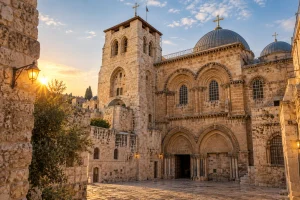
“Jesus of Nazareth” shows up exactly seventeen times in the New Testament, and almost never in a casual way. It is used as an identifier, the kind of phrase you reach for when you need to be precise about which person you mean in a crowd full of people sharing the same name, and yet it keeps appearing at the most loaded moments in the whole story: the arrest, the cross, the empty tomb, the first sermons the apostles preached after the resurrection. Once you start noticing how deliberately it is used and what it would actually have communicated to the people who first heard it, this plain little geographical phrase turns into something much richer than a historical footnote.
| Full name | Jesus of Nazareth; Jesus Christ; Yeshua; the Nazarene |
| Original name | Yeshua (Hebrew/Aramaic), meaning “the Lord saves” |
| Born | Bethlehem, Judea, c. 6 to 4 BC |
| Raised | Nazareth, Galilee (approx. 30 years) |
| Occupation before ministry | Craftsman (tekton: carpenter or stonemason) |
| Public ministry | c. AD 27 to 30, Galilee and Judea |
| Death | Crucified in Jerusalem c. AD 30, under Pontius Pilate |
| “Jesus of Nazareth” in NT | Appears 17 times across the Gospels and Acts |
| Non-Christian sources | Josephus (Antiquities c. AD 93); Tacitus (Annals c. AD 116) |
| Nazareth today | Largest Arab city in Israel, growing Christian community |
The Name Itself Was a Mission Statement
The name his mother used every day was Yeshua, and it traveled a long road to reach us, through Greek as Iesous, through Latin as Iesus, finally landing in English as Jesus. The pronunciation kept shifting across two thousand years of languages, but the meaning underneath it never moved an inch. Yeshua means “the Lord saves,” and when the angel told Joseph what to name the child, he was not just handing him a nice-sounding option. He gave the name along with the reason for it, telling Joseph to call him this because he would save his people from their sins (Matthew 1:21). So before Jesus ever spoke a word in public, before any healing or any sermon, the name itself was already announcing what he had come to do.
“Of Nazareth” got added for a far more practical reason than theology. Yeshua happened to be one of the most common names a Jewish man could carry in first-century Judea, common enough that Josephus lists at least twenty different men sharing that name from roughly the same era. So on its own, the name told you almost nothing useful. Tack on “of Nazareth,” though, and suddenly everyone knew exactly which Jesus you meant.
What “Of Nazareth” Actually Communicated to First-Century Ears
This is the part most retellings skip past, and it changes the whole texture of the story once you slow down on it. To a first-century Jewish listener, “of Nazareth” was not some neutral GPS coordinate attached to a name. It carried a particular kind of social weight, and that weight was not exactly flattering.
Think about how obscure this place really was. Nazareth never shows up in the Old Testament. Josephus, who documented Jewish geography in painstaking detail, never mentions it anywhere in his other writings either. The Talmud has nothing to say about it. Archaeologically, what you find is a small agricultural village of maybe two to four hundred people, no paved streets, no bathhouses, no palaces, just modest homes spread across a hillside where people grew grain and pressed olives for a living. There was nothing about the place that would have made anyone outside Galilee think it worth mentioning.
So when Philip ran up to Nathanael and told him the Messiah had finally come, and that he was from Nazareth of all places, Nathanael’s reaction came out before he could think better of it: “Can anything good come out of Nazareth?” (John 1:46). That was not Nathanael being unusually cynical or rude to his friend. That was just the honest reflex of someone hearing that the long-promised Messiah had grown up in a village that nobody bothered thinking about at all. Even the demons Jesus encountered reached for the same identifier when they wanted to put him in his place: “What do you want with us, Jesus of Nazareth?” (Mark 1:24). His enemies, human and otherwise, kept grabbing the town name as the quickest way to frame him as someone who came from nowhere worth mentioning.
And God chose that town anyway, on purpose. Not Jerusalem, with its temple and its prestige. Not Capernaum, sitting along the trade routes with money moving through it. Just thirty quiet years in a village nobody had heard of, and that village ended up attached to his name at every defining moment of the story that followed. If you have ever wondered why the Incarnation tends to catch people off guard, the choice of Nazareth is not a bad place to start thinking about why.
There is also a layer of prophecy folded into the name itself. Nazareth most likely comes from the Hebrew root netzer, meaning branch or shoot, and Matthew 2:23 ties the family’s decision to settle there to a prophetic fulfillment, pointing back toward Isaiah 11:1 and its image of a shoot rising from the stump of Jesse. So even the geography of his obscure, overlooked upbringing had already been written into the prophets centuries before his family ever arrived there.
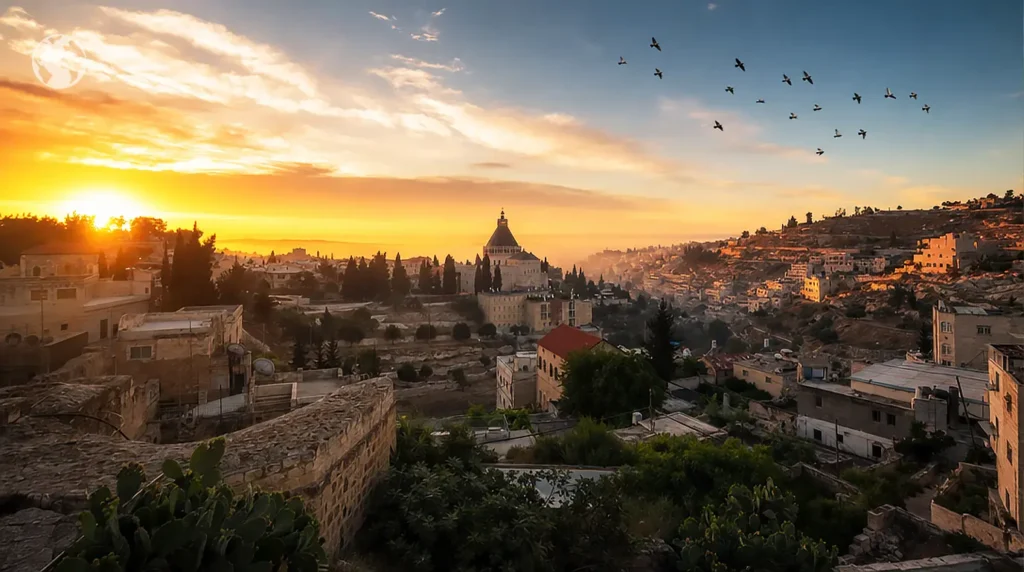
The Name That Kept Showing Up at Every Turning Point
Read through the Gospels and Acts with this in mind, and a pattern becomes hard to miss. “Jesus of Nazareth” never shows up in throwaway moments. Every single time it appears, it is because the stakes have gotten high and nobody can afford ambiguity about who is being named.
In Gethsemane, the soldiers came looking specifically for Jesus of Nazareth, and he stepped forward and answered them in a way that carries far more weight than a simple yes would have: “I am he” (John 18:5). Anyone who knows their Scriptures will catch the echo of the divine name tucked inside that answer. He gave the soldiers the geographical tag they came asking for and then answered it with something much older underneath.
On the cross, Pilate had the inscription written out in three languages, Aramaic, Latin, and Greek, so that no one walking past could possibly misunderstand it: Iesus Nazarenus Rex Iudaeorum. Jesus of Nazareth, King of the Jews. The chief priests came to him afterward and asked for a rewording, something softer. His refusal has stuck around in the record for two thousand years for good reason: “What I have written, I have written” (John 19:22). A Roman governor, without ever meaning to, nailed the name and the title above a Jewish peasant’s head and then would not take it down.
At the tomb, the angel did not soften the language either, telling the women plainly: “You seek Jesus of Nazareth, who was crucified. He has risen” (Mark 16:6). The resurrection got announced using the full historical name on purpose, because the point being made was that the risen Christ was the very same man, from the very same overlooked town, who had been executed under that name just days before.
And the apostles held onto the full name even after Easter, which might be the detail that matters most here. Peter could have leaned entirely into the theological title when he stood before the Sanhedrin in Acts 4, letting the embarrassing little hometown fade quietly into the background now that the resurrection had happened. He did not. He said it the long way: “by the name of Jesus Christ of Nazareth, whom you crucified, whom God raised from the dead” (Acts 4:10), holding the geography and the theology together in the same breath. The town name was not something to be quietly retired once the bigger claim was on the table. It stayed part of the testimony because they insisted on keeping it there.
“Jesus of Nazareth” and “Jesus Christ” Are Doing Different Jobs
“Jesus of Nazareth” is making a historical claim, placing a specific man in a specific place at a specific point in history, which is exactly why it shows up on the arrest record, the inscription above the cross, and the angel’s words at the empty tomb. It answers the question any skeptic or any Roman official would have asked first, which one are we talking about?
“Jesus Christ” is making a different kind of claim entirely, since Christ was never a surname but a title. It translates the Greek Christos,, which itself translates the Hebrew Mashiach,, the Anointed One, the Messiah. So saying “Jesus Christ” is a theological statement, a way of saying this is the one the prophets were pointing toward all along.
Peter fused both of these together in Acts 4 when he said “Jesus Christ of Nazareth,”, compressing the personal name, the messianic title, and the place into a single breath. This specific man, from this particular nowhere town, is the risen Messiah, and Peter would not let go of either half of that claim, because the history without the theology is just a tragedy, and the theology without the history is just a story.
A Note on Nazarene Versus Nazirite, Since People Mix These Up Constantly
A Nazarene is simply someone from Nazareth, and Jesus is called the Nazarene all through the Gospels, with his early followers picking up the same label in Acts 24:5. That root has had a long life, too, since the Arabic word for Christians today, Nasrani,, traces directly back to it, which means the name of that small Galilean village is still embedded in how more than 400 million Arabic speakers refer to followers of Christ today.
A Nazirite is something else completely, someone who took a specific consecration vow described in Numbers 6 that involved abstaining from wine and leaving the hair uncut for the duration of the vow. Jesus was never a Nazirite, and Matthew 11:19 actually records his critics accusing him of the opposite, calling him a glutton and a drunkard because he ate and drank with people so freely. The words just happen to sound alike and have nothing else in common.
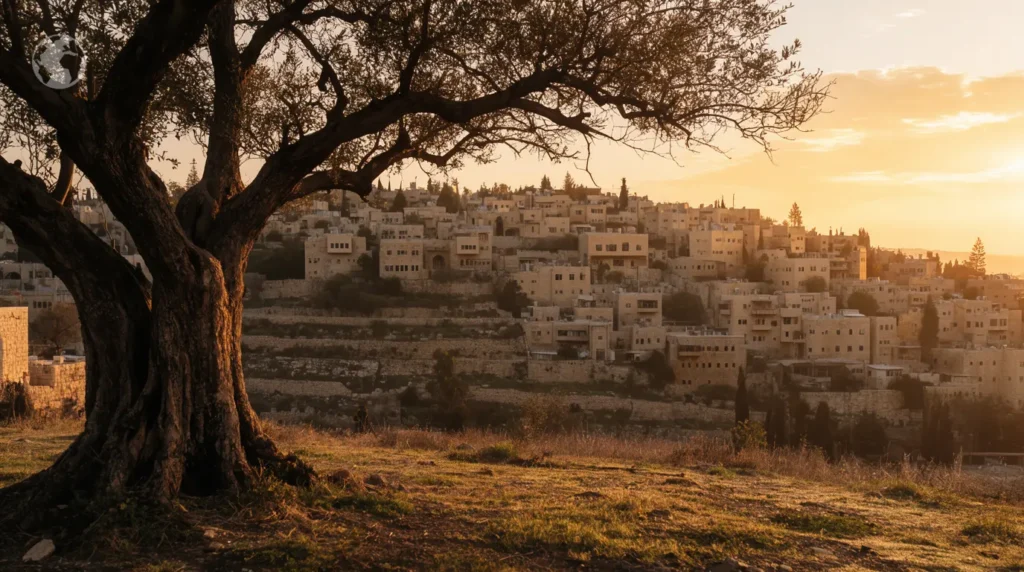
Nazareth Is Still There, and So Is the Church He Left Behind
Nazareth today is a thriving city of roughly 78,000 people, the largest Arab city in Israel, and it holds a detail most people in the West never hear about: it also has the largest Arab Christian population of any city in the country, somewhere around 18,900 Christian residents. The Basilica of the Annunciation, finished in 1969 over the traditional site of Mary’s home, stands as the largest church in the entire Middle East. And when archaeologists from the Israel Antiquities Authority dug there in 2009, they uncovered the first confirmed first-century residential structure ever found in the city, a small two-room home with pottery dated between 40 BC and AD 70, modest in every way, exactly what you would expect from a village that nobody thought much of at the time.
The contrast with Bethlehem, just a couple hours south, is striking, and it is worth sitting with. Christians made up 86 percent of Bethlehem’s population back in 1950. By the time of the last Palestinian census in 2017, that number had fallen to around 10 percent, and since October 2023, at least 142 more Christian families have packed up and left the Bethlehem area altogether. The town where Jesus was born is quietly losing the community that has worshipped there for two thousand years.
Nazareth is telling a different story right now. Its Christian community is not shrinking but actually growing, part of a wider pattern across Israel where the Christian population grew by 0.7 percent in 2024, making it one of the only places in the entire Middle East where that is happening. Benedictine Abbot Nikodemus Schnabel, speaking to Aid to the Church in Need, put the underlying stakes in words that are hard to shake off: without living Christian communities in Jerusalem, Bethlehem, and Nazareth, he warned, the holy places risk becoming empty symbols, heritage without witnesses.
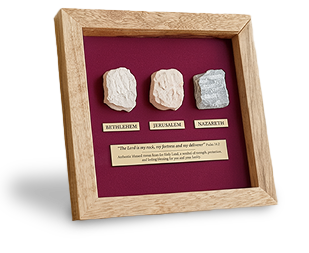
That phrase deserves a second read. Heritage without witnesses. The stones of Nazareth can show you where Jesus grew up, but it is the people of Nazareth who can tell you the story never actually stopped. So when you hold something made in the Holy Land by those families, whether it is a stone carved in Bethlehem, a piece of olive wood from a Nazareth workshop, or something tied to the long history of Jerusalem, you are not just holding a souvenir from an old archaeological site. You are holding something that came out of a community that has kept his name alive in that land, without a single break, from the first century all the way to right now.
Jesus of Nazareth. His enemies used that phrase to belittle him. A Roman governor nailed it above the cross. An angel spoke it at an empty tomb. And it is still being spoken in worship in Nazareth this very week, in Arabic and in Hebrew, by people whose families have never once left the town the name points to. That is not a coincidence worth glossing over. That is what continuity actually looks like, in real time, in a real place.
Questions People Ask About Jesus of Nazareth
What does the name Jesus mean?
Jesus comes from the Hebrew Yeshua, which means “the Lord saves,” and the angel’s instruction to Joseph was not an arbitrary choice of name. He told Joseph to call the child this because he would save his people from their sins (Matthew 1:21), so the purpose of the whole mission was already folded into the name before that mission ever began.
Why is he called “of Nazareth” if he was born in Bethlehem?
In Jewish culture, a man tended to be known by where he was raised and recognized day to day, not strictly by where he happened to be born. Jesus was born in Bethlehem in fulfillment of Micah 5:2, but he grew up in Nazareth and spent roughly thirty years of his life there before his public ministry ever started, which is exactly why Nazareth became the name everyone used for him, even though Bethlehem was technically his birthplace.
How many times does “Jesus of Nazareth” appear in the New Testament?
The phrase shows up seventeen times across English translations of the New Testament, while the Greek original alternates between Jesus the Nazarenos and Jesus the Nazoraios depending on the passage. It tends to surface at the biggest turning points in the story, the arrest, the inscription on the cross, the announcement at the resurrection, and the preaching recorded in Acts.
What did “of Nazareth” mean to people who heard it in the first century?
It carried a social weight that most modern readers never pick up on. Nazareth was a small, obscure agricultural village with no mention anywhere in the Old Testament or the Talmud and no reputation to speak of, so hearing someone described as being from Nazareth was not a neutral piece of information back then. It implied they came from a place that did not matter. The demons who confronted Jesus used the phrase that way, and so did the people who opposed him, which makes it all the more striking that the apostles kept insisting on using it themselves even after the resurrection had changed everything.
Is there historical evidence for Jesus outside the New Testament?
Yes, and it comes from two separate non-Christian historians. Josephus mentions him in Antiquities of the Jews around AD 93, and Tacitus records his crucifixion under Pontius Pilate in Annals 15.44 around AD 116, and both of these references are widely accepted as authentic by mainstream historians today. His existence as a historical figure is simply not seriously in dispute among scholars.
What is the difference between a Nazarene and a Nazirite?
A Nazarene just means a person from Nazareth, while a Nazirite refers to someone who took a specific consecration vow laid out in Numbers 6 involving abstaining from wine and leaving their hair uncut. The two words have nothing to do with each other beyond sounding similar. Jesus was a Nazarene because of where he was from, but he was not a Nazirite, and Matthew 11:19 actually records people accusing him of drinking wine freely, which runs in the exact opposite direction of that vow.
What is happening to Christians in Nazareth and Bethlehem today?
The two cities are heading in opposite directions right now. Nazareth has the largest Arab Christian population in Israel, somewhere around 18,900 people, and that community is actually growing. Bethlehem has watched its Christian population fall from 86 percent of the city in 1950 down to roughly 10 percent today, with the pace of people leaving picking up noticeably since 2023. For Christians who care about the actual places where the Gospel happened, these numbers are not just statistics sitting in a report somewhere. They describe what is happening, right now, to the communities that have kept the faith alive in those towns for two thousand years.