Most of the Christian world doesn’t actually call it Good Friday. In German it’s Karfreitag, from an Old High German word meaning grief or lament. In French it’s Vendredi saint, Holy Friday. Spanish, Viernes Santo. Italian, Venerdi santo. In Greek Orthodox tradition, it’s Megali Paraskevi, the Great and Holy Friday. Russian tradition calls it Passion Friday. Only English and Dutch use the word “good” at all, and once you notice that, the word gets more interesting, not less.
The “good” in Good Friday isn’t the same word we use today when we say a meal was good or a book was good. It’s the older sense of the word, the one that meant holy or set apart. The Oxford English Dictionary traces the phrase back to at least 1290, in a Middle English manuscript called the South English Legendary, where it appears as “guode Friday.” Some people have suggested the phrase evolved from “God’s Friday,” but linguists generally set that theory aside, because “good” in Old and Middle English already carried the sense of holy without needing to be a shortening of anything else.
So the plain answer is that Good Friday means Holy Friday. The day set apart. The day the whole rest of the Christian year hinges on. This article walks through what actually happened that day, hour by hour, the reasons Christians have believed the timing was not coincidence, and how the physical ground where the story took place is still with us today.
Quick Reference Table
| Question | Answer |
|---|---|
| Why is it called “Good” Friday? | Because “good” in Old and Middle English carried the sense of “holy” or “pious.” The name means Holy Friday. Oxford English Dictionary traces the phrase back to “guode Friday” in a 1290 Middle English manuscript. |
| Do other Christian languages call it “Good” too? | No. German is Karfreitag (Sorrowful Friday). French, Italian, and Spanish use Holy Friday. Greek Orthodox tradition calls it the Great and Holy Friday. English and Dutch are the outliers. |
| What year did it happen? | Most scholars place the crucifixion in either AD 30 or AD 33. Cambridge scientists Colin Humphreys and Graeme Waddington published a 1983 paper in Nature arguing for Friday, April 3, AD 33, based on Passover dating, the day of the week, and a lunar eclipse visible in Jerusalem that evening. |
| What time of day did Jesus die? | The ninth hour in Jewish reckoning, which is 3 p.m. He was crucified at the third hour (9 a.m.) and died six hours later, according to Mark 15:25, 33, and 37. |
| What’s the connection to Passover? | John’s Gospel places Jesus’s death at the exact hour the Passover lambs were being slaughtered in the Temple courts. Christians read Jesus as the ultimate “lamb without blemish” of 1 Peter 1:19, fulfilling the Passover pattern of substitutionary sacrifice from Exodus 12. |
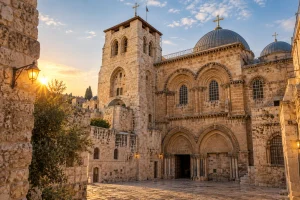
| Where can Good Friday be visited today? | The Church of the Holy Sepulchre in Jerusalem, built by Constantine’s mother Helena in AD 326, contains both the site traditionally identified as Golgotha (where Jesus was crucified) and the empty tomb. |
The word “good” used to mean holy
In modern English, “good” is a small word doing light work. A good sandwich. A good time. A good movie. That’s not the word Christians in the thirteenth century were using when they started calling this Friday “good.” In Old and Middle English, “good” carried a much heavier meaning, closer to “holy,” “pious,” or “set apart for God.” The Bible itself, in Middle English translations, sometimes uses “good” where a modern translation would use “righteous.” It’s the older, weightier version of the word.
The Oxford English Dictionary’s earliest citation of Good Friday comes from a Middle English collection of saints’ lives called the South English Legendary, dated to around 1290, where the phrase appears as “guode Friday.” Around the same period, in the same sense of “holy,” you find “good tide” used for Christmas and Easter, and “the Good Book” as a name for the Bible. All three uses point to the same older meaning that we’ve mostly lost.
A common piece of folklore says the phrase started as “God’s Friday” and got shortened over time. It’s a nice story, but linguists generally don’t accept it. The older sense of “good” already meant holy, so no shortening from “God’s” is needed to explain the name. Occam’s razor applies to language history too.
What actually happened, hour by hour
The Gospels don’t leave much guesswork about the timing of that day. Mark 15 gives specific hours in the Jewish reckoning, which counted from sunrise (roughly 6 a.m.). Read straight through, the timeline is remarkably tight.
At the third hour, 9 a.m., Jesus was crucified on the hill outside Jerusalem called Golgotha, an Aramaic word meaning “place of the skull.” Mark 15:25 gives the hour directly. He had already been through the night trials, the beating, and the walk carrying the crossbeam through the streets. By the time the nails went in, he had been awake for at least twenty-four hours.
At the sixth hour, noon, darkness came over the whole land and stayed until the ninth hour. Mark 15:33. Whatever the natural cause, and there’s been long debate about whether it was an eclipse, a dust storm, or something else, the Gospels record it as a strange darkening of the sun at midday that lasted three hours.
At the ninth hour, 3 p.m., Jesus cried out “Eloi, Eloi, lema sabachthani,” which Mark translates for the reader: “My God, my God, why have you forsaken me.” It’s the opening line of Psalm 22, a psalm that begins in abandonment and ends in triumph, and Jesus is quoting the whole arc of it by naming the first line.
Just after that, John 19:30 records his last words: “It is finished.” In Greek, tetelestai. A single word that means it has been completed, paid in full, brought to its intended end. Merchants used the same word on business receipts to mark a debt paid. The whole gospel message is compressed into that one word. It was Jesus’s last coherent statement, and then he died.
Six hours on the cross. From 9 a.m. to 3 p.m. The specific detail worth pausing on is what was happening in the Temple courts a short distance away at exactly the same 3 p.m. hour.
The Passover parallel that explains why the timing wasn’t coincidence
Exodus 12 gives the original instructions for Passover, and every detail in that chapter is worth reading slowly next to the story of Good Friday. The lamb had to be “without blemish.” It had to be a male, in its first year. It had to be chosen on the tenth day of the month of Nisan and kept in the household until the fourteenth. And on the fourteenth, at what the Torah calls “between the evenings,” which the rabbis of Jesus’s day understood to mean 3 p.m., the lamb was slaughtered. The blood was painted on the doorposts of the house, and the destroyer that came through Egypt that night passed over the doors that carried the blood.
Now line that up with Good Friday. Jesus rode into Jerusalem on what Christians call Palm Sunday, which was the beginning of Passover week, in the days when the lambs were being selected and prepared. His last meal, the Last Supper, was tied to Passover directly. And John’s Gospel, in a detail the other three don’t include, times Jesus’s death at the exact hour the Passover lambs were being slaughtered in the Temple. He died at 3 p.m. on the day of Preparation, when the priests a few hundred yards away were killing the lambs whose blood would mark the doorways of Jerusalem’s households.
1 Peter 1:19 puts the connection into a single sentence, calling Jesus “a lamb without blemish or spot.” 1 Corinthians 5:7 makes it a direct claim: “Christ, our Passover lamb, has been sacrificed for us.” John the Baptist, back at the beginning of John’s Gospel, points at Jesus walking toward him and says, “Behold, the Lamb of God, who takes away the sin of the world” (John 1:29). This isn’t Christians reading the Passover parallel back into the story after the fact. It’s the New Testament itself doing that reading, out loud, on the page.
What the Passover pattern gave Israel was the doctrine of substitutionary sacrifice, one life given so another was spared. What Christians see happening on Good Friday is that pattern brought to its full meaning. Jesus is the lamb without blemish. His blood, in the Christian reading, marks the doorway of the human heart. And death, when it comes for the ones under that blood, passes over. That’s the Christian claim about Good Friday, and it’s why the timing of Good Friday and Passover in the same week, at the same hour, has been read for centuries as something other than accident.
Why Good Friday only makes sense because of Easter Sunday
If the story ended at 3 p.m. on Good Friday, there would be nothing good about it, in any sense of the word. A rabbi from Nazareth would have been executed by a Roman governor on false charges of insurrection, and history would have quietly forgotten him within a few decades, the way it forgot dozens of other messianic figures of the first century.
What makes Good Friday “good,” in the older holy-set-apart sense, is that the story didn’t end there. After the sabbath (Saturday, when nothing could be done under Jewish law) the women went to the tomb at first light on Sunday morning to finish preparing the body for burial. Mark 16:2. The tomb was open. The stone had been rolled away. The body was gone. Luke 24 records the moment: they were greeted by a figure they didn’t recognize at first, who said, “Why do you seek the living among the dead? He is not here, but has risen.”
That’s the Easter claim, and everything Christian faith is, hinges on it. If Christ isn’t raised, Paul writes in 1 Corinthians 15:17, our faith is futile and we are still in our sins. If he is raised, Good Friday is retroactively transformed from a tragedy into the moment sin was defeated. Same six hours. Different meaning entirely, depending on what happened on the third day. It’s also why the assurance of the believer’s salvation rests on that specific Sunday morning outside the walls of Jerusalem, and not on the believer’s own steadiness of feeling from one day to the next.
This is why Christians talk about Good Friday and Easter Sunday together, and often can’t separate them cleanly. The full weight of Good Friday requires Easter Sunday to make sense of it. And the joy of Easter Sunday requires knowing what Friday actually cost.
Where it all happened, and the ground that’s still there
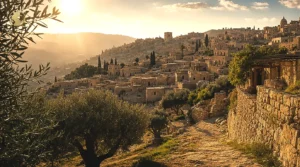
The place where Good Friday and Easter Sunday both happened is a specific location outside the walls of first-century Jerusalem, on a low rocky rise called Golgotha, which had a garden nearby with tombs cut into the stone. When Constantine’s mother Helena came to Jerusalem in AD 326 to identify the sites of the Christian story, she found the memory of both locations still intact in the local church, and the basilica now known as the Church of the Holy Sepulchre was built over both. It’s a single church that contains both the place of the crucifixion and the empty tomb, roughly a hundred and thirty feet apart under one roof.
The custody of the Holy Sepulchre has been shared between six Christian denominations for close to a thousand years, in an arrangement that has held remarkably steady despite tensions between the groups. Even more striking, the keys to the front door have been held for over eight hundred years by two Muslim families, the Joudeh and the Nuseibeh, in a small daily ritual of interfaith trust. Each morning, at the same hour, one of the family members walks up to the church, unlocks the massive wooden door, and hands the key back for the day. That’s been happening, unbroken, since the twelfth century.
The point of naming all of this is that Good Friday is not an idea. It has an address. Somebody was crucified on this rise. Somebody was buried in that tomb. Somebody walked out of it. And Christians have been standing at that location, remembering, for seventeen hundred years.
That living Christian community is still there. The families of Bethlehem, Nazareth, and Jerusalem have carried the memory of these places across the centuries, often through very hard seasons, and their work of shaping olive wood carvings and small stones from the actual ground of the Holy Land is one of the ways that memory reaches the wider church today. Each piece is still shaped by hand, one at a time, in workshops within walking distance of the sites they represent.
Good for us, not for him
Good Friday isn’t called good because it was a pleasant occasion. It was the opposite. It was six hours of public execution of a man who had done no wrong, at the hands of a colonial government using false charges to placate a mob. There was nothing good about what Jesus went through. Every part of it was bad, cruel, unjust.
What Christians have always meant by calling it good is the outcome for humanity, not the experience for Jesus. Because he took the sentence, sinners could go free. Because he became the Passover lamb, death could pass over the ones under his blood. Because he said “it is finished” at 3 p.m. that afternoon, the sentence that had been hanging over the human race since Eden was answered once and for all, and the answer was written in one man’s blood so it wouldn’t have to be written in ours.
That answer changes how Christians live now. It is through Christ who strengthens us that believers face the ordinary difficulty of any given day, not by manufacturing our own righteousness or our own steadiness, but by leaning on the strength of the one who already paid the debt on Good Friday. Whatever the week is asking of you, the source of the strength for it is not you.
So Christians honor Good Friday not by pretending it wasn’t painful, and not by leaving it in mourning either. The tradition, worked out over centuries, is to give thanks in the middle of the sorrow, because the sorrow is the shape gratitude takes when you understand what it cost. He is risen. He is risen indeed.
FAQs
What is Good Friday?
Good Friday is the Christian holy day that commemorates the crucifixion and death of Jesus Christ. In English it’s called “Good,” from the older sense of the word meaning “holy” or “set apart.” Most other Christian languages call it Sorrowful Friday, Holy Friday, or Great Friday.
Why is Good Friday called “Good” when it commemorates a death?
Because “good” in Old and Middle English carried the sense of “holy” or “pious,” not “pleasant.” The name means Holy Friday. It refers to the significance of the day for humanity, not to the experience of Jesus, which was brutal in every sense.
When exactly did the crucifixion happen?
Historians place it in either AD 30 or AD 33. Cambridge scholars Colin Humphreys and Graeme Waddington argued in a 1983 paper in Nature that Friday, April 3, AD 33 is the most likely date, based on Passover dating, the day of the week, and a partial lunar eclipse that would have been visible in Jerusalem at moonrise that evening.
Why is Jesus called the Passover Lamb?
Because the parallels between him and the Exodus 12 Passover lamb are pointed and specific: he lived without sin (the lamb was without blemish), his crucifixion took place during Passover week, and John’s Gospel places his death at the exact 3 p.m. hour the Passover lambs were being slaughtered in the Temple. 1 Corinthians 5:7 states the identification directly: “Christ, our Passover lamb, has been sacrificed for us.”
What happened on Good Friday, in order?
Jesus was betrayed by Judas the night before, tried through the night, condemned by Pontius Pilate in the morning, and crucified at 9 a.m. Darkness came over the land from noon to 3 p.m., at which hour Jesus quoted Psalm 22 (“My God, my God, why have you forsaken me”) and then said his last words, “It is finished” (John 19:30). He was buried in a rock tomb before sundown, because Jewish law forbade leaving a body on a cross overnight during Passover.
Why is Good Friday important?
Because Christians believe it’s the day the sin of the world was answered. The Christian gospel is that Jesus took the sentence that belonged to the human race, on that specific Friday afternoon, so the sentence could pass over the ones who trust him. Without Good Friday, Easter Sunday has nothing to be the answer to.
Is Good Friday a public holiday?
It depends on the country. It’s a full public holiday in most of Europe, in much of Latin America, in Australia, New Zealand, Canada, and many other places. In the United States, it isn’t a federal holiday, but it’s observed by many churches and by some states as an official day.