“Faith without works is dead” gets quoted the way a lot of Bible verses do, as a standalone slogan bolted onto a sermon or a wall hanging. It comes from a specific chapter, in a specific letter, about a specific problem in a real congregation, and once you read the twelve verses that come before it, the sentence stops meaning quite what most of us assumed it meant.
| Where it is from | James 2:14–26 (the sentence itself appears at verses 17, 20, and 26) |
| Traditionally written by | James, called “the brother of the Lord” in Galatians 1:19 |
| Usual dating | Somewhere between the mid-40s and early 60s CE |
| Immediate context | A rich man and a poor man entering the assembly (James 2:1–7) |
| What “works” actually means here | Clothing and feeding believers in need (James 2:15–16) |
| Greek word for this kind of faith | argē: literally “workless” (James 2:20) |
| The other side of the debate | Paul in Romans 3–4 and Galatians 2–3 |
| Historic flashpoint | Sola fide and the sixteenth-century Reformation |
What Does “Faith Without Works Is Dead” Mean?
The meaning of ” faith without works is dead”, at the plainest level, is that a genuine trust in God will show itself in concrete action, and that a “faith” that never produces anything is inert the way a corpse is inert. James makes the point three times in the same chapter, at verses 17, 20, and 26, closing with the image of a body without breath. The rest of this article is about what he specifically had in mind when he said “works,” because he was much more specific than the phrase alone suggests.
The Full Passage: James 2:14–26
This is the passage everything else in the article turns on. It is quoted here from the World English Bible, which is in the public domain.
“What good is it, my brothers, if a man says he has faith, but has no works? Can faith save him? And if a brother or sister is naked and in lack of daily food, and one of you tells them, ‘Go in peace. Be warmed and filled;’ yet you didn’t give them the things the body needs, what good is it? Even so faith, if it has no works, is dead in itself. Yes, a man will say, ‘You have faith, and I have works.’ Show me your faith without works, and I will show you my faith by my works. You believe that God is one. You do well. The demons also believe—and shudder. But do you want to know, vain man, that faith apart from works is dead? Wasn’t Abraham our father justified by works, in that he offered up Isaac his son on the altar? You see that faith worked with his works, and by works faith was perfected. So the Scripture was fulfilled which says, ‘Abraham believed God, and it was accounted to him as righteousness,’ and he was called the friend of God. You see then that by works a man is justified, and not only by faith. In the same way, wasn’t Rahab the prostitute also justified by works when she received the messengers and sent them out another way? For as the body apart from the spirit is dead, even so faith apart from works is dead.”
The Verse Doesn’t Start at Verse 14
Almost every article you can find on this passage begins the quotation at verse 14, which makes the argument feel like a free-standing theological proposition. It isn’t. James starts a specific complaint at verse 1 of the same chapter, and the faith-and-works discussion is the conclusion of that complaint. If you begin at 14, you get a slogan. If you begin at 1, you get a pastoral correction with a very specific address.
The Rich Man and the Poor Man, James 2:1–7
The chapter opens with a scene. Two men walk into the assembly. One is wearing fine clothes and a gold ring on his finger. The other is in filthy clothes. The rich man gets steered to a good seat. The poor man is told, in so many words, to stand off to the side or sit on the floor by someone’s footstool. James’s response is unambiguous: this is favoritism, it’s a violation of the royal law to love your neighbor as yourself, and it contradicts everything the assembly claims to believe about God choosing the poor of this world to be rich in faith.
“Go in Peace, Keep Warm and Eat Well,” James 2:15–16
A few verses later the specific failure sharpens. A brother or sister in that same congregation is without adequate clothes and without daily food, and someone in the room sends them off with a warm blessing and empty hands. “Go in peace, be warmed and filled,” but the person is still hungry and still cold. That is the picture of faith without works that James is actually painting. It isn’t the abstract failure to do good deeds in general. It is looking at a hungry believer, offering them nothing but a benediction, and considering the exchange completed.
What “Works” Actually Means Here
So when verse 17 says faith without works is dead, the “works” aren’t abstract virtuous behavior in some general sense. They are, in the argument James is actually making, clothes and meals for specific people in the same room. James isn’t writing a systematic theology of how salvation is obtained. He’s writing pastoral correction to a congregation that fawns over rich visitors while letting its own poor members go hungry, and the sentence everyone quotes is the sharp end of that argument.

“Even the Demons Believe”
There’s a line in the middle of the passage that tightens what “faith” means in James’s argument. In verse 19 he writes, “You believe that God is one. You do well. The demons also believe, and shudder.” The “faith” he is criticizing, in other words, is bare intellectual assent. Agreement that certain propositions about God are true. Demons manage that much and it doesn’t do them any good, and it doesn’t make them any less demons.
That’s a much narrower target than the English word “faith” usually implies. It isn’t the trusting allegiance to Christ that Paul talks about when he says believers are justified by faith. It’s closer to a checked box on a doctrinal survey. Once you notice James is aiming at box-checking, the passage stops sounding like a threat to anyone who has ever doubted, and starts sounding like a specific pastoral complaint: don’t confuse “I agree that God exists” with actually belonging to God.
Does This Contradict Paul?
This is the question most readers actually arrive with, and the answer, as scholars across a wide range of traditions now broadly agree, is no. What looks like a contradiction is a vocabulary problem. Paul and James use the same words to mean different things, and they’re arguing against different opponents.
Paul’s “Works” and James’s “Works” Are Different Things
| Term | Paul means | James means |
| works | Works of the Law: circumcision, dietary rules, Sabbath. The boundary markers of Jewish identity. | Acts of mercy: feeding, clothing, and caring for widows, orphans, and poor believers. |
| faith | Trusting allegiance to Christ. | In chapter 2, bare intellectual assent. The kind demons also have (2:19). |
| justified | Declared righteous before God. | Shown or vindicated to be righteous. |
They’re Answering Different Questions
Paul is arguing against people who thought they could earn standing with God by keeping the Jewish Law, especially in Galatians and Romans. His whole point is that gentile Christians don’t need to be circumcised or keep dietary rules to belong. James is arguing against a completely different mistake, made by people who thought that mental agreement with correct doctrine was enough and that concrete care for other believers was optional. Those are two different opponents making two different errors, and Paul and James are dismantling them from two different angles.
Abraham, Quoted by Both
Both writers point to Abraham as their key example, and both quote Genesis 15:6: “Abraham believed God, and it was credited to him as righteousness.” Paul, in Romans 4, cites the verse to prove Abraham was declared righteous before he was circumcised, which is to say before he did any of the “works of the Law” his opponents were insisting on. James, in chapter 2, cites the same verse to argue that Abraham’s faith showed itself decades later when he was willing to offer Isaac. Same verse, same patriarch, two different conclusions, because they are each answering a different question.
The Pun You Can’t See in English
There’s a piece of wordplay in the Greek of this passage that gets lost in every English translation. In verse 20, James uses a specific word to describe faith that has no works, and the word is argē (ἀργή). Argē is built from the negative prefix a- and the noun ergon (ἔργον), meaning “work.” So argē literally means workless. James is saying that faith without erga is argē. Faith without work is workless. It’s almost a tautology in Greek, and it’s the kind of tight verbal knot that shows how deliberate the argument is.
The word wasn’t obscure or theological. In ordinary commercial Greek, argos described money that earned no interest, or a field lying fallow. Idle. Not producing. English versions land on “barren,” “useless,” or “dead” depending on translation, and each of them carries part of what argē means without ever quite capturing the pun on ergon that James clearly built into the sentence.
How Different Traditions Read It
This passage sits on the fault line of the Reformation, and different Christian traditions have read it in meaningfully different ways for centuries. Here are three of them, laid out at roughly equal length, with no attempt to referee between them.
The Catholic Reading
The Catholic Church teaches that faith and works cooperate in a living whole, and that the works love produces don’t earn salvation but do complete and sustain the faith that receives it. The Council of Trent, in the sixteenth century, formalized this reading in direct response to the Reformers, and it remains the position of the Catholic Church today. On this reading, James is saying almost exactly what he sounds like he’s saying: a faith that produces nothing isn’t the living faith God gives.
The Protestant Reading
Most Protestant traditions hold that a person is justified by faith alone, sola fide, and that works are the necessary and inevitable fruit of that faith rather than any part of its cause. On this reading, James isn’t teaching that works save. He’s teaching that any “faith” without works is a dead thing, and dead faith doesn’t save anyone because it isn’t real faith to begin with. Paul and James end up saying the same thing about a real Christian life from opposite directions.
The Free Grace Reading
A smaller position, sometimes called Free Grace theology, argues that James isn’t discussing salvation in chapter 2 at all, but rather the usefulness and vitality of a believer’s faith in this life. On this reading, “dead” means unfruitful or useless rather than spiritually lost, and the whole argument is about a Christian’s effectiveness rather than their standing before God. It’s a minority view but a serious one, and it’s honestly represented in the range of published commentary on the letter.
Martin Luther famously called the letter of James “an epistle of straw” in a 1522 preface to his German New Testament, borrowing an image from 1 Corinthians 3 where straw is the material that burns when tested. He was uncomfortable with what he read as a tension with Paul. He never removed the letter from the canon, though. He kept it, and simply ranked it below the books he considered most central to the gospel.
What Faith Without Works Looks Like Today
The specific scenarios James was describing haven’t disappeared. They’ve just changed clothes. A church that pours attention on a large donor and quietly loses touch with the members who can’t afford the mission trip. A believer who prays for a friend’s medical bills and never asks how much is on the credit card. A congregation that runs its programs beautifully while the widow three pews back is choosing between the electric bill and groceries. Belief that costs nothing, in either direction, is what James is pointing at.
The other pattern James names, less often quoted, is offering a spiritual blessing as if it were a physical solution. A promise of prayer for a friend, standing in for the practical help you could give. Prayer is not the enemy in this passage. Prayer offered in place of what someone actually needs, when you have the ability to help and don’t, is.
The Community James Would Recognize
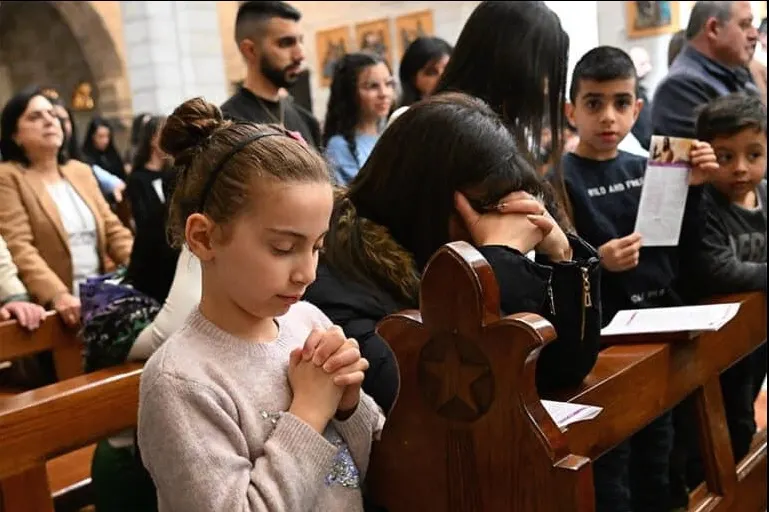
The church James was writing to had specific poor believers with specific needs in the same room, and the correction he demanded was equally specific. Not doctrine, not theology. Clothes and food. That kind of congregation still exists in the Holy Land, and it’s under more pressure than most Western Christians see from a pew on Sunday morning. The Christian community in Bethlehem, Nazareth, and the Christian quarters of Jerusalem has been shrinking for decades, squeezed by economics that don’t make it into most prayer letters.
There’s no theological requirement to buy anything to be a Christian. James wouldn’t have suggested there was. But if the whole thrust of chapter 2 is that real trust in God shows itself in specific, practical care for other believers, then a stone from Bethlehem, or a piece of olive wood shaped by hands in Nazareth, or a small set of miniature keys of the Holy Sepulchre made in that same neighborhood, is one small honest thread from your daily life to a real Christian family’s rent. Not the whole answer to what James was asking. Just a real, quiet piece of it.
Frequently Asked Questions
What does God say about faith without works?
The clearest passage is James 2:14–26, where James argues that a “faith” that produces no concrete action is inert, like a corpse. He isn’t saying good deeds save people. He’s saying that a genuine trust in God will show itself in specific care for others, and that when it doesn’t, something at the root is missing.
What are examples of faith without works?
James gives one directly in 2:15–16: seeing a brother or sister without adequate clothes or food, offering them a warm blessing, and giving them nothing. Modern parallels are easy to find. Praying for someone’s medical bills without asking how much they need. Attending church while ignoring a struggling member. Belief that costs nothing, in either direction.
What does James 2:17 mean?
James 2:17, in most translations, reads that faith by itself, if it doesn’t have works, is dead. In context, “works” refers specifically to concrete care for believers in need, which James describes just two verses earlier. The verse isn’t a general slogan about doing good deeds. It’s a specific charge against congregations that mistake bare belief for the whole of faith.
What are examples of dead faith?
James defines dead faith as belief without corresponding action, using demons in verse 19 as the extreme case. Demons believe correctly that God is one, and shudder at it, but that belief doesn’t change what they do. Any pattern of holding true beliefs while acting completely untouched by them fits the same shape James is describing.
Does faith without works mean you lose salvation?
This is where Christian traditions divide on assurance of salvation, and no article should pretend the question is settled. Catholic teaching holds that living faith and its works form one whole. Most Protestant traditions hold that saving faith always produces works but the works don’t save. Free Grace teachers argue James isn’t discussing salvation at all in the passage.
Did Paul and James disagree about faith and works?
Modern scholarship broadly holds that they did not, once you line up their vocabulary. Paul is arguing against people who tried to earn standing through the Jewish Law. James is arguing against people who thought mental assent to doctrine was enough. Same words, different targets, different opponents. Complementary rather than contradictory.