Omnipotent means all-powerful, omniscient means all-knowing, and omnipresent means present everywhere at once, and those three attributes are the ones Christian theology most often uses to describe God. They show up in sermons, in creeds, in Sunday school posters, and in almost every explainer article you can find online. But there’s something almost nobody mentions about them: none of these three words is in the Bible in the form we recite them, and two of them didn’t even exist in English until around the year 1600.
What Omnipotent, Omniscient, and Omnipresent Mean
The three “omni” words come from the Latin omnis, meaning “all,” and each names a different way God’s being extends without limit. Here’s the shortest form:
| Word | Meaning | Focus |
|---|---|---|
| Omnipotent | All-powerful | What God can do |
| Omniscient | All-knowing | What God knows |
| Omnipresent | Present everywhere at once | Where God is |
Omnipotent (om-NIP-uh-tuhnt): all-powerful
God has no external limits on what he can do. In classical theology this covers everything that is logically possible, which is why the question “can God make a square circle” isn’t really a limitation on his power but a request for something that has no coherent meaning. When Jesus says “with God all things are possible” in Matthew 19:26 (KJV), this is the attribute he’s naming, even if the Latin word isn’t the one used.
Omniscient (om-NISH-uhnt): all-knowing
God knows everything: the past, the present, the future, every hidden thought, every possibility. Nothing is concealed from him. Psalm 147:5 in the KJV puts it plainly: “his understanding is infinite.”
Omnipresent (om-nih-PREZ-uhnt): present everywhere
God is fully present at every point in the universe at the same time, and this is the definition most articles get slightly wrong. God isn’t spread thin across space. He’s fully present here, fully present in the next room, fully present on the other side of the galaxy, all at once. That isn’t pantheism either, since God is present to the world without being identical with it.
The Difference Between Them, and Why People Mix Them Up
The three attributes cover three different things. Omnipotence is about what God can do, omniscience about what God knows, and omnipresence about where God is. They get conflated for a good reason, since if God knows everything he must be aware of what’s happening everywhere, and if he can do anything he must know everything about the situation he’s acting on. The attributes overlap in practice even though they name different things.
None of These Three Words Is in the Bible
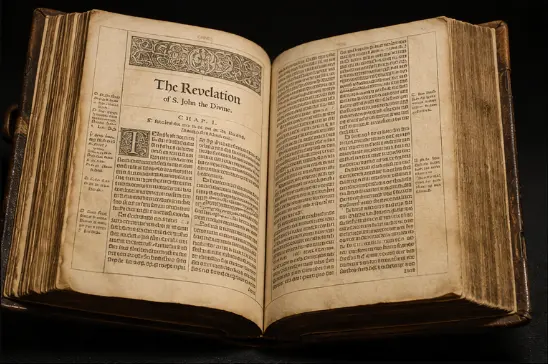
If you sit down and search for the word “omnipotent” in the King James Bible, you’ll find it exactly once, in Revelation 19:6:
“Alleluia: for the Lord God omnipotent reigneth.” (KJV)
That’s the whole list. One verse, in one book, in the entire Bible. Search for “omniscient” or “omnipresent” and you’ll get nothing at all, not in the KJV, WEB, NIV, ESV, NASB, or NKJV. The three abstract nouns we use as shorthand for God’s power, knowledge, and presence don’t appear in the Bible we read. (The NKJV, worth noting for precision, does keep “Omnipotent” at Revelation 19:6, so it isn’t quite right to say no modern translation uses the word at all.)
The Greek behind Revelation 19:6 is where it gets more interesting. The word is pantokratōr (παντοκράτωρ), and it shows up ten times in the New Testament: once in 2 Corinthians 6:18 and nine times in Revelation (1:8, 4:8, 11:17, 15:3, 16:7, 16:14, 19:6, 19:15, and 21:22). The King James translators rendered it “Almighty” nine of those ten times, and “omnipotent” only in Revelation 19:6. There’s no difference in the underlying Greek. Our entire English vocabulary for divine power traces back to one translator’s inconsistent choice in 1611.
What the Bible Says Instead
Scripture doesn’t use abstract nouns for God’s power, knowledge, and presence. It uses images, and the images are more vivid than the Latin summaries that eventually replaced them.
For God’s Power: “Almighty,” Pantokratōr, and El Shaddai
The Greek pantokratōr is a compound of pan (all) and a form of krateō (to rule or hold). Many scholars argue it means “all-ruling” or “all-holding” rather than abstractly “all-powerful,” and that shift matters, since the Latin omnipotens leans toward raw capability while the Greek leans toward sovereignty and grip.
In the Septuagint, pantokratōr regularly translates the Hebrew title YHWH Sabaoth (“Lord of hosts”), particularly in the prophets. It also translates El Shaddai in some books but not others: in Job about sixteen of the thirty-one occurrences become pantokratōr and three become hikanos (“sufficient”), while in Genesis it isn’t rendered as pantokratōr at all (Gen 17:1 LXX is simply “your God”).
El Shaddai itself is one of the great unsolved etymologies in Hebrew. Four proposals compete: an Akkadian shadû meaning “mountain” (Albright’s proposal, the most cited, though the doubled consonant has always been a problem); a Semitic root shdd meaning “strong” or “to destroy”; the noun shad meaning “breast”; and the rabbinic sha-day, “the one who is sufficient,” the source of the LXX’s hikanos. None has won.
For God’s Knowledge
Psalm 147:5 in the KJV says “his understanding is infinite,” and 1 John 3:20 says God “knoweth all things.” But the Bible almost never states God’s knowledge as a metaphysical property. It says he searches the heart, tries the reins, knows our sitting down and our rising up. It’s relational language, not informational language.
For God’s Presence
Psalm 139:7–10 in the KJV is worth quoting at length, since it stays with the question of how close God stays to the person praying:
“Whither shall I go from thy spirit? or whither shall I flee from thy presence? If I ascend up into heaven, thou art there: if I make my bed in hell, behold, thou art there. If I take the wings of the morning … even there shall thy hand lead me.”
Jeremiah 23:23–24 (KJV) says the same thing from God’s side: “Am I a God at hand, saith the LORD, and not a God afar off? … Do not I fill heaven and earth?” These aren’t metaphysical statements. They’re personal addresses, and that changes how they land.

Where the Omni Words Actually Came From
The Latin sources are worth naming, because they aren’t as parallel as most explainers imply. Omnipotent comes from omnipotens, a straight compound of omnis (all) and potens (powerful). Omnipresent comes from omnipraesens, omnis plus praesens. Omniscient is the odd one out: it isn’t a clean omnis + sciens compound but a back-formation from the Medieval Latin noun omniscientia, itself omnis plus scientia (knowledge).
They also didn’t enter English together. “Omnipotent” is attested in the early 1300s, borrowed through Old French from the Latin omnipotentem. “Omniscient” and “omnipresent” don’t appear until around 1600, roughly three centuries later. They were assembled into a set retroactively.
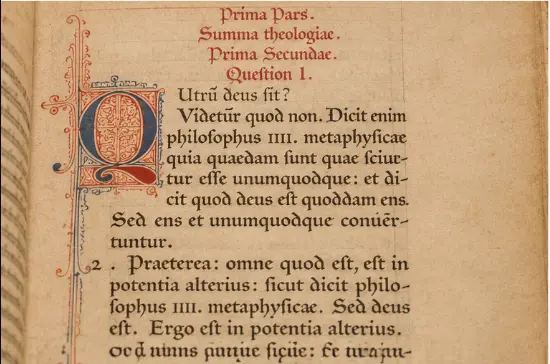
The systematization into “the three omni attributes” belongs to scholastic theology. Anselm treats them in chapters 5 through 7 of the Proslogion, and Aquinas gives them their canonical treatment in the Summa Theologiae: question 25 on God’s power (article 3 is titled “Whether God is omnipotent”), question 14 on God’s knowledge, and question 8 on God’s existence in things.
None of that means the attributes weren’t drawn from scripture; Aquinas cites Job and Luke 1:37 in question 25 alone. The narrower claim is that the vocabulary and the systematization into a set are scholastic. Scripture supplied the material, not the frame or the terms.
Are There Three Omni Attributes, or Four, or Five?
There isn’t a canonical list, which is why the question keeps getting asked in different forms. Some writers stop at three. Others add omnibenevolent (all-good) to make four. Others push further to omnisapient (all-wise), omnificent (all-creating), and omnitemporal (spanning all time) for five or more.
Omnibenevolent is the most common addition, and it has a specific history. The word doesn’t appear in English until 1679, in a work by William Penn, and it’s absent from the church fathers, Augustine, and Aquinas. It shows up mainly in modern analytic philosophy of religion as a term for stating the problem of evil in its sharpest form: an omnipotent, omniscient, omnibenevolent God shouldn’t permit gratuitous suffering, and yet suffering exists. Three is the classical set; anything beyond it depends on the author and the argument.
The Paradoxes: Can God Make a Rock Too Heavy to Lift?
You can construct sentences that seem to trap divine omnipotence in a contradiction, but the classical tradition has never thought they succeed. Aquinas and most Christian philosophers since have argued that omnipotence means power to do anything logically possible, and a “stone God cannot lift” isn’t a real object being denied to God but a contradiction wearing a noun. Asking whether God can do the incoherent is like asking whether he can draw a four-sided triangle.
The harder paradox is between foreknowledge and free will. If God knows now what I’ll choose tomorrow, is my choice really free? Boethius answered in the sixth century that God doesn’t foresee our actions from the past but sees all of time in a single eternal present, which removes the “before” problem, and Aquinas took a similar line. Molinist theologians developed the concept of middle knowledge, where God knows what any free creature would do in any situation. Open theists, a minority position within evangelical thought, argue that God knows all that can be known but that free future choices aren’t yet knowable even to him. Christians hold different views, and the tradition hasn’t settled it.
The problem of evil sits nearby. If God is all-powerful, all-knowing, and all-good, why does suffering exist? This is the question omnibenevolent was invented to sharpen. Classical answers include the free-will defense and soul-making theodicy, and Christians have always lived with the problem as a wound the doctrine can’t quite close.
Does It Matter That the Words Aren’t Biblical?
Both yes and no.
No, in the sense that theology has always used vocabulary the Bible doesn’t. “Trinity” isn’t a biblical word either, and neither is “incarnation” as a technical term, and Christians have understood for centuries that non-biblical shorthand can name biblical realities faithfully. The doctrine of God’s boundless power, knowledge, and presence is on every page of scripture even where the Latin nouns aren’t.
Yes, in the sense that shorthand does flatten. “Omnipresent” is tidier than “whither shall I go from thy spirit?” and considerably less moving. The abstraction is easier to argue about and harder to pray with. The Bible’s own vocabulary is concrete, personal, and often physical, and something happens when God is described as filling heaven and earth rather than as occupying all points in space. It isn’t that the Latin words are wrong. It’s that summaries lose some of the color of the thing they’re summarizing.
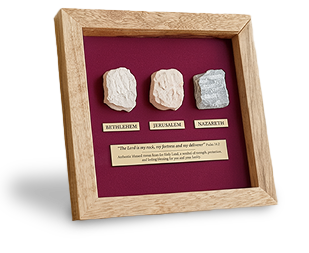
That concreteness is worth sitting with. Nothing in Christian faith depends on holding a tangible piece of the ground the Bible describes; scripture, prayer, and the Spirit are enough, and the tradition has always said so. But something is fitting about keeping a stone from Bethlehem close by, since this is a piece of the actual place where the words “fill heaven and earth” were first spoken. An object won’t teach you theology. It can quietly hold your eyes on the God who met people in a place, and still does.
Frequently Asked Questions
What is omnipotent, omniscient, and omnipresent?
Omnipotent means all-powerful, omniscient means all-knowing, and omnipresent means present everywhere at once. The three are the classical “omni” attributes Christian theology uses to describe God’s boundless power, knowledge, and presence. All three come from the Latin omnis (“all”), though the words themselves aren’t in the Bible in this form.
What are the four omni words?
The four are usually omnipotent, omniscient, omnipresent, and omnibenevolent (all-good). The fourth was added mainly to sharpen the problem of evil in modern philosophy of religion; the word itself is first attested in English in 1679, in William Penn.
What are the five omnis of God?
The most common additions to the classical three are omnibenevolent (all-good), omnisapient (all-wise), omnificent (all-creating), and omnitemporal (spanning all time). There isn’t a fixed canonical list, which is why the count you’ll see anywhere ranges from three to seven.
Where in the Bible does it say God is omnipotent, omniscient, and omnipresent?
Only “omnipotent” appears at all, once, in Revelation 19:6 in the KJV and NKJV. “Omniscient” and “omnipresent” don’t appear anywhere in the KJV, WEB, NIV, ESV, NASB, or NKJV. The ideas run throughout scripture in verses like Psalm 139 and Jeremiah 23; the Latin-derived words don’t.
What is the difference between omnipotent and omniscient?
Omnipotent describes what God can do, and omniscient describes what God knows. Power and knowledge are related, but they aren’t the same thing, and scripture and theology treat them as two distinct attributes even when discussing them together.
How do you pronounce omnipotent, omniscient, and omnipresent?
Omnipotent is om-NIP-uh-tuhnt, with the stress on the second syllable. Omniscient is om-NISH-uhnt, the “sc” softening to “sh.” Omnipresent is om-nih-PREZ-uhnt, stressed on the third syllable, with the “s” pronounced like a soft z.