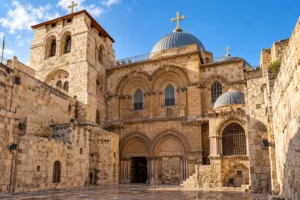
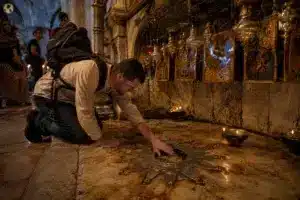
The polished slab of reddish limestone that pilgrims kneel to the moment they cross the threshold of the Holy Sepulchre was installed in 1810. The stone thousands of people kiss every day was put in place a little over two hundred years ago, during the Greek Orthodox restoration that followed the great fire of 1808. And still, of everything inside that vast and contested church, nothing draws quite the same immediate physical response as the Stone of Anointing. People fall to their knees at it without being told to. They press their foreheads to it, kiss it, weep against it, wipe cloths across it, and carry those cloths home as if the newer stone had somehow gathered up the memory of a night twenty centuries earlier. That is the real story of this stone, and it is more honest than the usual version.
It is also a story about how Christian faith uses physical objects, which turns out to be more interesting than either the archaeology or the sentiment on their own.
Quick reference
| Fact | Detail |
|---|---|
| Also called | Stone of Unction (from Latin unctio, the act of anointing with oil) |
| Location | Just inside the main entrance of the Church of the Holy Sepulchre, between Golgotha and the Rotunda |
| Material | Reddish limestone slab, roughly six meters long and one meter wide |
| Installed | 1810, during Greek Orthodox restoration after the great fire of 1808 |
| Earliest recorded tradition | 1288, in the account of the Italian Dominican pilgrim Riccoldo da Monte di Croce |
| Custodian churches | Jointly held by the Greek Orthodox, Roman Catholic (Franciscan Custody), and Armenian Apostolic Churches |
| Lamps above | Eight lamps contributed by Armenians, Copts, Greeks, and Latins |
| Station on the Via Dolorosa | Thirteenth Station of the Cross |
| Gospel passage | John 19:38 to 40, the burial preparation of our Lord by Joseph of Arimathea and Nicodemus |
What actually happens at the stone
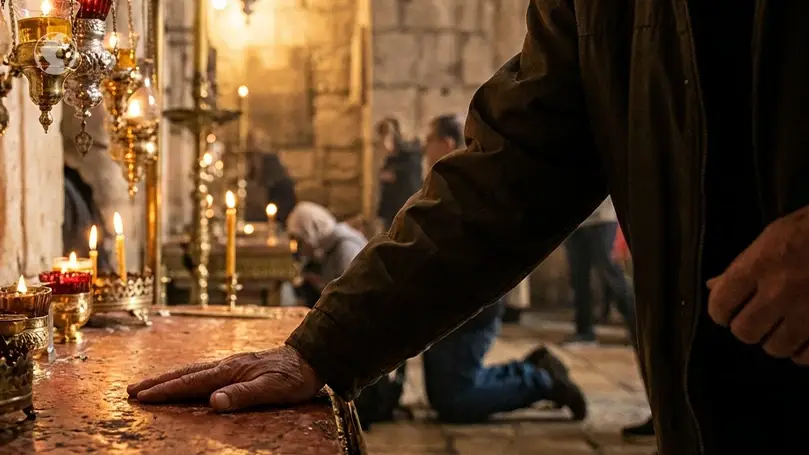
The first thing you notice when you enter the church is not Golgotha to your right or the great dome of the Rotunda to your left. It is a line of people bent over a red slab on the floor, dipping small vials of oil, dabbing scented water, laying rosaries and small icons on the surface, then wiping the stone with white cloths they have brought with them from home. Those cloths go back into pockets and bags and eventually into churches and homes on every continent. The idea, quietly held rather than doctrinally taught, is that the cloth carries something of the stone back with it, and the stone carries something of the burial of our Lord.
Most of this ritual is Orthodox in origin, though Catholics and Armenians and pilgrims from every tradition end up drawn in by watching it happen. Some pilgrims bring babies to be laid briefly on the slab for a blessing. Others rest photographs of sick relatives on it and pray for a moment before lifting the photograph and touching it to the still-warm oil. The scent of rose water and myrrh hangs over the slab most of the day. It is one of the most physically intimate acts of devotion in all of Christian pilgrimage.
Why the stone is younger than most pilgrims realize
Eusebius of Caesarea, writing in the fourth century about Constantine’s building of the church, described the tomb and Golgotha in detail and said nothing about an anointing stone. Pilgrims from the sixth through the twelfth centuries who wrote accounts of what they had seen inside the church described areas where the body of our Lord was believed to have been prepared for burial, but no fixed slab like the one there today. The first clear witness to an actual stone being venerated at this spot is the Italian Dominican pilgrim Riccoldo da Monte di Croce, writing in 1288, near the end of the Crusader era.
The stone that was there in Riccoldo’s time did not survive. It was damaged, replaced, and eventually destroyed. The slab pilgrims kneel to today was installed by the Greek Orthodox during the reconstruction of the church after the fire of 1808. The wall behind it was added at the same time, partly to help support the arches above, and partly, some historians think, to seal off a direct sight line from the entrance to the Rotunda. The lamps that hang above the stone were installed in the same restoration and are still there today, contributed by the Armenian, Coptic, Greek, and Latin communities in a rare small act of shared care.
What the Gospel actually says
The stone commemorates the moments described in John 19:38 to 40, when Joseph of Arimathea, described in all four Gospels as a wealthy member of the Jewish council and a secret disciple, asked Pilate for the body of our Lord and was granted it. Nicodemus, the Pharisee who had come to Jesus by night earlier in the Gospel, joined him. Together they brought a mixture of myrrh and aloes weighing roughly seventy-five pounds, wrapped the body in strips of linen with the spices, and prepared it for burial in the manner of the Jews.
The Gospel does not name a stone. It does not describe a slab. What it describes is a burial preparation carried out quickly in the fading light of Friday afternoon, with the Sabbath approaching and the women watching from a short distance away. The idea of a specific place, marked and venerated and eventually turned into a slab, came centuries later, as pilgrims and clergy sought a physical anchor for a scene the Gospel had left in outline.
The mosaic behind the stone, read right to left
The wall directly behind the Stone of Anointing is covered by a large modern Greek Orthodox mosaic in three panels, and if you know how to read it, the whole Passion narrative of that Friday afternoon is laid out in the order the events happened.
The right panel shows the Descent from the Cross, our Lord’s body being brought down from the wood by Joseph, Nicodemus, and the others. The center panel shows the anointing itself, the body laid out and prepared with oil and spices, exactly the moment the stone below commemorates. The left panel shows the burial, the body being carried the short distance from the anointing to the tomb. It reads right to left because the geography of the church itself reads right to left. Golgotha is up the stairs to your right as you enter. The Aedicule with the tomb is down and to your left in the Rotunda. The stone sits between them, and the mosaic tells the story of that walk.
Above the mosaic hang eight lamps, four of them Armenian, and the rest belonging to the Coptic, Greek, and Latin communities. That mix of ownership over such a small space is characteristic of the whole church. Almost nothing inside the Holy Sepulchre belongs entirely to one tradition.
The thirteenth station, and the pause between the cross and the tomb
For Catholic pilgrims walking the Via Dolorosa, the Stone of Anointing is the thirteenth of the fourteen Stations of the Cross. The tenth through twelfth stations are up on Golgotha, marking the stripping, the nailing, and the death of our Lord. The fourteenth station is the tomb itself, inside the Aedicule. The thirteenth, this stone, marks the moment in between, which is what makes it emotionally distinct.
Christians have a lot of language for the crucifixion and a lot of language for the resurrection. What we have less of is language for the hours in between, the quiet, awful hours when a body is being washed and wrapped and no one yet knows how the story will end. The Stone of Anointing is a physical marker for that pause. It is the place in the church that holds the grief specifically, before the tomb turns it into something else on Sunday morning.
What to notice when you stand at the stone
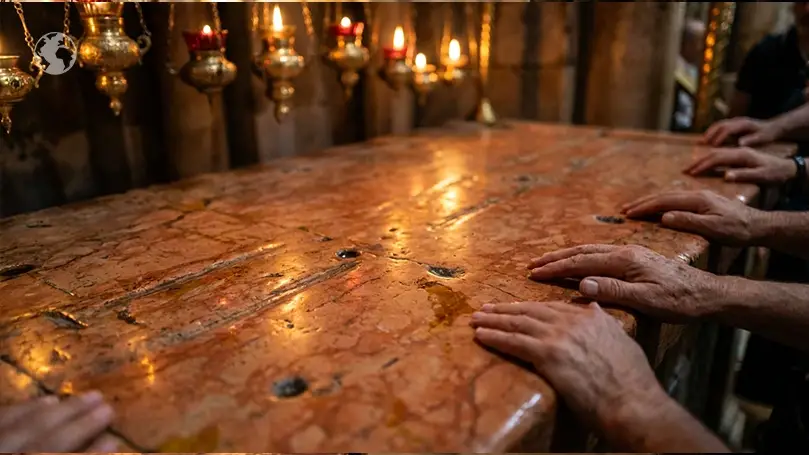
The slab is a single piece of reddish limestone, about six meters long and one meter wide, polished by centuries of hands and cloths. It sits low, only a few inches off the floor. There is no barrier, no rope, no sign. You kneel down. You touch it. Anyone can, and everyone does.
If you have time to notice details, look up at the lamps first. Notice the small variations between them, the different chain patterns and hanging styles that mark which community each one belongs to. Then look at the mosaic behind and let your eye move right to left through the three panels. Then kneel. If you have brought a cloth or a small icon or a rosary, this is the moment to press it briefly to the stone. Do not hurry. The line will move again in a minute or two.
Frequently asked questions
Is this really the stone where the body of our Lord was anointed?
Not the stone itself, no. The current slab was installed in 1810 during the Greek Orthodox restoration after the fire of 1808. The tradition of an anointing stone at this location only goes back with certainty to 1288, in the Crusader period. What Christians have believed for centuries is that this location, just inside the entrance of the church, is close to where Joseph of Arimathea and Nicodemus prepared the body of our Lord. The stone is a marker, and a witness, and a focus for prayer. It is not the original.
Why is the stone red?
The reddish color is natural to the limestone and has been enhanced over two centuries by the oils, myrrh, rose water, and human contact that saturate it every day. Some pilgrims see the color as a quiet allusion to the blood of the Crucifixion. That is not the reason it was chosen, but it is often the reason people remember it that way afterward.
Who owns the Stone of Anointing?
The stone is jointly held by the Greek Orthodox, the Roman Catholic Franciscan Custody of the Holy Land, and the Armenian Apostolic Church, under the Status Quo arrangement that governs the whole Church of the Holy Sepulchre. Ownership disputes over even small features of the church have been fought for a thousand years, and the Stone of Anointing is one of the few objects where three communities share responsibility without visible friction.
Can I bring my own cloth or oil to the stone?
Yes, and many Orthodox pilgrims do, along with a small vial of oil to sprinkle first. You are welcome to lay rosaries, small crosses, olive wood objects, or photographs on the slab for a moment before wiping it and taking them back with you. There is no ritual you need to know beforehand. The Orthodox tradition is simply to anoint the stone with oil, wipe it with a white cloth, and carry the cloth home as a personal blessing.
Why does the stone matter if it is not the actual burial preparation slab?
Because Christian faith has never been only about the archaeologically original. The Gospels themselves come to us through centuries of copying, translation, and interpretation, and no serious believer thinks the paper their Bible is printed on matters less because it is not the parchment John wrote on. A stone marked, venerated, and prayed over for centuries by pilgrims from every tradition, in the exact spot where our Lord was prepared for burial, becomes a real focus for real prayer. The younger age of the slab does not shrink what happens at it. It just changes what the object is doing. It is not a relic of the first century. It is a shared act of remembering, held together by hands that keep coming back.
Is there a way to bring some of this home?
Yes, in a way that is worth thinking about. Christians know that the presence of God is not in a slab of stone or a bottle of oil or a piece of cloth, that He is given directly to every believer through the Holy Spirit and reached through prayer offered in the name of our Lord, and none of that depends on carrying anything home from Jerusalem. But keeping something physical from this land still matters to a lot of believers, not as a channel to God, but as a way of holding the story close in the ordinary days when the story is easy to forget. The Stone of Anointing itself makes that argument better than any writer could. A stone put in place two hundred years ago has become one of the most prayed-over surfaces on earth, because generations of hands have kept coming back to it. A small stone from Bethlehem, a golden cross from Nazareth, or a key from the Holy Sepulchre door works the same way. It is not what the object once was. It is what it holds now, and what your hands keep coming back to.