Jesus was crucified at Golgotha, a site just outside Jerusalem’s first-century city walls that is today enclosed within the Church of the Holy Sepulchre in the Old City’s Christian Quarter. The Gospels name it in Aramaic as Golgotha, meaning “place of the skull”; the Latin translation, calvaria, gives us the name Calvary. Both words name the same ground.
The church sits inside walls built by Suleiman the Magnificent in the sixteenth century, which sometimes puzzles visitors who know that Roman and Jewish law required executions beyond the city boundary. The apparent contradiction dissolves under archaeology: the crucifixion site lay outside an earlier line, the Second Wall, which formed Jerusalem’s northern boundary in the first century. The city grew to swallow it. The location has never moved; the walls around it did.
A nineteenth-century alternative, Gordon’s Calvary and the Garden Tomb, draws many Protestant pilgrims to a quieter, garden-like site north of Damascus Gate. It is a place worth visiting. But the historical and archaeological weight behind it does not match what has accumulated over two millennia at the Holy Sepulchre.
Golgotha and Calvary: Two Names, One Site
Golgotha traces back to the Aramaic gulgolta, meaning “place of the skull.” When that word passed into Greek, it was transliterated as Golgotha — the form all four Gospels use. Matthew 27:33, Mark 15:22, and John 19:17 render it in Greek with the translation attached; Luke 23:33 refers to “the place called the skull” without preserving the Aramaic form. The Latin Church translated the same meaning as calvaria, and from calvaria came Calvary. Same site, same meaning, two languages.
When you encounter Calvary in older English devotion, in the Stations of the Cross, or in a hymn, and Golgotha in the Gospel text before you, they are pointing to the same ground outside first-century Jerusalem.
The City-Wall Problem — and Why It Doesn’t Disqualify the Church of the Holy Sepulchre
The walls a visitor sees enclosing the Old City today were built by Suleiman the Magnificent in the sixteenth century, more than fifteen hundred years after the crucifixion. They are not the walls that defined Jerusalem in the first century, and treating them as such is the source of the confusion.
In the first century, the city’s northern boundary ran along what historians and archaeologists call the Second Wall. Mark 15:20 and John 19:17 both place the crucifixion outside the city, and Josephus, describing Jerusalem’s wall system in Jewish War 5.4, gives enough detail about the Second Wall’s course to allow scholars to reconstruct its general line. The question is whether Golgotha fell outside that line. The evidence says it did.
Excavations beneath the Church of the Redeemer, which stands immediately adjacent to the Holy Sepulchre, have been particularly useful here. Archaeologists found no trace of first-century domestic structures or occupation layers at the depth that would correspond to the city’s inhabited interior. What they found instead was consistent with an area that lay outside the built boundary of Jerusalem during the Second Temple period. A site used for burial and execution, as Golgotha was, would not have appeared inside a functioning city; Jewish law and Roman practice both prohibited it. The archaeology supports, rather than contradicts, the Gospel accounts.
The Church of the Holy Sepulchre appears to sit inside Jerusalem only because the city expanded northward in the decades and centuries after the crucifixion, eventually pulling the old execution ground within its walls. The location itself has not moved. What changed was the boundary drawn around it.
The Church of the Holy Sepulchre: History and Evidence for the Traditional Site
Helena and the Fourth-Century Identification
The claim for the Church of the Holy Sepulchre rests on far more than imperial decree. When Helena, the mother of Emperor Constantine, visited Jerusalem in 326 CE and identified the site, she was not pointing arbitrarily at a patch of ground. Eusebius records in his Life of Constantine that the location was already known to local Christians — Helena’s visit formalized and monumentalized what the Jerusalem community had preserved through generations of continuous veneration. The tradition she encountered had not waited for her to begin.
Cyril of Jerusalem, writing and preaching in the mid-fourth century, refers to Golgotha as a visible, identifiable landmark that his congregation could see from the city. His references carry no defensiveness, no sense that the identification was contested or novel. He writes as a man pointing to something his listeners already know. That confidence, coming within living memory of Helena’s work and within three centuries of the crucifixion itself, is itself a form of testimony.
What Archaeology Adds
The most striking piece of physical evidence is one of suppression, not commemoration. Around 135 CE, the emperor Hadrian built a temple to Venus directly over the site. The deliberate overlay of a pagan cult structure suggests that the location was already marked and significant to the Christian community. It is the kind of act that erases a rival sacred memory, not an act performed on ordinary ground. When Constantine’s builders cleared the temple in the fourth century, they found beneath it a first-century rock-cut tomb consistent with Jewish burial practice of the period. That tomb is the edicule the pilgrim visits today.
Excavations connected with the Church of the Redeemer, adjacent to the Holy Sepulchre, have confirmed that the area lay outside the first-century city boundary and was used as a burial ground. The exposed rock of Golgotha, still visible inside the church beneath its glass enclosure, shows the geological features of a limestone outcropping that would have been recognizable as a prominent, skull-shaped formation.
No single finding carries the entire argument. What carries it is convergence: early Christian memory, the patristic testimony of Eusebius and Cyril, the archaeology of a deliberate Hadrianic overlay, and the physical evidence of a first-century tomb beneath the edicule. Each line of evidence is independent. Together they point to the same ground.
Gordon’s Calvary and the Garden Tomb: The Alternative Site Described and Assessed
The rocky escarpment north of Damascus Gate became a candidate for Golgotha in 1883, when General Charles Gordon visited Jerusalem and was struck by a feature visible from the city walls: a limestone cliff face eroded into hollows that, to his eye, resembled a human skull. Gordon connected this to the Gospel name for the crucifixion site, and his identification spread quickly through Protestant circles, eventually giving the location its popular name.
The Garden Tomb nearby, discovered in 1867, seemed to complete the picture — a rock-cut tomb in a quiet garden setting, close to a place that looked like a skull-shaped hill.
What the site offers is genuinely worth naming. The Garden Tomb Association, a British Protestant charity, administers the grounds with care, and the experience of visiting is unhurried and contemplative. For pilgrims who find the Church of the Holy Sepulchre’s layered, incense-heavy interior difficult to inhabit devotionally, the open garden setting provides something the older church cannot: stillness, space, and a scene that corresponds visually to what the Gospels describe. That is a real thing, and it shouldn’t be dismissed.
The archaeological picture, however, is less generous to the site’s claims. The tomb itself has been dated not to the first century CE but to the Iron Age or early Israelite period, centuries before the crucifixion. A first-century tomb would typically show a loculus-style cutting consistent with Second Temple burial practice; the Garden Tomb’s form belongs to an earlier tradition. The skull-shaped rock face, meanwhile, owes its appearance to erosion patterns that postdate the first century, and Gordon’s identification had no ancient textual or archaeological grounding behind it — it was, in the end, a Victorian impression.
The site is worth visiting as a place of quiet prayer. It is not, on the evidence, the place.
Visiting the Crucifixion Site Today
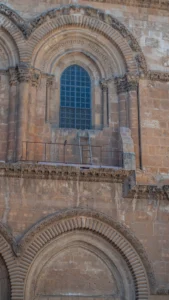
Inside the Church of the Holy Sepulchre
Entry to the church is free, and the doors open early — typically well before dawn for morning prayers. What greets you is not a single unified space but a layered complex of chapels, corridors, and alcoves built up across centuries, each one tended by a different Christian community. The three principal custodians are the Greek Orthodox, the Roman Catholic Franciscans, and the Armenian Apostolic Church, whose shared and sometimes tense custody arrangement governs which community holds which chapel, which altar, and which hours of liturgy. The arrangement has stood, with modifications, since the Ottoman-era Status Quo of the eighteenth century.
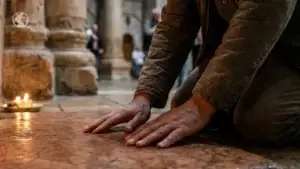
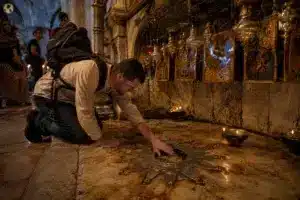
Golgotha itself is reached by a steep staircase just inside the main entrance. The upper chapel sits above the rock of the crucifixion, and beneath the altar you can reach down through a disc-shaped opening and touch the stone. Two altars occupy the space: the Latin Calvary altar on the right, maintained by the Franciscans, and the Greek Orthodox altar over the precise traditional site of the cross on the left. Both draw pilgrims kneeling, weeping, lingering.
Downstairs, the edicule stands at the center of the great rotunda. The edicule is the small stone structure built over the tomb itself, and a queue almost always forms to enter it. Inside are two small chambers; the inner one holds the stone shelf where the body of our Lord is believed to have lain. The wait can be long. It is worth it.
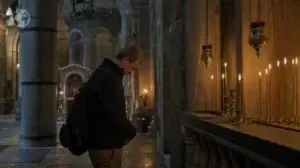
The church is rarely quiet. Incense, chant, tour groups, solitary pilgrims, and the bells of competing liturgies fill the air simultaneously. That density is not a distraction from the place’s meaning; it is part of it. Christians have been coming here without interruption since the fourth century.
The Garden Tomb
The Garden Tomb sits just north of Damascus Gate, outside the Old City walls, and is administered by the Garden Tomb Association, a British charitable organization that has managed the site since the late nineteenth century. Entry is free, and the grounds are open to visitors throughout the week with the exception of Sunday mornings, when services take priority.
The character of the place is entirely different from the Holy Sepulchre. The garden is tended, quiet, and unhurried. Benches sit among plantings. The rock-cut tomb is accessible, and visitors may step inside and stand in the chamber. For pilgrims who find the complexity and noise of the Holy Sepulchre difficult to absorb, this site offers space for stillness.
The devotional experience here is less encumbered by competing liturgies and visible institutional history. That simplicity has made it beloved, particularly among Protestant and Evangelical pilgrims. If your visit to Jerusalem allows time for both sites, the contrast between them is itself instructive. The one is ancient and communal and worn smooth by two thousand years of prayer; the other is open to the sky and easier to hold in the mind.
A Reminder of the Holy Sepulchre
If your faith has been shaped by standing at the place of the crucifixion, or if you’ve longed to stand there and haven’t yet, the Holy Sepulcher Keys are a way to carry something of that ground home with you.
These are replica iron keys to the Church of the Holy Sepulchre, made in the tradition of the Joudeh Al-Husseini and Nuseibeh families, who have held custody of the actual keys since Saladin entrusted them in 1187. The Joudeh family keeps the keys; the Nuseibeh family turns them. That arrangement has held for more than eight hundred years, through empires, occupations, and everything else history has brought to Jerusalem. A key to that church carries weight that no other object from that city quite replicates.
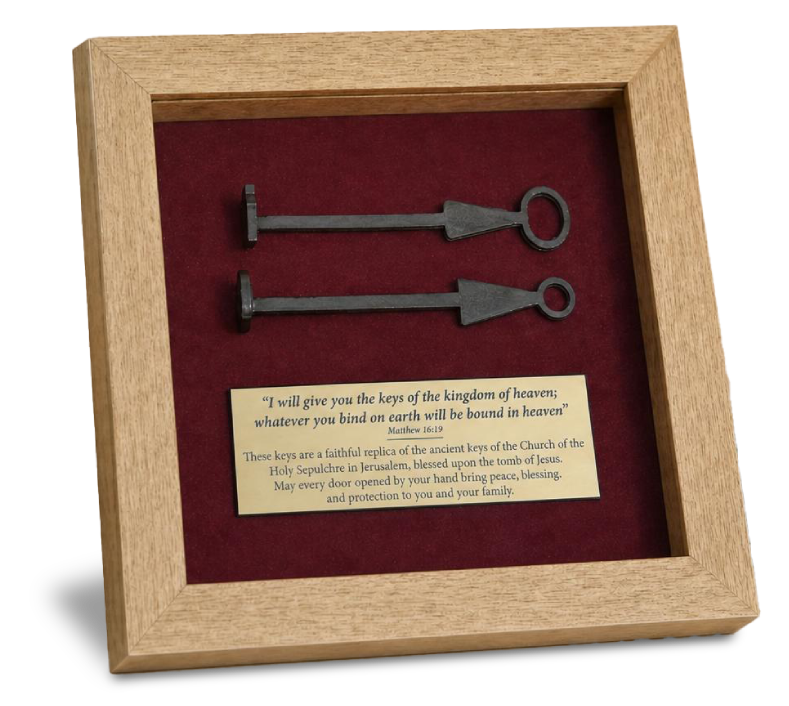
It isn’t a relic, and it makes no claim to be. It’s a reminder — of the site, of the families who have protected it through centuries of improbable continuity, and of what that door opens onto.
Frequently Asked Questions
Was Jesus crucified on the Passover?
The Synoptic Gospels (Matthew, Mark, Luke) place the crucifixion on the first day of Passover (Nisan 15), while John’s Gospel places it on the day of Preparation (Nisan 14, the eve of Passover). Both readings agree the crucifixion occurred at Passover time; the precise day is a long-standing question in biblical scholarship.
Can you still visit where Jesus was crucified?
Yes. Both candidate sites are open to the public and free to enter. The Church of the Holy Sepulchre, in Jerusalem’s Christian Quarter, contains the Golgotha altar on an upper level and the edicule enclosing the tomb below. The Garden Tomb, north of Damascus Gate, is administered by the Garden Tomb Association and offers a quieter, garden-like setting.
How do they know where Jesus was crucified?
The dominant identification rests on a convergence of early Christian veneration, patristic testimony from Eusebius and Cyril of Jerusalem, and archaeology — including evidence that a Roman temple to Venus was deliberately built over the site after 135 CE, suggesting it was already marked as significant. Excavations also confirm the site lay outside Jerusalem’s first-century Second Wall, satisfying the Gospel requirement.
Was Jesus crucified inside or outside Jerusalem’s walls?
Outside the walls. Both Jewish law and Roman practice required executions beyond the city boundary. The site is now enclosed within Jerusalem’s present Old City walls, but those were built by Suleiman the Magnificent in the sixteenth century. First-century archaeology places the crucifixion site outside the earlier Second Wall, which was Jerusalem’s northern boundary at the time.
The ground itself has not changed. Golgotha — called Calvary in Latin, “place of the skull” in either language — lay outside Jerusalem’s first-century walls, and the evidence for its location inside the Church of the Holy Sepulchre has only deepened over two millennia: early Christian memory, the testimony of Eusebius and Cyril, a deliberate Hadrianic temple built to suppress it, and a first-century tomb still visible beneath the edicule. The city expanded around the site; the site remained. Gordon’s Calvary offers a quieter, visually intuitive experience, and it is worth visiting — but the archaeological and historical weight behind it does not approach what has accumulated at the Holy Sepulchre across twenty centuries of unbroken veneration. For a pilgrim standing at either place, the evidence points clearly. For anyone who cannot yet stand there, the record is clear enough to know where, and why.