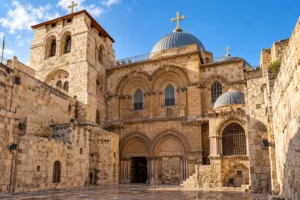
The place where Jesus was crucified, buried, and rose. Still opened at four in the morning, every day, by the same two families who have been doing it for eight centuries.
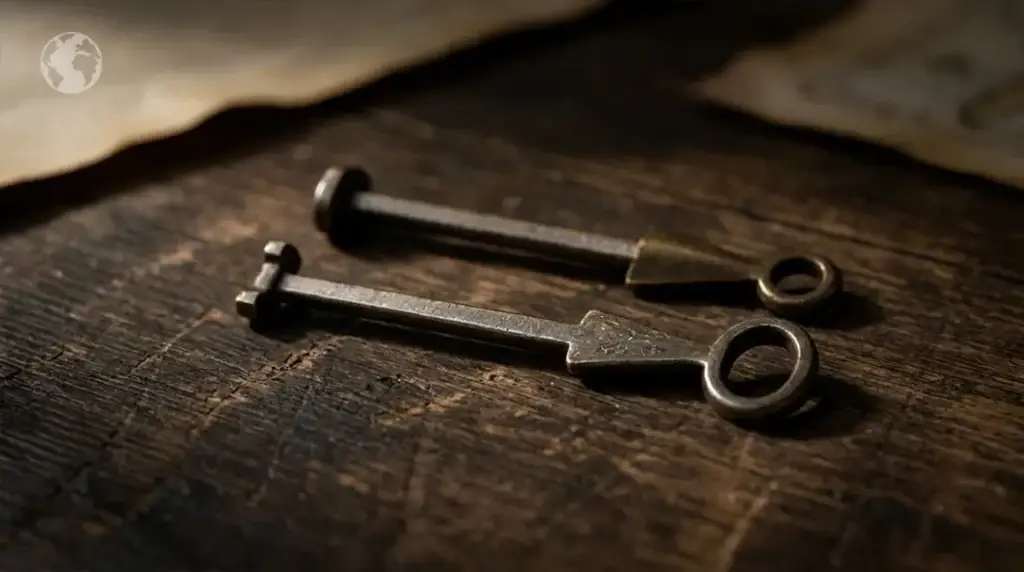
At four in the morning, before light gets over the Old City walls, a man named Adeeb Joudeh Alhusseini walks through the empty streets of Jerusalem carrying an iron key that is twelve inches long and about five hundred years old. He does it most days of his life. His father did it before him. When he gets to the church, he hands the key to a man from another family, the Nuseibehs, who climbs a small wooden ladder, unlocks the top lock, steps down, and unlocks the bottom one. The doors swing open. Christianity’s holiest place is ready for the day.
That is what happens every morning at the Church of the Holy Sepulchre, and it has happened, in almost exactly this way, for over eight hundred years. There have been two exceptions. The Black Death in 1349, and the day COVID hit Jerusalem in March 2020. Both times the doors opened again as soon as they could.
Quick reference
| Location | Christian Quarter, Old City of Jerusalem |
| Also known as | Church of the Resurrection (Anastasis in Greek, Kanisah al-Qiyamah in Arabic) |
| Traditional site of | The Crucifixion, burial, and Resurrection of Jesus Christ |
| First built | Between 326 and 335 AD, under Emperor Constantine |
| Custodial denominations | Greek Orthodox, Roman Catholic (through the Franciscan Custody), Armenian Apostolic, Coptic Orthodox, Ethiopian Orthodox, Syriac Orthodox |
| Key holders | The Joudeh Alhusseini family and the Nuseibeh family, since 1187 |
| Major feast days observed here | Good Friday, Holy Saturday and the Holy Fire, Easter Sunday, the Feast of the Cross |
Why is the key held by Muslims?
Because the Christians couldn’t be trusted with it.
By the medieval period, the Christian denominations sharing the church had been arguing over every inch of it for centuries. If the key went to any one of them, the others would read it as a claim of ownership over the whole building. So when Saladin took Jerusalem back from the Crusaders in 1187, he handed the key to a neutral Muslim family, the Joudeh Alhusseinis, and asked another Jerusalem family, the Nuseibehs, to open and close the doors. Both families have been doing it ever since, through Ayyubid, Mamluk, Ottoman, British, and Israeli rule, without a break.
Wajeeh Nuseibeh, who took over the door from his father in 1986, has put it most plainly. The Christians can’t agree, so the Muslims keep the peace.
The Joudeh family still keeps the original Ottoman contract, written on parchment, stamped in gold ink. They also still keep the original key, the one that came with the job in 1187. That one is eight hundred and fifty years old, and it broke sometime along the way. The one Adeeb walks with every morning is the newer key, which is about five hundred years old.
Standing inside the church
The first thing you notice is that more than one thing is happening at the same time.
You might hear Greek Orthodox chant coming from the Catholicon in the middle of the building, while a Franciscan procession moves through with Latin hymns and incense, while the Armenian community is in the middle of its own liturgy in its own chapel, all under the same roof. It sounds like it should be chaotic. Somehow it isn’t. It just sounds like heaven has more than one language.
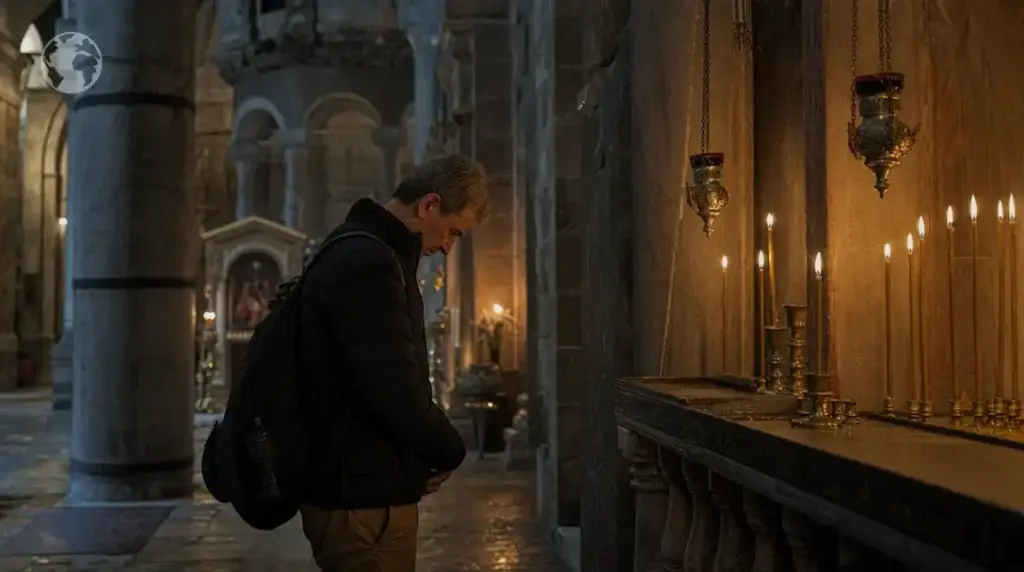
The stone is cool. The incense is heavy. The light is dim in most places and unexpectedly bright over the Aedicule, the small ornate shrine at the center of the rotunda that encloses the tomb itself. A line of pilgrims waits to enter it, and the line moves slowly. When you finally get inside, you have a moment or two on your knees in front of the burial place, and then a monk gently moves you along, because someone else has come thousands of miles for their own moment or two.
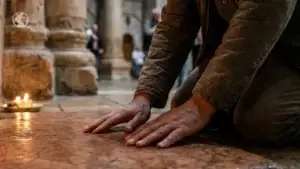
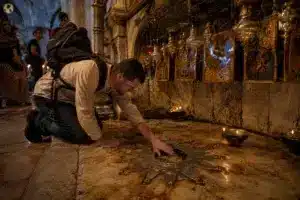
Off to one side, on the floor near the entrance, there is a stone slab, and pilgrims are kneeling beside it, pressing cloths and rosaries against it. That is the Stone of Anointing, where tradition holds that Christ’s body was prepared for burial. Up a steep flight of stairs to the right is the rock of Golgotha, enclosed in glass beneath an altar. You can reach through an opening under the altar and touch it with your hand. That is the memory of John 19 made physical.
When the tomb was carefully restored in 2016, researchers took mortar samples from just above the burial bed. The mortar dated to around 345 AD, meaning this exact spot has been marked as sacred since about a decade after Constantine finished the first church. Whatever the tomb is, seventeen hundred years of Christians have believed it enough to keep marking it.
The ladder
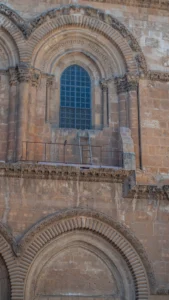
Look up at the church’s main facade, above the entrance. There is a small cedar ladder resting on a ledge under one of the upper windows. It has been there since 1757.
Nobody moves it. Nobody is allowed to.
The reason is an agreement called the Status Quo. In 1852, and reaffirmed in 1885, an Ottoman decree froze the arrangement of custodial rights inside the church at exactly the state they were in that year. Any object that belonged to one denomination at that moment still belongs to that denomination, and cannot be moved, cleaned, or repaired without unanimous agreement from every group involved. The ladder was already there when the decree took effect, and nobody has ever agreed on moving it. So it stays.
This sounds absurd. It isn’t. Before the Status Quo, monks were regularly getting into fistfights over who had the right to walk where. Historians have written those brawls up as comedy, but they weren’t comedy at the time. The Status Quo froze the arguments in place, which is how peace between six ancient Christian communities in the same building was made possible at all. The ladder is not really a joke. It is the visible proof that the arrangement is holding.
Who is actually inside
The six communities are the Greek Orthodox, the Roman Catholic (through the Franciscan Custody of the Holy Land), the Armenian Apostolic, and the smaller but present Coptic Orthodox, Ethiopian Orthodox, and Syriac Orthodox churches. Each of them has its own liturgical schedule inside the building, its own vestments, its own language, its own way of singing. The schedule is worked out in advance and followed strictly, because a five minute overlap can become a legal incident.
Beyond the priests and monks, there are the people who live around the church. Christian families in the Old City of Jerusalem have been praying at this building for two thousand years without interruption. They were here when the ladder was placed. They were here when the Crusaders were building. They were here when Constantine’s builders were still working. Their descendants are still here.
Fr. Rami Asakrieh is the parish priest of Jerusalem, and before that of Bethlehem. He carries prayer intentions from Christians around the world into the church and offers them at the Sepulchre. So do the priests of the other custodial denominations. That is one of the strange and precious things about this church. Your prayers, if you ask for them to be carried there, are not being carried into a museum. They are being carried into a place where the priest praying them is descended, in some real sense, from the community that has been praying there since the year 335.
The community is fragile. Christian numbers in Jerusalem have been falling for decades, as families emigrate under the pressure of economics and politics and daily difficulty. What keeps them here is faith, family, and support from Christians around the world who understand that a Christian Jerusalem without Christians in it would just be a museum. That is the reason places like this church are still open at four in the morning.
A word on carrying it home
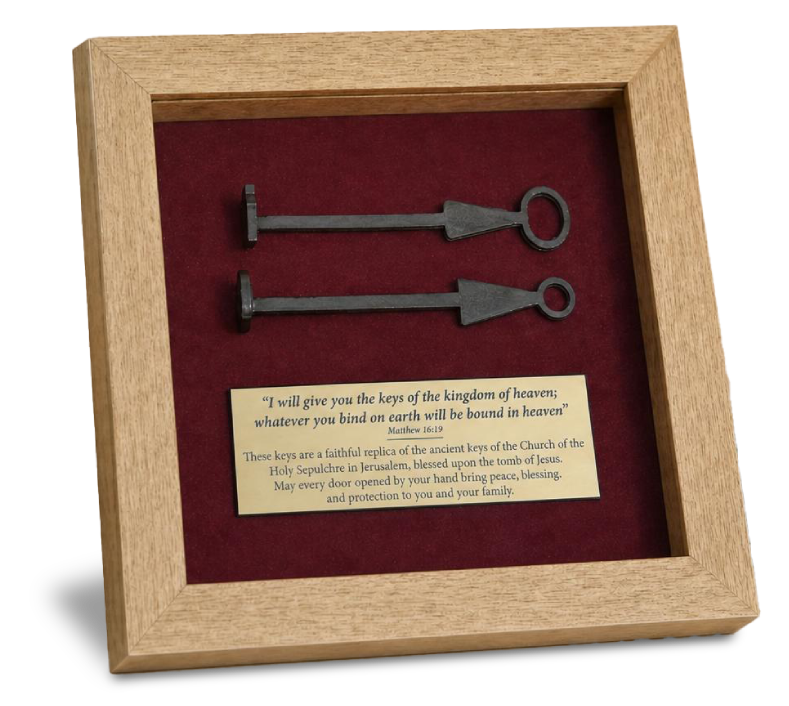
You might, at some point, want to keep something from this place near you. If you do, there is an honest reason to. The Holy Sepulchre replica keys that we offer were made in Bethlehem by Christian artisan families whose work depends on the continued Christian presence in the Holy Land. Holding one is not a substitute for anything, and it doesn’t do what the real keys have done every morning for eight hundred years. But it does quietly carry the story with you. It ties you, in a small physical way, to a door that still opens in Jerusalem, to a family that still walks it there, and to a Church that has never stopped remembering where Christ was buried. If you keep it near the door of your own home, that seems like a fine place for it.
Questions people actually ask
Why is a Muslim family opening a Christian church?
Because the Christian communities inside the church could not agree, and asking any one of them to hold the key would have been read as a claim on the whole building. In 1187, Saladin gave the key to a neutral Muslim family, the Joudeh Alhusseinis. The Nuseibehs were given the daily job of opening and closing the doors. Both roles have passed from father to son ever since. It isn’t symbolic. Every morning it actually happens.
Is this really where Jesus was buried?
The tradition goes back to the fourth century, when Empress Helena came to Jerusalem and identified the site. Recent archaeology has strengthened her identification rather than undermined it. Mortar dated to around 345 AD was found just above the burial bed during the 2016 restoration, which means the site was already being venerated within a decade of the first church going up. No other candidate site has anything close to that. A minority of Protestants prefer the Garden Tomb outside the walls, but even most of them will admit that is a devotional preference, not an archaeological argument.
What is the Immovable Ladder?
A cedar ladder that has been sitting on a ledge above the main entrance since 1757, and cannot be moved without the unanimous consent of six Christian denominations who have not been able to unanimously agree on anything since. It is a joke and it is also the physical proof of the peace agreement that runs the church.
Is it worth visiting?
Yes, without qualification. Go early or go late, because the middle of the day is full. Cover your shoulders and knees. Don’t try to see everything. Kneel at the Stone of Anointing if you want to, wait in line for the tomb, walk out slowly. Nothing you read prepares you for actually being there.