The Bible answers the question of how to get closer to God in one line, and it’s worth reading it before doing anything else: “Draw near to God, and he will draw near to you” (James 4:8). The Greek verb behind “draw near” is engizo, and it doesn’t mean to think about someone from across a room. It means to approach, to come close enough to touch. It’s the same word Mark uses in 1:15 when Jesus announces that “the kingdom of God has come near,” and the same word Luke uses in 24:15 when the risen Jesus, unrecognized, comes up alongside two of his disciples on the Emmaus road and starts walking with them. It’s a physical proximity word, and it’s the word the Bible uses for what closeness with God actually is.
That matters because most people who feel distant from God assume they’ve done something wrong, or that the feeling is proof of the distance. Neither is necessarily true. The feeling is real. But the closeness the Bible describes isn’t a feeling. It’s a fact ratified by the Incarnation, offered on the other side of a specific promise, and reachable through practices Christians have used for two thousand years.
The seven practices in this article aren’t a formula. They’re the specific things Scripture and the historical church have pointed to when believers ask exactly the question you’re asking. Any one of them, done honestly, is enough to start.
Quick Reference Table
| Question | Answer |
|---|---|
| What verse most directly answers this question? | James 4:8: “Draw near to God, and he will draw near to you.” The Greek verb is engizo, a physical-proximity word meaning to approach closely. |
| Is the feeling of distance a sign I’ve failed? | No. The Psalms are full of honest cries from believers who felt abandoned, and those were among the closest to God the Bible records. Distance is a feeling. Closeness is a relationship that holds under the feeling. |
| What Christian classic is about this exact topic? | The Practice of the Presence of God, letters and conversations by Brother Lawrence (Nicholas Herman, c. 1614-1691), a Carmelite kitchen worker in Paris. Published in 1692, it has never been out of print. |
| What Bible story shows what closeness feels like when you don’t recognize it? | The Emmaus Road, Luke 24:13-35. Two disciples walked seven miles with the risen Jesus, hearts burning, and didn’t recognize him until they broke bread together at the end of the walk. |
| Where did the practice of physical reminders of God come from? | Deuteronomy 6:8-9. God commands his people to bind his words on their hands, on their foreheads, and on the doorframes of their houses. This is the biblical origin of physical objects carrying spiritual meaning, and it’s the tradition Jesus was raised in. |
| What if I don’t know where to start? | Start with the first practice below, and do it once today. Then do it again tomorrow. Draw near is present tense in the Greek, meaning it’s a continuing action, not a one-time achievement. |
What closeness with God actually is
The word engizo shows up in about twenty-five places in the New Testament, and it almost always refers to something coming close in physical space. A crowd drawing near to hear Jesus. A blind man being brought near enough to be touched. Jesus drawing near to Jerusalem for the last week of his life. It is not a mental word. It is not “think hard about God.” It’s the language of approach.
What James 4:8 promises is that when you approach God, he approaches you, and that the movement is mutual. This is a stunning promise once you slow down enough to hear it. God isn’t waiting to be located. He isn’t hiding to see if you’ll try harder. He is meeting the first honest step you take with a step of his own.
Brother Lawrence, a lay brother who spent forty years washing dishes and repairing sandals in a Carmelite monastery in Paris in the 1600s, wrote a set of letters about this that were collected after his death into a small book called The Practice of the Presence of God. The book has never been out of print in over three hundred years, in both Catholic and Protestant traditions, and its central claim is simple: God’s presence is available in the middle of ordinary work, ordinary rooms, ordinary hours. You don’t need to leave the kitchen to find him. You just need to keep turning your attention his direction while you do the dishes.
The Emmaus road story in Luke 24 shows the same thing from the other side. Two disciples walked seven miles with the risen Jesus and didn’t know it. Their hearts were burning, they said afterward, but they couldn’t see who was walking with them until they sat down to a meal together and he broke the bread. That story is in Luke for a reason. Sometimes God is close and you don’t recognize him yet. Sometimes the burning in your chest is exactly what closeness feels like before the eyes catch up.
Seven practices that follow from the promise
1. Pray in plain, honest words, like someone is already in the room
Most people were taught to pray in a formal register that quietly implies God is at a distance, and after a while the prayer starts to feel exactly that way. Try starting your next prayer by saying what is actually true. “God, I feel like you’re far away.” “I don’t know what to say to you right now.” “I haven’t thought about you in three days and I’m tired.” That kind of prayer isn’t disrespect. It’s intimacy, and it’s what the Psalms sound like on almost every page.
Psalm 13 opens with “How long, O Lord? Will you forget me forever?” Psalm 22, which Jesus quoted from the cross, opens with “My God, my God, why have you forsaken me?” Psalm 88 doesn’t resolve at all. If those are in Scripture as prayers, so is yours. God isn’t looking for the perfect prayer. He’s looking for the real one, and Matthew 6:6 explicitly invites you into a private room to speak to “your Father, who is unseen.” Start there and you’ll be surprised how quickly the distance begins to shrink.
2. Read Scripture slowly, expecting it to say something to you today
There is a real difference between reading the Bible to finish it and reading it expecting God to speak. The first treats Scripture like a project. The second treats it like a conversation with someone who is present. Same words, and yet completely different experiences.
The Christian monastic tradition has a name for the second approach, lectio divina, or “sacred reading,” which goes back to Benedict of Nursia in the sixth century and to the Desert Fathers before him. The practice is simple: read a short passage slowly, notice which word or phrase catches your attention, sit with that phrase, and let it speak into whatever you’re carrying that day. If you’re not sure where to begin, the Psalms and the Gospel of John are the traditional starting places, and both reward this kind of reading.
When something catches, stop. Read the verse again. Ask what God might be saying to you through that specific line, on this specific day, in the specific situation you’re in. Psalm 18:2 says, “The Lord is my rock, my fortress and my deliverer,” and it isn’t just a line to memorize. It’s something to carry. Christians throughout history have understood the value of letting Scripture become physical, written down, held, spoken out loud, placed somewhere the eye will find it. When words like these are present in a home, they do quiet work on you even when you aren’t consciously praying.
3. Confess what’s between you and God, not to earn forgiveness but to open the door
Guilt is one of the most common reasons people feel far from God, and it’s worth understanding why. It isn’t that God has pulled away. It’s that we’re carrying the weight of things we haven’t brought to him yet, and that weight quietly creates the sense of distance.
Confession is not about earning your way back. 1 John 1:9 is direct about this: “If we confess our sins, he is faithful and just to forgive us our sins and to cleanse us from all unrighteousness.” The word for confess, homologeo, means to say the same thing about it that God says. That’s the whole point. Naming what’s between you and God removes it. Psalm 32 describes the physical relief David felt when he finally stopped hiding what he was carrying and simply said it out loud. You don’t have to have it all together before you come. You come as you are, you say what’s true, and the air clears.
4. Worship in small daily moments, not just on Sunday
Two hours on Sunday morning is a starting point for a relationship, not the whole of one. Closeness with anyone, including God, comes through repeated small moments of attention, and worship in the biblical sense is closer to that pattern than to a scheduled event on a calendar.
A song on the drive to work. A moment of genuine thanks before a meal, out loud, even if only in a whisper. A pause when you notice something beautiful, and the small acknowledgment that it came from somewhere. Brother Lawrence made a spiritual practice out of exactly this in the kitchen where he worked. The early Christians didn’t have church buildings for the first three centuries, and they still managed to develop the daily rhythm of morning and evening prayer that became the church’s regular practice. Every place, every moment, can become the ground of worship. That awareness is available to you right now, wherever you are.
5. Let physical things do spiritual work
Long before crosses hung on Christian walls, God had already commanded his people to make faith physical. Deuteronomy 6:8-9, part of the passage Jesus himself called the greatest commandment, tells Israel to tie God’s words as symbols on their hands, bind them on their foreheads, and write them on the doorframes of their houses. Jesus grew up in a home shaped by that command. The idea that a physical object can carry a spiritual meaning is not a later Catholic invention or a modern gimmick. It’s in the Torah, and it’s the tradition the Incarnation belongs to.
The theology behind it is straightforward. God entered the physical world in the person of Jesus, which is the strongest statement Christianity makes about the material world being capable of holding meaning. He was born in a specific manger, laid on specific straw, wrapped in specific cloths. The bread and the wine at the Last Supper are physical. Baptism is physical. If God has done this much with matter, it isn’t superstitious to keep a small physical object nearby as a reminder of him. It’s coherent theology.
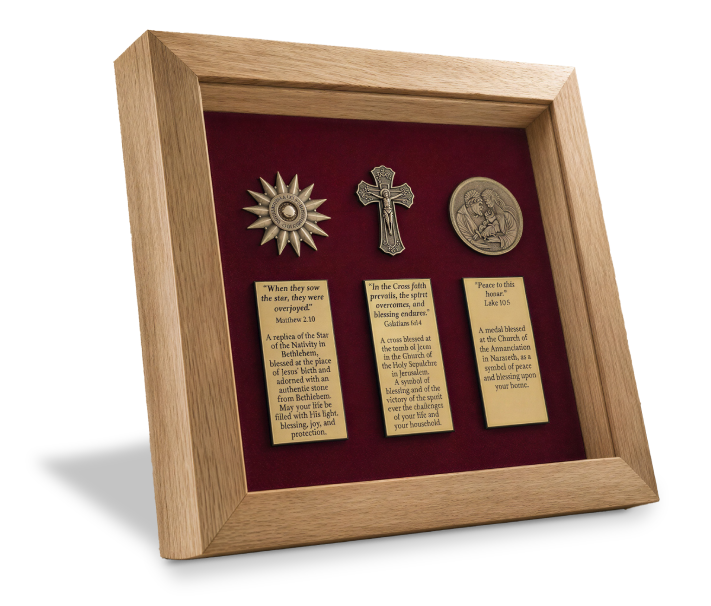
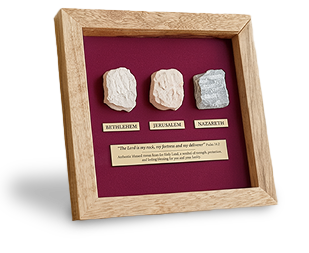
A cross pendant worn during the day is a quiet invitation to remember. A small stone from Jerusalem on a shelf is a small interruption of the drift. Anything placed intentionally, that means something and points somewhere, does spiritual work throughout the day even when you’re not consciously praying. You don’t need to redesign your home. A few things, honestly chosen, are enough.
6. Serve someone as an act of nearness
Matthew 25:40 is one of the most startling verses in the New Testament, and it’s worth reading it as if you were hearing it for the first time. “Truly I tell you, whatever you did for one of the least of these brothers and sisters of mine, you did for me.” Jesus is not speaking metaphorically. He is saying that when you serve someone hungry, alone, forgotten, or in need, you are in some real and mysterious way serving him. Which means that service isn’t merely obedience. It’s a form of closeness.
Many believers who go through seasons of spiritual dryness find that getting up and doing something small for someone else breaks through in a way that hours of quiet devotion couldn’t. Not because service replaces prayer, but because it puts you in the specific room where Jesus has already told you he is. Look for one person to serve this week. Something small, something that costs you something. And then pay attention to what shifts in you on the other side of it.
7. Let the geography of the faith become real
Christianity did not happen in the abstract. It happened at specific coordinates, on specific ground, at specific times. Jesus was born in Bethlehem, about six miles south of Jerusalem. He grew up in Nazareth, in the Galilean hills, and was baptized in the Jordan River. He preached from a hillside above the Sea of Galilee, healed a man in Peter’s house in Capernaum on the northern shore, wept over his friend Lazarus outside Bethany, prayed the night of his arrest in a garden on the Mount of Olives, and rose from a tomb outside the walls of Jerusalem that Christians have been visiting continuously since Constantine’s mother had a basilica built over it in AD 326.
When those places move from being story to being real for you, the faith tends to follow. Not everyone can travel there, and the point isn’t travel. The point is that something happens when the ground of the story becomes real to your imagination. Reading with a map open. Praying by name for the actual towns you’re reading about. Holding something small from that ground, if you have it, while you pray for whatever is on your heart today. The story stops being an idea and starts being yours.
When it doesn’t feel like it’s working
There are seasons in the life of every believer when none of this seems to be doing much, when the prayers feel flat and the reading feels dry and the moments outside Sunday feel empty. Saint John of the Cross, a sixteenth-century Spanish Carmelite, called this the dark night of the soul, and he treated it not as a failure of faith but as a normal, even necessary, part of maturing in it. Feelings of closeness come and go. What holds steady is God’s presence, ratified by his promise, whether the felt sense of it is there today or not.
The Emmaus road disciples are worth remembering here. They walked seven miles with the risen Jesus and didn’t recognize him, but their hearts were burning the whole time, and eventually they saw him. The burning in your chest, the vague sense that something is stirring even when you can’t name it, may be exactly the same thing. Keep walking. Keep talking. Keep sitting down to the table, so to speak. Recognition often shows up at the meal, not on the road.
A Holy Land connection worth thinking about
The reason MeliorMundus exists is that the physical ground of Christianity is real, still walked, and still tended by the small living Christian community in the Holy Land. Bethlehem still has the Church of the Nativity built over the cave where Jesus was born. Jerusalem still has the Church of the Holy Sepulchre built over the tomb, its keys held for over eight hundred years by two Muslim families in a small daily miracle of interfaith trust. Nazareth still has olive wood carvers whose families have been working the wood by hand for generations. The geography isn’t theoretical, it’s inhabited.
Objects tied to those places, an olive wood cross carved in Bethlehem, a small stone from the hills around Jerusalem, a key shaped like the one that opens the Holy Sepulchre at dawn, aren’t what draws you close to God. Christ himself does that, through his Spirit and his promise. But holding something rooted in that specific ground, while you pray, is a way of remembering that the closeness you’re asking for isn’t abstract. It has a location. Someone was born in a real cave. Someone walked out of a real tomb. And for two thousand years, believers have kept the memory of those places alive in their homes through small physical things that quietly point toward them.
Objects don’t save. But they do remind. And in the long slow work of drawing near to God, being reminded is a great deal of what the practice actually is.
FAQs
What is the single most important thing I can do to get closer to God?
Be honest with him. Tell God exactly where you are, including the distance, the doubt, and the dryness. That kind of honesty is the beginning of nearly every moment of closeness recorded in Scripture. You don’t need to be in a good spiritual place to start. You just need to start.
Is feeling distant from God a sin?
No. Distance is a feeling, not a moral failure. The Psalms are full of honest cries from believers who felt completely abandoned, and those same people were among the closest to God the Bible records. Bringing that feeling to God in prayer is itself an act of closeness, not the opposite of it.
How long does it take to feel close to God again?
There’s no fixed timeline. For some people, one honest prayer breaks through immediately. For others it takes weeks or months of quiet, consistent practice. What matters more than the timeline is the direction. Moving toward God, even slowly, is moving in the right way, and James 4:8 promises the movement is met from the other side.
What did Brother Lawrence actually teach?
He taught that God’s presence is available in the middle of ordinary life, that the practice of remembering him while doing simple work (in his case, washing pots in a monastery kitchen) is itself a form of prayer, and that the practice grows through repetition rather than through intense religious experience. His book The Practice of the Presence of God has been read continuously in both Catholic and Protestant traditions for over three hundred years.
Can physical objects like a cross really help my faith?
Yes, and this has been a Christian practice since the earliest centuries, with a biblical origin much older than that in Deuteronomy 6:8-9. Physical objects don’t replace a relationship with God. They serve as reminders, invitations to prayer, and small interruptions of the drift of attention. The Catholic and Orthodox traditions have a long, careful theology of sacred objects, and it’s grounded in the Incarnation itself: God entered the physical world, so the physical world is capable of pointing back to him.
How can I hear God’s voice?
Almost always through Scripture, prayer, the counsel of other believers, and the gentle inner nudge of the Holy Spirit, tested against Scripture. God rarely speaks in dramatic voices. He usually speaks in the ways John 10:27 describes: his sheep know his voice, and it takes time in his company for that recognition to become clear. Lectio divina, a slow, listening kind of Scripture reading, is one of the oldest Christian practices for learning to hear him this way.