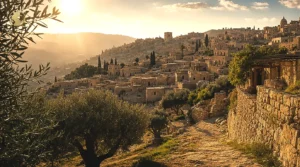
Christianity is a faith with universal reach, but its central events happened in a very specific part of the world. Jesus was born in Bethlehem. He grew up in Nazareth. He taught and healed around the Sea of Galilee. He entered Jerusalem at Passover, was crucified outside its walls, and Christians believe he rose from the dead there. For a Christian to speak of the Holy Land is to speak of the ground where these things happened.
That matters because it changes what the land is. The Holy Land is not sacred because generations of believers called it holy. It is sacred because the central events of the Gospel happened there, and the pilgrimage tradition, the churches built over sites of memory, and centuries of veneration all rest on that prior fact.
And the story did not end when the New Testament era ended. There has been a continuous Christian presence in these places since the earliest years of the Church, in families that have kept the faith in the land where it began. This article is about both halves of that reality: the places where the Christian story began, and the people who are still living it there.
What is the Holy Land?
The term Holy Land describes the region where the events of the Old and New Testaments took place, a land Jews, Christians, and Muslims regard as sacred in different but overlapping ways. For Christians, it is where Jesus lived, where the earliest Church took shape, and where nearly every major event in the Gospels can be pointed to on a map.
The Christian sacred geography of the Holy Land is fairly compact. It runs from Bethlehem, just south of Jerusalem, up through Jerusalem itself and the Jordan valley, into Galilee in the north where Jesus spent most of his ministry. All of these places are within a few hours of one another, and Christianity is anchored to them because it makes distinctive claims about God entering physical history in specific, locatable places.
Why the Holy Land matters to Christianity
Every religion has its centres, but Christianity’s relationship to the Holy Land has a particular shape. The Gospels do not present the life of Jesus as a set of teachings that could have taken place anywhere. They present it as a series of events that happened here, then there, then somewhere else, in a landscape a first-century reader could have travelled through in a week. Christianity’s oldest creeds identify Jesus by the town he was from, Nazareth, and the ruler who executed him, Pontius Pilate. It is a faith anchored in place in a way that would not be the same faith without the anchoring.
The Christian holy places at a glance
The main places associated with Christian sacred geography in the Holy Land are these. The sections that follow are deeper explanations of each, in roughly the order Jesus’s life unfolded.
| Place | Christian significance |
|---|---|
| Bethlehem | Birth of Jesus. Site of the Church of the Nativity. |
| Nazareth | Home of Mary and Joseph, and the town where Jesus grew up. Site of the Annunciation. |
| Sea of Galilee and surrounding villages | Most of Jesus’s public ministry, including the Sermon on the Mount, most of the parables, and the calling of the first disciples. |
| Jordan River | Baptism of Jesus by John the Baptist. |
| Jerusalem | Passion, Crucifixion, and Resurrection of Jesus. Birthplace of the Church at Pentecost. |
| Church of the Holy Sepulchre | Traditional site of both the Crucifixion and the tomb of Jesus, continuously venerated since the earliest years of the Church. |
| Mount of Olives | The Garden of Gethsemane, the Ascension, and much of Jesus’s final week. |
Bethlehem, where Jesus was born
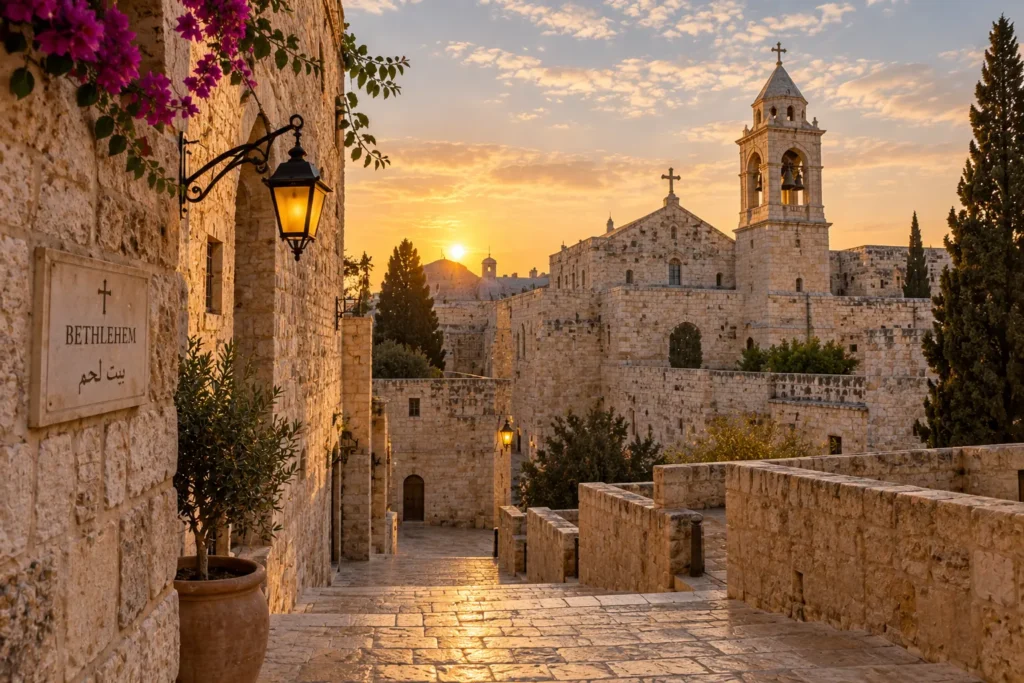
Bethlehem is a small town in the Judean hills, about six miles south of Jerusalem. It appears in the Hebrew Bible as the birthplace of David, and by the time of the prophet Micah it was associated with the promise of a ruler out of Judah (Micah 5:2). Christians read the accounts of Jesus’s birth in Matthew 2 and Luke 2 as the fulfillment of that older expectation.
The Church of the Nativity, built over what tradition identifies as the cave where Jesus was born, is one of the oldest continuously functioning churches in the world. A silver star set into the floor of the crypt marks the spot.
Bethlehem today is a Palestinian city with a majority Muslim population and a historic Christian minority that was once the majority. Its Christian artisans have practised olive wood carving and stone work for generations. A pendant set with an authentic Bethlehem stone carries a fragment of that specific ground into a Christian’s daily life, and supports the community that has kept the craft alive.
Nazareth, and the hidden years
Nazareth is a hill town in lower Galilee, roughly ninety miles north of Jerusalem. In Jesus’s time it was small and unimportant enough that the disciple Nathanael could ask, “Can any good thing come out of Nazareth?” (John 1:46). But it was where the angel Gabriel appeared to Mary at what Christians call the Annunciation (Luke 1:26-38), and it was where Jesus grew up.
Most of his life happened here, not in Jerusalem. The Gospels give a few chapters to his birth, a great deal to his final week, and almost nothing to the thirty years in between. Those years are simply Nazareth. They are called the hidden years because Scripture does not tell them, but Jesus learned a trade there, worshipped in its synagogue, and lived under the household of Joseph and Mary. When he was rejected in his own hometown (Luke 4:16-30), it was Nazareth he was rejected in.
Nazareth today is the largest Arab city inside Israel, and its Christian population of around 19,000 is the largest of any city in the country. The Holy Land Stone Trio, which pairs stones from Jerusalem, Bethlehem, and Nazareth, holds together three phases of one life: birth, hidden years, and passion.
Galilee, where he taught
Most of what is quoted in the Gospels was said in Galilee. Matthew 4 marks the moment Jesus began preaching there, and the chapters that follow contain the Sermon on the Mount, the parables of the kingdom, the calming of the storm, the feeding of the five thousand, and the calling of Peter and Andrew and James and John from their nets.
What Galilee gives a Christian reader of the Gospels is scale. The Sea of Galilee is only thirteen miles long and eight miles wide. The land where Jesus taught was small, his ministry was walked rather than driven, and the distances he covered on foot are the same distances any hiker can cover today. A Christian who has read the Gospels their whole life has travelled around this lake many times without leaving their armchair.
Jerusalem, where he was crucified and, Christians believe, rose from the dead
Jerusalem is where the four Gospels converge. Each one narrows toward Jesus’s final week here, and each gives more space to those few days than to any other stretch of his life. The Passion narratives (Matthew 26-28, Mark 14-16, Luke 22-24, John 18-21) unfold almost entirely within its walls and the immediate country around them. He entered on a donkey, ate the Passover meal with his disciples in an upper room, was arrested in a garden on the Mount of Olives, tried by the Sanhedrin, brought before Pilate, crucified at Golgotha outside the city wall, and buried in a tomb cut from the rock nearby. The women who came to that tomb on the first day of the week found it empty.
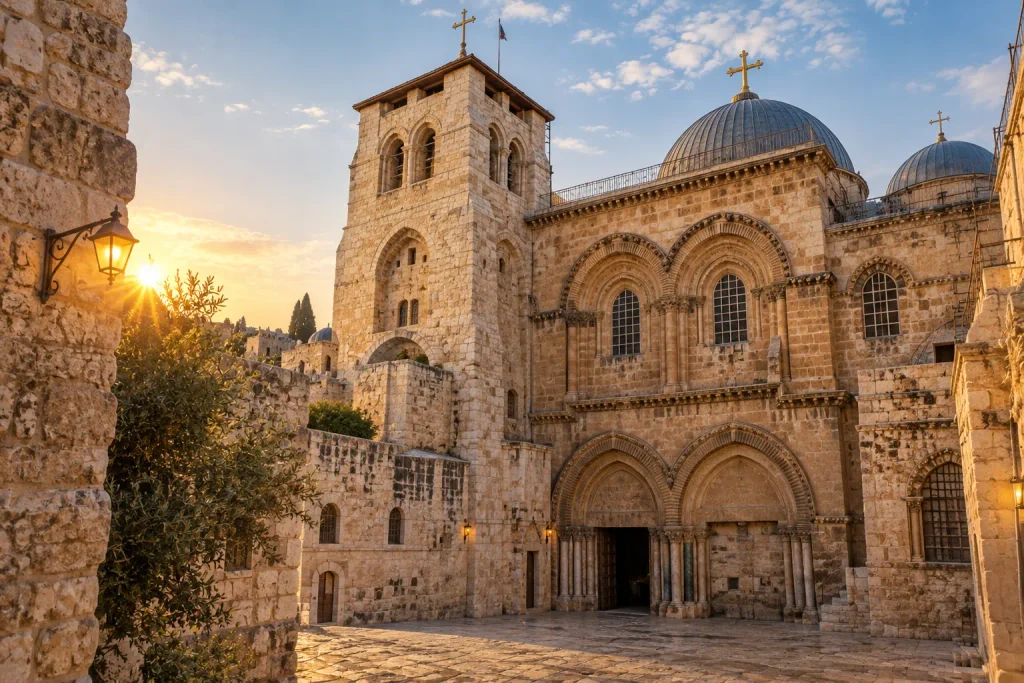
The Church of the Holy Sepulchre stands over both the site traditionally identified as Golgotha and the tomb. It is shared by six Christian communities, most prominently the Greek Orthodox, Roman Catholic, and Armenian Apostolic, and has been continuously venerated since the earliest years of the Church.
That continuity is what makes Jerusalem central to Christian memory. The Church of the Holy Sepulchre is not a memorial placed at a guessed location. It is a church built on a spot the Christian community was already visiting, kept in place through every subsequent century, and still visited today. The custody of its keys, which has passed through the same two Muslim families for eight centuries, is one small window into how carefully that continuity has been guarded.
How Christianity took root, and how it survived
The Christian Church began in Jerusalem. Acts 2 describes the apostles gathered in an upper room, the Holy Spirit descending on them at Pentecost, and Peter preaching to a crowd of pilgrims from across the Roman world. Three thousand were baptised that day. From that starting point Christianity spread outward through the Mediterranean, but the Jerusalem church remained the mother church of the early movement, and James, the brother of Jesus, led it until his martyrdom in the early 60s.
Every subsequent century reshaped the political situation of the Christian Holy Land without ever fully displacing the Christian communities on the ground. Byzantine, Arab, Crusader, Mamluk, and Ottoman rule each passed over the land; the arrangements at the Holy Sepulchre and the other shared shrines that hold to this day were formalised under the Ottomans. Through all of it, Christians remained in the land where the story began.
The Holy Land is still home to Christians today
It is easy for a Christian outside the region to think of Christianity in the Holy Land as something belonging to the biblical past. It is not. Christians still live in the places where these stories unfolded. They are a small minority now, but they include some of the oldest continuously present communities in the Christian world.
These communities are diverse: Greek Orthodox, Roman Catholic (both Latin and various Eastern Catholic churches), Armenian Apostolic, Syriac, Coptic, and Protestant. The largest single grouping is Arab Christian, and many families trace their line back to the earliest years of the Church.
They live in the places the Gospels name. In Israel, according to the Central Bureau of Statistics, there are about 184,000 Christians, roughly 1.9 percent of the population, with the largest communities in Nazareth, Haifa, and Jerusalem. In the West Bank and East Jerusalem, there are around fifty thousand more, concentrated in Bethlehem, Ramallah, Beit Jala, Beit Sahour, and the old Christian Quarter. Priests serve them, schools teach their children, and much of the craftsmanship associated with the Holy Land, from olive wood carving to religious jewellery, comes out of these communities.
They matter for the same reason the sacred sites matter. A holy place with no living community around it is a museum. The Christian communities of the Holy Land are what keep it something more than that.
Why the Christian presence is under pressure
The Christian population of the Holy Land has been shrinking as a proportion of the total for over a century. In Mandatory Palestine in 1946, Christians were about eight percent of the population. Today, in the West Bank and Gaza, they are about one percent. Inside Israel the Christian population has held roughly steady in absolute numbers, but as a share of the population it has declined for decades.
The main cause is emigration. Young Christian adults leave for the same reasons any young adult leaves anywhere: work, safety, education, family already abroad. The economic and political pressures of the region make each generation of that decision easier. Nobody involved in serving these communities describes the situation as hopeless, but nobody describes it as stable either.
Why preserving that presence matters
There are three reasons this matters to Christians who have never been anywhere near the Holy Land.
The first is that the physical places are part of Christian heritage. They belong to the whole Church, not to any one country’s citizens, and their upkeep is the wider Christian world’s business as much as anyone else’s.
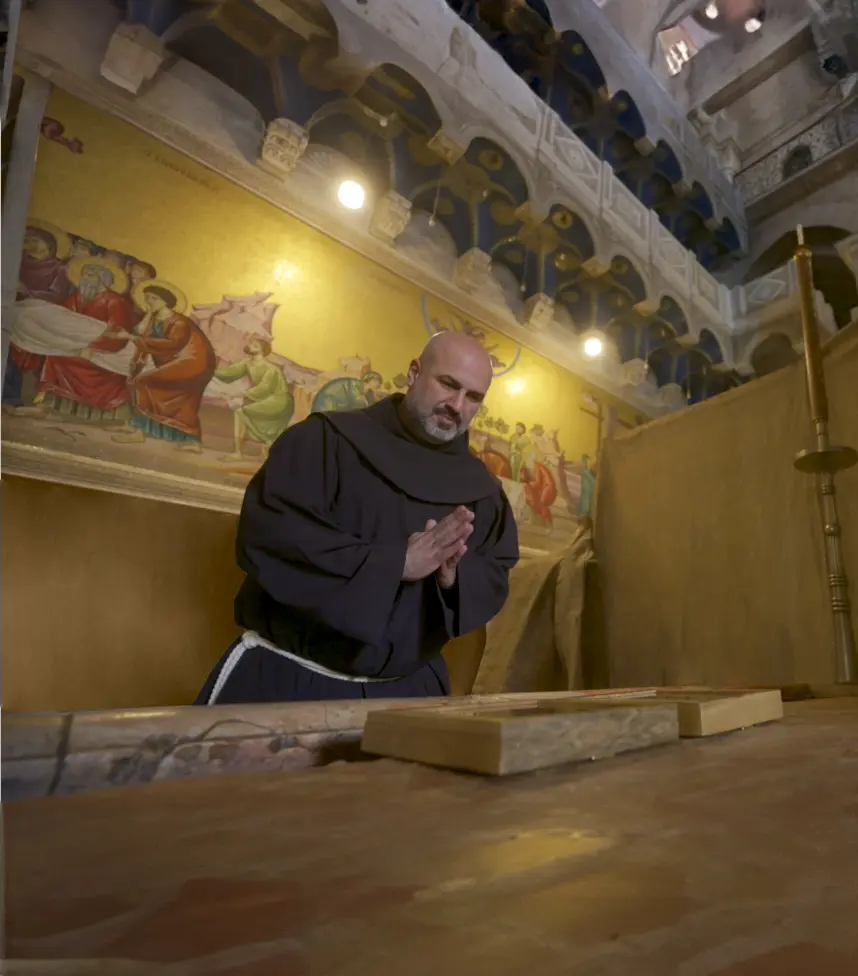
The second is that the sites do not preserve themselves. Christians preserve them. The Franciscans have served as papal custodians of the Latin Christian sites since 1342. The Greek Orthodox Patriarchate has been in Jerusalem far longer. The Armenian Apostolic Church has its own quarter of the old city. These are not caretaker arrangements maintained from a distance; they are communities of monks, priests, families, and lay workers who live in the place they are guarding. When their number thins out, the guarding gets harder.
The third is the shape of the Church as a whole. Paul writes that when one part of the body suffers, the whole body suffers with it (1 Corinthians 12:26). The historic Christian communities of the Holy Land are one of the oldest parts of that body. To care about them is not charity, it is family.
Carrying the Holy Land home
For most Christians, going to the Holy Land in person is either impossible or a once-in-a-lifetime effort. That is one of the reasons that, for centuries, Christians have taken pieces of the Holy Land home with them: a pressed flower, a phial of oil from a lamp, a rock from a hillside, a rosary blessed at a shrine.
The impulse is not superstitious. A physical object does not carry God around. But it does carry attention. A stone from Bethlehem set into a pendant is a small daily reminder that Christ was born in a specific town, that the town is still there, and that the woman who assembled the pendant lives a few miles from where Mary laid him in a manger. That is the concept underneath everything Melior Mundus makes: not a talisman or a souvenir, but a way of keeping the specific ground of the Christian story present in ordinary life, and of supporting the specific Christian families who still live on that ground.
The Holy Land Prayer Stone pairs Holy Land stone with a Scripture verse for daily prayer. The full story of how each piece is sourced, blessed, and assembled is on our story page.
Ways to stay connected
There are several things a Christian outside the Holy Land can do to remain in relationship with it.
Pray for it. The whole world Church prays for the peace of Jerusalem in the words of Psalm 122, but there are more particular things to pray for as well: the pastors of the local churches, the families raising children in Bethlehem and Nazareth, the safety of the sacred sites, the return of pilgrims. Melior Mundus offers a prayer submission that is carried by Fr. Rami Asakrieh, Parish Priest of Jerusalem, at the Church of the Holy Sepulchre.
Learn about it. Reading the Gospels with the geography in mind is one way, and the Melior Mundus Faith Guidance blog is another entry point into the Christian history and present of the Holy Land.
Support the communities directly. The initiatives Melior Mundus partners with support Christian families in the West Bank and Israel through church-led programmes. Any support the wider Church can give the local Church matters.
The story did not end there
The Holy Land is not only where Christianity began. It is where Jesus was born, where he grew up, where he taught, where he died, where Christians believe he rose again, and where the early Church emerged. That is one part of what makes it sacred.
The other part is that Christians still live there. To care about the Holy Land as a Christian is not simply to remember ancient places. It is also to recognise the people who continue to live their faith on the same ground, in the same towns, under a name that has not changed in two thousand years.
The story did not end there. It is still being lived there.
Frequently asked questions
What is the Holy Land in Christianity?
The Holy Land is the region where Jesus was born, lived, taught, died, and rose again. It is the geographical area associated with the biblical places central to Christianity, including Bethlehem, Nazareth, the Sea of Galilee, and Jerusalem, along with the surrounding biblical sites.
Why is the Holy Land important to Christians?
Because the central events of the Gospel happened there. Christianity is anchored to specific physical places in a way that is unusual among faiths, and those places are all in the Holy Land.
Where did Christianity begin?
In Jerusalem. The Church began there at Pentecost, described in Acts 2, when the Holy Spirit descended on the apostles and Peter preached the first Christian sermon. From Jerusalem, the faith spread outward through the Roman world.
What are the most important Christian holy sites in the Holy Land?
The Church of the Nativity in Bethlehem, the Basilica of the Annunciation in Nazareth, the Sea of Galilee and its surrounding sites, and the Church of the Holy Sepulchre in Jerusalem. The Jordan River, the Mount of Olives, and the Garden of Gethsemane are also central to Christian devotion.
Why is Jerusalem important to Christianity?
Because Jesus was crucified and, Christians believe, rose from the dead there. The Church of the Holy Sepulchre is built over both the site of the crucifixion and the tomb. Jerusalem is also where the Christian Church began at Pentecost.
Are there still Christians living in the Holy Land?
Yes. There are about 184,000 Christians in Israel and roughly 50,000 in the West Bank and East Jerusalem, with much smaller communities in Gaza. They include Greek Orthodox, Roman Catholic, Armenian Apostolic, Syriac, Coptic, and Protestant churches, and many belong to families that have been Christian since the earliest years of the Church.
Why does the Christian presence in the Holy Land matter?
Because the sacred sites are cared for by the people who live around them. When Christians in the Holy Land are supported, the historic Christian heritage of the region is preserved not as a museum but as a living community.
How can Christians stay connected to the Holy Land?
By praying for it, learning about its Christian history, supporting Christian communities and church-led initiatives there, and keeping a physical object from the Holy Land in daily use as a reminder.