The gospel message is the announcement that Jesus Christ died for human sin, was buried, and rose from the dead on the third day. It is not a philosophy or a set of religious instructions but a report of what happened: a real death, verified by burial, followed by a resurrection witnessed by hundreds of people in first-century Jerusalem. The word “gospel” comes from the Greek euangelion, meaning “good news.” It is good news because it addresses the one problem every person shares – sin has broken the relationship between humanity and God – and offers a solution that no person could provide for themselves. That solution is Christ. Receiving it requires repentance and faith.
Key Takeaways
- Gospel comes from the Greek euangelion, meaning “good news” or royal announcement of victory
- The core gospel message is in 1 Corinthians 15:3–4: Christ died for our sins, was buried, and rose on the third day
- Sin separates every person from God; the gospel is God’s answer to that problem
- Jesus died as a substitute, taking the penalty for sin that others owed
- The resurrection proved the death accomplished what it was meant to accomplish
- The gospel requires repentance (turning from sin) and faith (trusting Christ for salvation)
- The gospel is not for one nation or ethnic group; it is for everyone
- The events of the gospel happened in Jerusalem, at real locations, witnessed by real people
What Does the Word “Gospel” Mean?
The word “gospel” means “good news.” In English it comes from the Old English godspel (“good story” or “good message”). The Greek word behind it is euangelion, which appears 93 times in the New Testament. In the ancient Roman world, euangelion was the word used for a royal proclamation: when a king won a military victory, a messenger ran to the city and announced it publicly. The people in the city had not been at the battle. They received the report and acted on it.
Paul hands down the gospel in exactly these terms: “For I delivered to you as of first importance what I also received: that Christ died for our sins in accordance with the Scriptures, that he was buried, that he was raised on the third day in accordance with the Scriptures.” (1 Corinthians 15:3–4)
This is a creed Paul received and passed on, not something he composed. Even skeptical historians, including the atheist scholar Gerd Lüdemann, date this creed to within two to five years of the crucifixion. It is among the earliest dateable documents in the New Testament.

What Is the Gospel in Simple Terms?
God is holy. People are sinful. That sin cuts off the relationship between a person and God, and nothing a person does can fix that on their own. God sent his Son, Jesus Christ, to die in the place of sinners, bearing the penalty they owed. Three days after he was buried, he rose from the dead. Because of this, anyone who turns from sin and trusts in Christ can be forgiven. That is the gospel.
What Problem Does the Gospel Solve?
The gospel solves the problem of sin. Romans 3:23 says “all have sinned and fall short of the glory of God.” The standard is not relative. It is not a comparison between people who are better or worse than average. The measure is God’s own holiness, and every person has failed to meet it.
Sin is not just a moral category. Isaiah 59:2 describes what it does: “Your iniquities have made a separation between you and your God, and your sins have hidden his face from you.” The problem is relational and legal at the same time – a broken connection and a standing verdict. Romans 6:23 names the verdict: “The wages of sin is death.”
The gospel answers this directly. Not with advice on how to live better, but with a rescue carried out by someone else, at great cost, for people who had no way to rescue themselves.
Why Did Jesus Have to Die?
Jesus had to die because someone had to bear the penalty for sin, and no ordinary human could do it for others – each person already owes the same debt.
This was the logic behind Israel’s entire sacrificial system, which God gave through Moses and which ran for roughly fifteen centuries before Christ. A priest would lay his hands on an animal, symbolically placing the guilt of the people on it, and the animal died in their place. But this never resolved the underlying problem. Hebrews 10:4 is direct about it: “It is impossible for the blood of bulls and goats to take away sins.” The sacrifices pointed forward. They were not the answer themselves.
When Jesus was crucified at Golgotha, a rocky outcrop outside Jerusalem’s walls, he was not simply an innocent man killed by an unjust government. He took on himself the penalty that others owed. Isaiah 53:5 had written this down seven centuries before it happened: “He was pierced for our transgressions; he was crushed for our iniquities; upon him was the chastisement that brought us peace, and with his wounds we are healed.”
That prophecy was not written after the fact. The Great Isaiah Scroll, discovered among the Dead Sea Scrolls and dated to approximately 125 BC, contains the full text of Isaiah 53 – more than a century before Jesus was born. Revelation 13:8 describes Christ as “the Lamb slain from the foundation of the world.” The cross was not improvised. Every altar in Israel’s history was pointing here.
Why Is the Resurrection Important?
Without the resurrection, the death of Christ proves nothing. Paul says this plainly: “If Christ has not been raised, your faith is futile and you are still in your sins” (1 Corinthians 15:17). A dead savior cannot save anyone.
The resurrection is not a symbol. It is a claim about what happened to a body placed in a sealed tomb in Jerusalem on a Friday afternoon around AD 30. By Sunday morning, the tomb was empty. The earliest critics of Christianity did not deny the tomb was empty – they claimed the disciples had stolen the body (Matthew 28:13). That argument has an obvious problem: the disciples spent the rest of their lives insisting on the resurrection, were imprisoned and killed for it, and not one of them ever produced the body or changed their story. That is not how a conspiracy behaves.
The resurrection did three things the death alone could not do:
It showed the sacrifice was accepted. If God had not raised Jesus, the death would have looked like any other – someone crushed by sin’s weight, even if the sin was not his. The empty tomb was the answer: the debt was paid.
It declared who Jesus actually is. Romans 1:4 puts it plainly: he was “declared to be the Son of God in power… by his resurrection from the dead.” The resurrection was a public verdict on his identity.
It secures the future of everyone who belongs to him. 1 Corinthians 15:20 calls Jesus “the firstfruits of those who have fallen asleep.” In harvest language, firstfruits meant the early portion that guaranteed the full crop. His resurrection comes first. Theirs follows.
The Gospel Happened in a Real Place
Most explanations of the gospel treat Jerusalem as a detail. It is not a detail. The gospel makes geographical claims, and those claims matter.
The arrest happened in the Garden of Gethsemane, on the Mount of Olives. The crucifixion happened at Golgotha, outside the city’s northern wall. The burial was in a garden tomb near the execution site. The risen Christ appeared first in and around the same city. The ascension happened from the Mount of Olives.
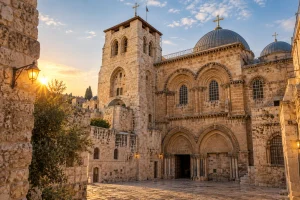
These can be located. The Church of the Holy Sepulchre, built over the site Christians in the second century identified as Golgotha and the tomb, has been studied extensively by archaeologists. The current scholarly view is that the site fits the first-century topography: outside the city walls at the time of Jesus, used as a burial ground, consistent with the Gospel accounts.
This matters because the gospel does not ask for faith in a concept. It reports events. Events leave traces. The place is part of the evidence.
What Is the Gospel of Jesus Christ?
The gospel of Jesus Christ is the same gospel: Christ died for sin, was buried, and rose from the dead. The phrase “of Jesus Christ” names both who the message is about and through whom it comes.
Paul writes in Romans 1:16: “I am not ashamed of the gospel, for it is the power of God for salvation to everyone who believes, to the Jew first and also to the Greek.” The gospel of Jesus Christ is not for one people group. Paul makes this explicit: it is for Jews and Gentiles, which means everyone.
What Does the Gospel Require from Us?
The gospel requires repentance and faith. These are not two separate steps. They are two aspects of the same response.
Repentance is not remorse about particular mistakes. It is turning away from the assumption that God can be ignored or pushed to the margins. When people at Pentecost heard Peter preach the resurrection and asked what to do, Peter said: “Repent and be baptized every one of you in the name of Jesus Christ for the forgiveness of your sins” (Acts 2:38).
Faith is trusting Christ for your standing before God. Not relying on your own record, your effort, or your religious activity. Romans 4:5 describes how God counts a person righteous: he credits it “to the one who does not work but believes in him who justifies the ungodly.” God justifies the ungodly. The gospel is not for people who have cleaned up their lives. It is for people who have not.
Romans 10:9 is direct: “If you confess with your mouth that Jesus is Lord and believe in your heart that God raised him from the dead, you will be saved.” The resurrection appears here specifically. This is not about believing in God in a general sense, or admiring Jesus as a teacher. It is trusting the risen Christ.
What Is the Difference Between the Gospel and Christianity?
The gospel is the news at the core of Christianity: Christ died for sin and rose from the dead. Christianity is everything that grows from responding to that news – worship, community, ethics, mission, doctrine, and practice.
The gospel is what the whole thing stands on. Paul called it “of first importance” (1 Corinthians 15:3). A church that preserves the traditions but loses the gospel has kept the shell and lost what was inside it.
The Gospel and the Whole Story of Scripture
Paul says the death and resurrection happened “according to the Scriptures” – twice, once for each event. He is not adding a footnote. He is saying neither event makes sense apart from everything the Old Testament had been building toward.
God told Abraham in Genesis 12:3 that through him “all the families of the earth shall be blessed.” Paul identifies this directly in Galatians 3:8 as the gospel announced in advance. The sacrifices in Israel’s temple courts repeated the same logic for fifteen centuries: a substitute dies so others can live. The prophets described a coming servant who would bear the penalty of the people. All of it pointed to the same place.
After the resurrection, Jesus walked with two disciples on the road to Emmaus and worked through Moses and the prophets, showing what the Scriptures had been saying about him all along (Luke 24:27). The gospel did not interrupt the biblical story. It was the ending the story was always moving toward.
Why the Gospel Is News and Not Teaching
A teaching is something you apply. You can follow it or ignore it. News is different. It reports something that already happened. You can believe it or disbelieve it, but the event does not wait for your opinion.
The gospel reports a death, a burial, and a resurrection. It does not ask you to adopt a worldview or try a new approach to living. It reports what God did in Jerusalem, at identifiable locations, in front of witnesses, and it asks whether you believe it.
Paul was direct about what is at stake: “If Christ has not been raised, your faith is futile and you are still in your sins… If in Christ we have hope in this life only, we are of all people most to be pitied” (1 Corinthians 15:17, 19). The gospel is either true or it is nothing. There is no middle position that leaves it standing as a useful framework while setting aside the resurrection.
The gospel is good news because the problem it addresses – sin, guilt, death, separation from God – has already been dealt with. The work is done. What remains is whether a person receives it.

Frequently Asked Questions
What is the gospel in simple terms?
Christ died for sin, was buried, and rose from the dead. Anyone who turns from sin and trusts in him can be forgiven and know God. That is the gospel.
What does the word “gospel” mean?
It comes from the Greek euangelion, meaning “good news.” In the ancient world the word was used for a royal proclamation of victory. The gospel is the announcement that Christ defeated sin and death.
Where is the gospel summarized in the Bible?
The clearest summary is 1 Corinthians 15:3–4. Romans 1:16–17 and John 3:16 also state it plainly.
Why is the resurrection important to the gospel?
Without the resurrection, Christ’s death proves nothing. The resurrection showed the sacrifice was accepted, confirmed who Jesus is, and guarantees the future resurrection of everyone who trusts in him. Paul says plainly in 1 Corinthians 15:17 that if Christ was not raised, faith in him is empty.
What is the difference between the gospel and the four Gospels?
The four Gospels – Matthew, Mark, Luke, and John – are the New Testament books that record the life, death, and resurrection of Jesus. The gospel is the message those books carry. The books are named after the news they contain.
What is the gospel of Jesus Christ?
The gospel of Jesus Christ is the announcement that Jesus, God’s Son, died for sin and rose from the dead, and that salvation is available through him to anyone who repents and believes.
What does it mean to spread the gospel?
It means telling people what happened: that Christ died for sin and rose from the dead, and that this is available to them. Christians call this evangelism. Jesus gave this task to his followers in Matthew 28:19–20.
Is the gospel only for Christians?
No. Romans 1:16 describes it as “the power of God for salvation to everyone who believes, to the Jew first and also to the Greek.” The gospel carries no ethnic or national restriction.