The famous list of “5 Assurances of Salvation” that gets passed around Christian discipleship groups isn’t in the Bible as a list, and it isn’t a piece of ancient church tradition either. It comes from a specific 1930s American ministry called the Navigators, founded in 1933 by a young California lumberyard worker named Dawson Trotman, who started teaching the foundations of Christian growth to United States Navy sailors on the USS West Virginia and eventually built one of the most influential discipleship movements of the twentieth century. The list was published in a booklet called Lessons on Assurance that has since sold more than two million copies as part of the Navigators’ Growing in Christ series, and if you’ve ever been walked through the “five fingers” chart in a Bible study, that’s where it came from.
Knowing where the framework came from doesn’t make it less true. It just helps you read it for what it is, a discipleship tool that packages a real biblical teaching into something a new believer can actually hold in their mind. The five promises the Navigators pulled out are all in Scripture, and each one is anchored to a specific verse. Before any of these five assurances can mean anything, you have to already believe the gospel they’re built on.
But there’s a deeper answer to the question of assurance that the list itself points toward without saying, and it’s what the rest of this article is about.
Quick Reference Table
| Question | Answer |
|---|---|
| Where does the “5 Assurances” framework come from? | The Navigators’ Lessons on Assurance booklet, part of the Growing in Christ series. The Navigators is a Christian discipleship ministry founded in 1933 by Dawson Trotman and now based in Colorado Springs, Colorado, serving in more than 120 countries. |
| What are the five? | Assurance of Salvation (1 John 5:11-12), Answered Prayer (John 16:24), Victory over sin (1 Corinthians 10:13), Forgiveness (1 John 1:9), and Guidance (Proverbs 3:5-6). |
| Which book of the Bible was written specifically to give believers assurance? | 1 John. The letter states its own purpose in 5:13: “I write these things to you who believe… that you may know that you have eternal life.” |
| What are the classic “three tests of life” from 1 John? | The doctrinal test (believing Jesus is the Christ), the moral test (walking in obedience), and the love test (love for other believers). The framework was named by Scottish minister Robert Law in his 1909 book The Tests of Life. |
| What one historical event is the foundation of assurance? | The resurrection of Jesus. Paul writes in 1 Corinthians 15:17, “If Christ has not been raised, your faith is futile and you are still in your sins.” |
| Do all Christian traditions agree salvation cannot be lost? | No. Reformed and Baptist traditions generally teach eternal security. Catholic, Orthodox, and Wesleyan traditions teach that grace can be forfeited through persistent unbelief or grave sin. Both sides claim strong scriptural support. |

What the Bible actually means by “assurance”
The English word “assurance” usually means feeling certain about something, but the New Testament word behind it is doing more than that. The Greek word is plerophoria, and it literally means “full-bearing,” the way a ship carries a full sail. It shows up in Hebrews 10:22 as “full assurance of faith,” in Colossians 2:2 as “full assurance of understanding,” and in Hebrews 6:11 as “full assurance of hope.” In every case, it’s the image of being fully carried by something bigger than yourself, not the image of achieving a mental state of certainty by trying harder.
That’s important because a lot of Christians treat assurance as something they have to generate, and then blame themselves when they can’t produce enough of it. Scripture treats it as something you receive, the way a sail receives wind. Your job is to face into it. The wind does the carrying.
The letter of 1 John was written to give you exactly this
Most of the New Testament wasn’t written primarily about assurance. 1 John was. The apostle, writing late in life to churches he had cared for over decades, states his purpose in almost so many words:
“I write these things to you who believe in the name of the Son of God, so that you may know that you have eternal life.” — 1 John 5:13
The Greek verb he uses for “know” is eidete, a form of oida, which carries the sense of settled knowledge, not guesswork. John isn’t asking his readers to hope. He’s telling them the letter they’re holding was written so that they can know. That’s the entire point of the letter.
If you read 1 John looking for this, you’ll notice it running through the whole thing. Chapter 2: “By this we know that we have come to know him, if we keep his commandments.” Chapter 3: “We know that we have passed out of death into life, because we love the brothers.” Chapter 4: “By this we know that we abide in him and he in us, because he has given us of his Spirit.” Chapter 5, near the end: “Whoever has the Son has life; whoever does not have the Son of God does not have life.”
If you’re looking for the one place in Scripture that most directly speaks to the question “how do I know I’m saved,” 1 John is the answer, and the answer runs through five chapters, not a single verse.
The Navigators’ 5 Assurances, one by one
The five promises the Navigators pulled out of Scripture, in the order they usually appear in the study, are these.
Assurance of Salvation — 1 John 5:11-12. “God has given us eternal life, and this life is in his Son. Whoever has the Son has life.” This is the anchor of the whole framework, and it’s meant to be memorized so that a believer facing doubt at 2 a.m. has a specific sentence they can recall.
Assurance of Answered Prayer — John 16:24. “Ask, and you will receive, that your joy may be full.” A believer who isn’t sure they can approach God at all has a promise here that the door is open.
Assurance of Victory over Sin — 1 Corinthians 10:13. “God is faithful, and he will not let you be tempted beyond your ability, but with the temptation he will also provide the way of escape.” Notice the promise isn’t that a believer won’t be tempted. It’s that God will provide a way through.
Assurance of Forgiveness — 1 John 1:9. “If we confess our sins, he is faithful and just to forgive us our sins and to cleanse us from all unrighteousness.” The condition here is honesty, not performance.
Assurance of Guidance — Proverbs 3:5-6. “Trust in the LORD with all your heart, and do not lean on your own understanding. In all your ways acknowledge him, and he will make straight your paths.” The Proverbs verse frames guidance as the fruit of trust rather than the reward of accuracy, which matters when a believer feels like they’ve chosen wrong.
The five are meant to be held together, not one at a time. A believer who has all five in memory has scriptural answers for the specific doubts that show up most often in the early years of following Christ: Am I saved? Does God hear me? Am I strong enough to resist? Am I forgiven for what I did? Am I going the right way?
The three tests of life: 1 John’s own answer
There’s a classical framework inside 1 John itself that most articles on assurance skip over, and it’s worth knowing because it’s older than the Navigators list and more comprehensive. A Scottish minister named Robert Law wrote a book in 1909 called The Tests of Life that named the pattern, and careful readers of the letter have used the framework ever since.
The doctrinal test asks what you believe about Jesus. 1 John 5:1: “Everyone who believes that Jesus is the Christ has been born of God.” Believing Jesus is the promised Messiah, the Son of God sent by the Father, is the first test. This isn’t a test of theological expertise. It’s a test of trust.
The moral test asks how you live. 1 John 2:3-6 says we know we know him if we keep his commandments, and that whoever claims to know him but doesn’t keep them is a liar. John isn’t asking for perfection. He is asking whether the direction of your life has turned.
The love test asks who you love. 1 John 3:14: “We know that we have passed out of death into life, because we love the brothers.” 1 John 4:7 pushes it further: love comes from God, and everyone who loves has been born of God. This is the test John comes back to most often, and it’s the one that’s hardest to fake.
The three tests are meant to be read together. Any one of them alone can go wrong: doctrine without transformation is intellectual assent, obedience without love is moralism, love without truth is sentimentality. All three together are what John is looking for, and if all three are quietly present in a life, that life is a saved life, whether the person can name the date it started or not.
Where assurance actually lands: the empty tomb
If you follow the chain of assurance back through any of these frameworks, you eventually hit the same historical event. Paul is blunt about it in 1 Corinthians 15:17: “If Christ has not been raised, your faith is futile, and you are still in your sins.” That claim holds only if Good Friday was more than a somber memorial, which is exactly what makes the day worth understanding on its own terms. Every promise in the Navigators list, every test in 1 John, every reassurance in any pastoral letter of the New Testament, is built on the assumption that the tomb was empty on Sunday morning.
That isn’t a metaphor. It happened at a specific location outside the walls of first-century Jerusalem, a rocky outcrop with a garden and a set of tombs cut into the stone. Christians in the first three centuries kept the memory of the site. When Constantine’s mother Helena came to Jerusalem in AD 326, she found the memory still intact, and the Church of the Holy Sepulchre was built over the spot, where it still stands. The small structure inside the church covering the tomb itself is called the Aedicule, and Christians have been standing at its door for roughly seventeen hundred years.
None of that proves the resurrection historically the way a courtroom would. But it means that when you say the words “assurance of salvation,” you’re not talking about an idea floating in the air. You’re talking about something with a specific address, and a very long line of witnesses who’ve stood at that address across two millennia.
The Catholic-Protestant question, fairly stated
Most modern articles on this topic assume a Protestant framework where salvation, once truly received, cannot be lost. Reformed and Baptist traditions in particular teach what’s called “eternal security” or “perseverance of the saints,” rooted in verses like John 10:28-29 (“no one will snatch them out of my hand”) and Romans 8:38-39 (“nothing… will be able to separate us from the love of God”). If you were raised in that world, or in most modern American evangelical settings, that’s the answer you were taught.
But it isn’t the only Christian answer. The Catholic and Orthodox traditions, and the Wesleyan and Arminian traditions within Protestantism, teach that grace can be forfeited through persistent unbelief or grave sin, and that assurance is real but conditional on continuing in the faith. The Council of Trent stated this explicitly for Catholics. John Wesley preached it. Hundreds of millions of sincere Christians hold it today, and they point to passages like Hebrews 6:4-6 and 2 Peter 2:20-22 as reasons.
The reason to name this isn’t to argue for one side. It’s to point out that “assurance of salvation” is a serious topic that different parts of the church have thought about carefully for two thousand years, in different ways, and a believer wrestling with doubt is in very good company, on either side of the divide.
The common ground across all these traditions is worth stating. Assurance rests on Christ, not on you. Whether your tradition frames that as unbreakable security or as continued dependence on grace, the direction of the promise is the same. The whole church looks toward the same tomb.
When you don’t feel any of this
There are seasons in almost every believer’s life when none of the frameworks above land, when the tests come up gray and the sail hangs slack. This is normal, and it isn’t a failure of faith. It’s how faith actually feels sometimes.
The Psalms are full of it. Psalm 42 speaks of a soul cast down, longing for God. Psalm 88 doesn’t resolve. Even the best Christian writers, from Augustine to John of the Cross to modern figures like Mother Teresa, have described long seasons of what the tradition calls the dark night, when God’s presence is felt as absence. None of them concluded from the absence that they were lost. They concluded that assurance is not the same as emotion, and that the promises hold even when the feelings don’t.
If that’s where you are right now, the practice worth learning is small and repetitive: keep showing up. Read 1 John slowly, one chapter at a time. Say a short prayer even when you don’t feel like it. Mark 9:24 will lend you the words when you can’t find any of your own: “I believe; help my unbelief.” Stay near other believers who can carry you until you can carry yourself. Assurance usually comes back the same way it came the first time, quietly, and often through someone else’s faith reflected back at you.
A Holy Land connection worth thinking about
The center of Christian assurance is a piece of ground. The garden tomb, the Aedicule inside the Church of the Holy Sepulchre in Jerusalem, is the physical location that the earliest church identified as the place of the resurrection, and the site Christians have gathered at continuously since Constantine’s mother built a basilica over it in AD 326. The custody of the church itself has been shared between six Christian denominations for close to a thousand years, and the keys of the door have been held for over eight hundred years by two Muslim families, the Joudeh and the Nuseibeh, in a small daily miracle of interfaith trust that opens Christianity’s most sacred site each morning.
Objects tied to that place, a key shaped like the one that opens the church at dawn, or a small stone from the hills around Bethlehem, aren’t the source of anyone’s assurance. That source is Christ himself, raised on the third day. But holding a small physical piece of the ground where the tomb was found empty is a way of remembering that assurance has a location, and that the promise you’re trusting isn’t abstract. Someone walked into that tomb on Friday. Someone walked out on Sunday. Christians have been standing at the door of it, unbroken, for seventeen centuries.
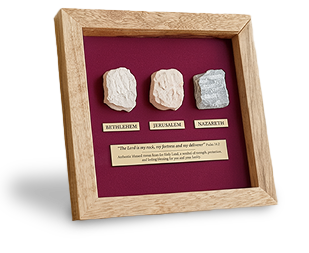
Objects don’t save. But they do remind. That’s a modest claim, and it’s true.
FAQs
What are the 5 Assurances of Salvation?
They are five promises the Navigators pulled together in the 1930s as a discipleship tool: Assurance of Salvation (1 John 5:11-12), Assurance of Answered Prayer (John 16:24), Assurance of Victory over Sin (1 Corinthians 10:13), Assurance of Forgiveness (1 John 1:9), and Assurance of Guidance (Proverbs 3:5-6). The framework is published in the Navigators’ Lessons on Assurance booklet, part of the Growing in Christ series, which has sold more than two million copies.
Can a Christian lose their salvation?
Christians disagree, and the answer depends on your tradition. Reformed and Baptist teaching says salvation, once genuinely received, cannot be lost, and points to John 10:28-29 and Romans 8:38-39. Catholic, Orthodox, and Wesleyan traditions teach that grace can be forfeited through persistent unbelief or grave sin, and point to passages like Hebrews 6:4-6 and 2 Peter 2:20-22. Both sides are trying to take Scripture seriously, and both sides have been part of the historic Christian church.
How do I know if I’m actually saved?
1 John gives three tests, in different words in different chapters. Do you believe Jesus is the Christ, sent from God (the doctrinal test). Do you show, imperfectly but really, obedience to his commands (the moral test). Do you love other believers, not as a performance but as something that has quietly turned inside you (the love test). None of the three alone is the whole answer. Held together, they’re what 1 John itself points to as the shape of a real Christian life.
What if I don’t remember when I was saved?
The Bible never asks anyone to point to a moment. Many sincere believers grew into their faith slowly, in Christian homes, and can’t name a date. Salvation is a matter of trust in Christ, not a matter of remembering the day trust started. 1 John’s three tests apply whether you were converted at eighteen or absorbed the faith over eighteen years.
Is it wrong to feel unsure?
No. Some of the deepest Christian spiritual writers, from Augustine to modern figures, describe long seasons where God feels absent. The tradition has a name for it, the dark night. Feelings of assurance come and go. What holds steady is what’s outside you: Christ risen from the tomb, the promises of Scripture, and the church that stands around you.
Does prayer help when I’m in doubt?
Yes, and Scripture is direct about it. James 1:5 says if any of you lacks wisdom, ask God, who gives generously without reproach. Mark 9:24 gives you the words when you can’t find them: “I believe; help my unbelief.” Both are addressed to God honestly. Prayer in doubt is still prayer, and it’s often the specific way assurance is restored.