Lord, we place [NAME] and this surgery in your hands. Steady the hands of the surgeons and the minds of everyone caring for [him/her]. Quiet the fear on all sides, in the room and out of it. Bring [NAME] safely through, and give strength for the recovery ahead. Amen.
Throughout this page, where you see [NAME] and [him/her], say the name of the person you are praying for.
The prayer above is short on purpose, so you can pray it now, from wherever you’re reading this, without scrolling anywhere first. What follows is organized by the moment you are actually standing in, from the night before, through the morning of, through the waiting room, and into the second week of a recovery that is taking longer than anyone promised it would.
Quick Reference
| Moment you are in | What to pray for | Verse to hold |
|---|---|---|
| Night before | Sleep, honest fear, family who cannot fix it | Philippians 4:6-7 |
| Morning of | The surgical team by name, a short prayer with the patient | |
| Waiting room | The wait, delays, the moment the surgeon walks in | Psalm 46:1 |
| First hours after | Pain, nausea, waking gently, knowing where you are | Jeremiah 17:14 |
| Recovery week 3 | Discouragement, peace not just speed, setbacks | Isaiah 41:10 |
| Hard news | Presence, borrowed words, the Kyrie | Psalm 22, Psalm 42 |
Prayers for the Night Before Surgery
The night before surgery is the hardest one, and almost nothing written about prayer will admit that. You are not in the hospital yet, so nobody is really taking care of you, and you are not asleep, because the mind will not turn off. If that is where you are right now, or if you are the one lying awake worrying about someone else, these are prayers to say quietly in the dark.
For sleep when the mind will not stop
“God, my mind will not stop and I am scared. I know that whatever tomorrow brings, you will be in it with me. I am not asking to feel brave. I am just asking you to hold what I cannot carry tonight, so I can sleep. Amen.”
For your own fear, when you are the patient
“Father, I am afraid. Not just of the surgery, but of what happens if it does not go the way we hope. Hold my body and my family both. Give me a peace that is not the same as pretending. Amen.”
For the family member who cannot fix any of this
“Lord, I want to fix this for [NAME] and I cannot. Let me be steady tomorrow, even when I do not feel it. Help me love [him/her] well in a room full of things I do not control. Amen.”
Paul writes in Philippians 4:6, “Be careful for nothing; but in every thing by prayer and supplication with thanksgiving let your requests be made known unto God” (KJV). The old word “careful” here means anxious, not careless. He is saying, in plain terms, do not carry the anxiety alone. Bring it in prayer, all of it, and let the peace of God stand guard over what your own mind cannot.
If you are planning to be with someone in pre-op the morning of, most US hospitals allow one visitor to stay until the patient is wheeled back, though policies vary and change often, so it is worth checking with the hospital in advance.
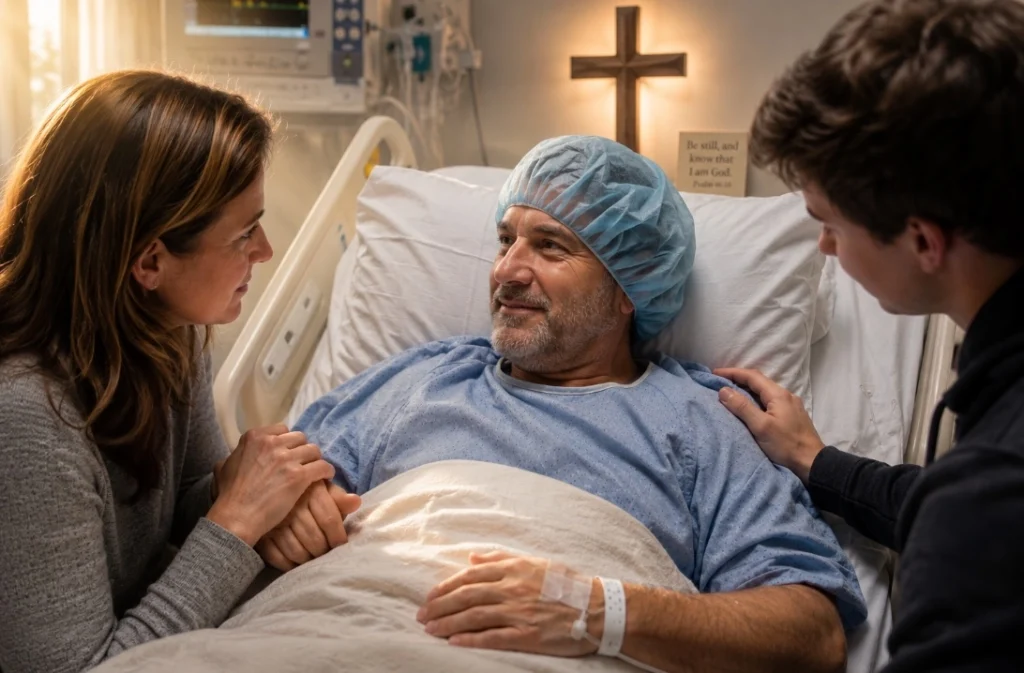
Prayers for the Morning of Surgery
Mornings before surgery move faster than you expect. There is a shower with a special soap, paperwork, a wristband, a lot of waiting for other people to do things, and less time to pray than you thought there would be, which is why the prayers for this moment need to be short enough to actually finish.
For the drive to the hospital
“God, we are on our way. Steady our hearts. Steady the drivers around us. Bring us safely to the hospital, and hold what happens after we get there. Amen.”
To say with the patient before they are wheeled back (under 40 words)
“Lord, be with [NAME] now. Give the surgical team clear minds and steady hands. Bring [him/her] back to us safely. Amen.”
For the surgical team, by name if you can
“Father, I pray for Dr. [SURNAME] and the anesthesiologist and every nurse in that room today. Guide their hands. Give them clear eyes and calm minds. Let them do their best work in the next few hours. Amen.”
For Catholic readers, the Church actually encourages Anointing of the Sick before serious surgery, and it is not reserved for the dying. The Catechism says it plainly in paragraph 1515: “It is fitting to receive this sacrament just prior to a serious operation.” The sacrament was formerly called Extreme Unction, and it is still sometimes confused with Last Rites, which is actually a set of three sacraments together (Penance, Anointing, and Viaticum), described in CCC 1524 to 1525. If Anointing feels right, ask the hospital chaplain or call your parish before you leave for the hospital. Sts. Cosmas and Damian, the twin physicians of the early Church, are the traditional patrons of surgeons, and their names are worth carrying quietly into the room with you.
Prayers for the Waiting Room
Nobody writes about the waiting room, which is strange, because it is often the longest and loneliest part of the whole day. You are not in the surgery, so there is nothing to do, and you are not at home, so there is no way to rest. The lights are too bright, the coffee is terrible, and every time a door opens your heart jumps.
For the wait itself
“Lord, the clock has almost stopped moving and I do not know what is happening in there. Stay with [NAME]. Stay with me too. Hold this room. Amen.”
For when it runs longer than they said
“Father, they said an hour and it has been three. I do not know what the delay means. Whatever it is, be inside it. Keep steady hands on [NAME] and steady hearts on the family sitting in this room. Amen.”
For the moment the surgeon walks in
“God, whatever comes out of the next few sentences, be here. Give me ears to hear it and a heart to hold it. Amen.”
Psalm 46:1 is written for exactly this kind of room: “God is our refuge and strength, a very present help in trouble” (KJV). Not a distant help. A present one, meaning here, in the chair you are actually sitting in, in the hour that is not ending.
What to Say to Someone Before Surgery (Instead of “Good Luck”)
If you have been trying to think of the right thing to text someone before their surgery, and “good luck” keeps coming out wrong, that is because it is wrong for this moment. “Good luck” frames a surgeon’s skill as chance, and it invites the patient to think about the odds, which is exactly what they have spent the last week trying not to do. These are the lines that actually help.
What to say instead
• “I will be right here when you wake up.”
• “You are in good hands. I will be praying the whole time.”
• “You do not have to be brave with me.”
• “I am not going anywhere.”
• “Text me when you can. No rush.”
• “I love you. That is all I came to say.”
• “I will be thinking of you every minute.”
Any of those can be sent as a text, said in person, or written in a card that gets tucked into a bag. They all do the same thing, which is tell the person they are not alone.
What not to say
• Do not share survival statistics, even reassuring ones. The person has already looked them up, and even a 98% number leaves a 2% they do not want to think about.
• Do not tell them about someone else’s surgery, especially one that went well, since it sounds like comparison, and never mention one that did not go well.
• Do not say “everything happens for a reason.” At a hospital bedside, that line closes the door on grief instead of sitting with it.
• Do not quiz them on their emotions. “How are you feeling” is fine. “You must be terrified” is not.
If they are not religious
Do not fake it, and do not skip the message. “I will be thinking of you” carries the same weight as “I will be praying for you” when it is true. What matters is that a real person is holding this moment for them from the outside, and that they hear it in words that sound like you. Presence is what people remember, and whether you framed it as prayer or as thought is much less important than whether you actually showed up.
How to Pray With Someone Before Surgery
Praying out loud with someone before their surgery is one of the kindest things you can do, and one of the easiest things to do badly. The failure mode is a long prayer performed at a frightened person, which almost always feels worse than saying nothing. A few small guidelines make it much simpler.
Ask first. “Would it be alright if I prayed with you” is a real question, and they need a real option to say no. Some people, even devout ones, do not want to be prayed over out loud when they are scared. Take a no gracefully and mean it.
Keep it under thirty seconds. They are tired, medicated, and about to go somewhere. A short honest prayer is worth more than an eloquent one. If you would feel embarrassed by how brief it is, you are probably about right.
Pray about what they actually told you. If they said they are scared of the anesthesia, pray about the anesthesia. If they said they are worried about their kids, pray about their kids. Do not pray about a generic surgery. Pray about theirs.
Silent is fine too. If they do not want you to speak but you want to pray, do it silently and do not announce it. Sitting there quietly, holding a hand, counts as prayer for most Christians, and even as company for those who do not share the faith.
If they say no, or if they are not religious, “Can I just sit with you” is a complete offer. Presence without commentary is one of the most Christian things you can bring into a hospital room, whether the person receiving it shares your faith or not.
Chaplains. Most US hospitals offer chaplain visits, though historically only around 54 to 64% of hospitals employ chaplains directly, so it is worth asking your pre-op nurse. Chaplains serve patients of any faith or none, and they will come whether or not the patient is Christian.
Prayers for Recovery After Surgery
Recovery starts in the first strange hour after the anesthesia wears off, when you are not sure where you are and everything hurts in a distant, chemical way. The prayers for this part are quiet ones, meant for a body that has just been through something and a mind that is not fully back yet.
For the first hours after
“Lord, ease the pain. Settle the nausea. Help [NAME] wake up gently and know [he/she] is safe. Amen.”
For the first week home
“Father, thank you for bringing [NAME] out of surgery. Now give patience for a body that heals slowly, and honesty to say when the pain is bad. Give the people caring for [him/her] rest, and remind us all that healing is not a race. Amen.”
For the caregiver, who is tired and not allowed to say so (see also our prayers for a loved one going through illness)
“God, I am tired. I am not supposed to say that, but you know it anyway. Give me strength for one more day of this. Give me kindness in the small hours. Give me space to be a person, not just a caregiver. Amen.”
Jeremiah 17:14 has been prayed over sickbeds for thousands of years and it still fits: “Heal me, O LORD, and I shall be healed; save me, and I shall be saved: for thou art my praise” (KJV). It is a plea and a confession at once, admitting we cannot heal ourselves and asking the one who can. Isaiah 41:10 is the other verse most people reach for in recovery: “Fear thou not; for I am with thee: be not dismayed; for I am thy God” (KJV). Both belong in a bedside notebook.
When Recovery Is Slower Than You Expected
Around week three, the flowers are gone, the visitors have stopped coming, and everyone assumes you are fine, which is often the loneliest part of surgery. Nobody talks about this part either. This section is for the person who thought they would be back to normal by now and is not.
For discouragement
“Lord, this is taking longer than anyone said it would. I feel like I am failing at getting better. Remind me that healing is your work, not mine, and that slow is not the same as wrong. Amen.”
For the day you cannot tell if you are improving
“Father, I do not know if today is better than yesterday. I cannot tell anymore. Give me eyes to see the small progress I am missing, and patience for the parts that have not come back yet. Amen.”
For a setback, complication, or a readmission
“God, we thought we were past this and we are not. Something new has come up and I am scared. Give the doctors clarity, give me courage, and give this body strength for one more round. Amen.”
Here is the thing this whole cluster of prayers keeps pointing at without saying directly. Sometimes healing is slow. Sometimes it is partial. Sometimes it does not come in the shape we asked for. Which is why it is worth praying for peace as often as for healing, and not treating peace as the consolation prize when healing runs late. Peace is answered in surgery rooms and recovery weeks more often than we notice, because we are usually asking for something else. It is the answered prayer we forget to count. Isaiah 41:10 does not promise you will not need to be strengthened. It promises you will not be alone when you are.
When the News Is Bad
If you are here because the news was not what you hoped for, the first thing to know is that you do not have to have any words right now. This section will not try to fix that, and it will not tie itself up at the end.
For the moment the surgeon says something you were not ready to hear
“Lord, I do not know what to do with what I just heard. I do not know how to hold it. Be here. Amen.”
For a family sitting in a corridor (our collection of powerful family prayers for healing may also help in this moment)
“God, we are a family that just changed shape, and we do not know what to say to each other. Sit with us in this hallway. Keep our love steady, even when we cannot find words. Amen.”
For when you cannot find any words at all
“Lord, have mercy. Christ, have mercy. Lord, have mercy.”
If your own words will not come, you can borrow the words of people who have been in this place before. The Psalms are full of them, especially Psalm 22 and Psalm 42. The Lord’s Prayer works too, if you can get through it. So does the older prayer above, called the Kyrie, which is just three lines and asks for exactly what it says. This is a moment for presence, not answers, so if someone you love has just heard hard news, sit with them. Do not try to explain. Do not offer a reason. Nothing you can say will do what your quiet presence does.
Bible Verses for Surgery and Healing
These are the verses people return to before and after surgery. Every wording below is King James, since older translations can be reproduced in full without licensing concerns, and their language is what most people know from a hospital bedside anyway.
| Reference | Verse (KJV) | Why it fits |
|---|---|---|
| Psalm 46:1 | “God is our refuge and strength, a very present help in trouble.” | For the waiting room, when the trouble is right now |
| Isaiah 41:10 | “Fear thou not; for I am with thee: be not dismayed; for I am thy God: I will strengthen thee; yea, I will help thee; yea, I will uphold thee with the right hand of my righteousness.” | For the fear that comes at 3am and the fear that comes at week three |
| Philippians 4:6-7 | “Be careful for nothing; but in every thing by prayer and supplication with thanksgiving let your requests be made known unto God. And the peace of God, which passeth all understanding, shall keep your hearts and minds through Christ Jesus.” | For the night before. “Careful” here means anxious, not careless |
| Jeremiah 17:14 | “Heal me, O LORD, and I shall be healed; save me, and I shall be saved: for thou art my praise.” | The healing prayer people have prayed the longest |
| Exodus 15:26 | “…for I am the LORD that healeth thee.” | The name of God as healer |
| James 5:14-15 | “Is any sick among you? let him call for the elders of the church; and let them pray over him, anointing him with oil in the name of the Lord.” | The scriptural basis for anointing the sick, still practiced |
| Psalm 91:1 | “He that dwelleth in the secret place of the most High shall abide under the shadow of the Almighty.” | The psalm most commonly prayed before surgery, though none is officially designated |
For a wider collection of scripture and prayers organized by season of the body, from acute illness through chronic conditions to recovery, see our companion piece on prayers for health and healing. In Jewish practice, the traditional prayer for the sick is not a psalm but the Mi Shebeirach, a communal blessing dating to at least the 11th century, still recited in synagogues today when a member of the community is ill. No Christian article about surgery seems to mention it, but it is one of the oldest continuous traditions of prayer for the sick in the world.
Carrying Something From the Holy Land Into the Room
Christian faith does not require an object to reach God. Scripture is enough. A prayer said quietly from a hospital bed is heard as clearly as a prayer said in a cathedral. So nothing in this next paragraph is a requirement, and nobody who prays without it prays any less than someone who prays with it.
But a lot of Christians, especially in a moment like surgery, find it steadying to hold something physical that carries a story with it. James 5:14 tells the elders of the church to pray over the sick “anointing him with oil in the name of the Lord,” and the tradition of using something from the ground Jesus walked on, a small stone from Bethlehem, oil from the olive groves that surround the Church of the Nativity, water from the Jordan, has never really left Christian practice. It shows up in the pockets of pilgrims coming home. It shows up in hospital rooms. It shows up quietly on bedside tables through long recovery weeks.
If you are carrying something from the Holy Land into a hospital room, for yourself or for someone you love, you are not carrying magic and you are not carrying protection. What you are carrying is a physical reminder that the same God who walked those hills is present in this hospital room too, and that the living Christian community who has held those places for two thousand years is holding this moment with you. That is a small thing. But small things are what surgery is made of.
Frequently Asked Questions
How do you pray for someone before surgery?
Pray briefly, honestly, and about what they actually told you. Ask permission first, keep it under thirty seconds, and pray about their specific fear (the anesthesia, their kids, the surgeon), not surgery in general. If they say no or are not religious, presence without commentary is its own kind of prayer.
What is a powerful prayer for surgery?
The effective prayer is not the elaborate one. It is the specific and honest one, said by someone who actually loves the person on the table. A short prayer that names the patient, names the surgeon, names the fear, and asks for peace does more than a long one that stays general.
What is the “miracle prayer”?
The prayer often called The Miracle Prayer was written by Fr. Peter Mary Rookey and is copyrighted 1993 by the Servite Fathers, O.S.M., so it is not reproduced here. It is also worth clearing up a common misreading, since it is not a prayer of immediate healing. It is a prayer of surrender and personal conversion. You can find the full text on the Servite Fathers’ own website.
What psalm is for successful surgery?
There is no psalm officially designated for surgery in either Christian or Jewish tradition. Psalm 91 is the one most people turn to, because of its language of protection and covering, especially the line “He shall give his angels charge over thee, to keep thee in all thy ways” (91:11 KJV).
What is a comforting Bible verse for someone having surgery?
Isaiah 41:10 (KJV): “Fear thou not; for I am with thee: be not dismayed; for I am thy God: I will strengthen thee; yea, I will help thee; yea, I will uphold thee with the right hand of my righteousness.”
What do you say to someone before surgery instead of “good luck”?
“I will be right here when you wake up,” or “I will be praying the whole time,” or simply “I love you.” “Good luck” reframes a surgeon’s skill as chance. The other lines remind the person they are not alone, which is what they actually need to hear.
Can Catholics receive Anointing of the Sick before surgery?
Yes. Catechism paragraph 1515 says it is fitting to receive the sacrament just before a serious operation, and it is not reserved for the dying. Ask the hospital chaplain or your parish. It used to be called Extreme Unction, and it is part of, but not identical to, Last Rites.
What if the person I am praying for is not religious?
Offer presence, not language they do not share. “I will be thinking of you” carries the same weight as “I will be praying for you” when it is honest, and sitting quietly with someone in a hospital room is a complete gift with no words attached.
Does prayer help surgery go better?
Many people turn to prayer before surgery, and hospitals increasingly recognize spiritual care as part of good treatment. What research does not show is that prayer changes surgical outcomes, since the largest trial of intercessory prayer, the STEP study published in 2006, found no difference between patients who were prayed for and those who were not. The evidence on whether prayer eases pre-operative anxiety is also genuinely mixed. That is not a reason not to pray. It is a reason to pray for peace and presence rather than treating prayer as a medical intervention.
One Final Prayer
Lord, we have come to the end of this page. Somewhere, someone is reading this before a surgery, or during one, or after news that changed everything. Meet them there. Bring [NAME] safely through what is ahead. Give steady hands to the people caring for [him/her]. Give peace to the people who love [him/her] and cannot fix any of it. And when the room finally quiets, be the presence that stays. Amen.
This page offers prayers and encouragement. It is not medical advice. Always follow the guidance of your surgeon and care team.