

You notice a cross with a ring around its centre on an old gravestone and realise you can't name it, or say what it means. The cross you see most often is the Latin Cross, a long upright crossed by a shorter bar near the top, and it is the most widely recognised Christian symbol in the world. The Greek Cross has four equal arms and appears throughout early church architecture and heraldry. The Celtic Cross adds a ring at the intersection and belongs to Ireland and the memory of St. Patrick. The Eastern Orthodox Cross carries three bars, the familiar two plus a short angled footrest, recalling the inscription board and the footrest at our Lord's Crucifixion. The Jerusalem Cross sets four small crosses around a large one, read as Christ's wounds or as the Gospel going out to the four corners of the earth. Some cross shapes aren't Christian at all. The Ankh is an ancient Egyptian sign of life, and the Sun Cross, a circle quartered by equal arms, is older than every major religion.
The surest way to tell one cross from another is to look at its structure, meaning the proportions of the arms, the number of bars, any circle, and the shape of the ends. Context matters just as much, because many crosses belong to a particular tradition, saint, or flag.
Key Takeaways
- Check arm proportions, the number of bars, any circle, and the shape of the ends first, since these identify most crosses reliably.
- When a cross has two bars, compare them: equal bars point to the Patriarchal Cross, a longer lower bar to Lorraine.
- An angled footrest below the main crossbar identifies the Eastern Orthodox Cross, which also carries a short inscription board above it.
- The Ankh and the Sun Cross predate Christianity entirely, so their shape alone tells you nothing about Christian belief.
- For a pendant or gift, a crucifix suits Catholic or Orthodox wearers, while a plain Latin Cross is recognised across most traditions.
The Most Widely Recognised Christian Crosses and What They Mean
Most crosses you'll see in a parish church, a jeweller's case, or a cemetery are one of these six.

- Latin Cross (crux immissa): The upright runs well below the crossbar, and this is the standard Christian cross, the shape most people picture when they think of the Crucifixion.
- Greek Cross: Four arms of equal length meet at the centre, and it was the dominant form in early Byzantine church architecture.
- Tau Cross (crux commissa): The crossbar sits on top of the upright like the letter T. St. Francis of Assisi adopted it as his personal sign, and Christians have long read it as prefigured in the Old Testament, such as the mark Ezekiel saw set on the foreheads of the faithful.
- Celtic Cross: A ring circles the point where the arms meet, and that ring is commonly read as eternity or as a halo of glory around Christ.
- Crucifix: A cross bearing the figure of our Lord, so that you look at his suffering and death and not only at the wood.
- Calvary Cross: A Latin Cross standing on three steps. The steps represent the hill of Calvary or, in another common reading, faith, hope and charity.
If a cross in front of you doesn't match any of these, count its bars and look closely at how its arms end.

Pilgrims have always wanted to leave something of themselves in these places. In one hall in Bethlehem, they still can.
The Hall of Faith · Bethlehem
A name on the wall, where Christianity was born
Within the Church of the Nativity complex, names are engraved on golden plaques, beside those of Pope Benedict XVI and Pope Francis.
Take partNo payment. 30 seconds.
How to Tell Apart Multi-Bar Crosses: Patriarchal, Orthodox, and Lorraine
Count the bars first, then compare their lengths and angles. Those details separate these three crosses.
| Cross | Bars | What to look for | Where you'll see it |
|---|---|---|---|
| Patriarchal Cross | Two | Both horizontal bars are the same length, set near the top of the upright | A sign of episcopal rank in Catholic heraldry and some Anglican heraldry |
| Eastern Orthodox Cross | Three | A short inscription board on top, the main crossbar below it, and a footrest set at an angle near the base | Orthodox churches and icons, recalling the inscription board and footrest at our Lord's Crucifixion |
| Cross of Lorraine | Two | The lower bar is longer than the upper bar and sits further down the upright | The arms of the Dukes of Lorraine, and later the emblem of Free France |
If the lowest bar slants, you're looking at an Orthodox Cross. If both bars are level, compare their lengths: equal bars mean the Patriarchal Cross, and a longer lower bar means Lorraine.
Heraldic Cross Types: Identifying Crosses on Flags, Coats of Arms, and Gravestones
Heraldry names a cross by the shape of its arms and the way it sits on the field, so a handful of terms covers most of what you'll see on shields, flags, and civic arms.
- Saltire: Also called crux decussata or St. Andrew's Cross, the saltire is an X shape, best known as the white diagonal cross on Scotland's blue flag and one of the crosses combined in the Union Jack.
- Cross pattée: Its arms are narrow at the centre and flare wide at the ends, the form linked to the Knights Templar and still used in modern military insignia.
- Cross fitchy: The lower arm tapers to a sharp point, as though the cross were made to be pushed into the ground.
- Cross botonnée: Each arm ends in a cluster of three rounded knobs, which gives the cross a clover look.
- Scandinavian Cross: A Latin Cross set off centre toward the flagpole on a field of colour. It is the defining design of the Nordic national flags.
When you meet an unfamiliar cross on a coat of arms, look first at the ends of the arms, then at its angle and where it sits on the field.
Non-Christian Cross Types: Origins and Meanings Outside Christianity
A few cross shapes come from outside the Church entirely, and one that's often taken for an anti-Christian sign actually belongs to St. Peter.
- Ankh: The Ankh is a cross with a loop in place of the upper arm, and in ancient Egypt it was the sign of life. It appears again and again in tomb art and in the hands of Egyptian deities, and it has no Christian origin.
- Sun Cross: Also called Odin's Cross or the solar wheel, the Sun Cross is a circle quartered by equal arms. It's a prehistoric symbol found all over Eurasia, older than every major world religion.
- Inverted cross: This one isn't outside Christianity at all. A Latin Cross turned upside down is St. Peter's Cross, which recalls the tradition that Peter asked to be crucified head downward as an act of humility. Historically it belongs to the apostle and has nothing diabolical about it.
A loop at the top points to Egypt, and a plain quartered circle points to prehistoric Eurasia, so neither shape tells you anything about the faith of whoever carved or wore it.
Which Cross Belongs to Which Tradition: A Denominational Guide
Where you saw the cross usually tells you more than its shape does, so start with the church or community it came from.
| Tradition | Cross you're likely to see | Why that tradition uses it |
|---|---|---|
| Catholic | The crucifix, showing our Lord's body, above the altar and in homes. The Papal Cross, with three horizontal bars, appears in papal heraldry. | The crucifix keeps the Passion in view, above all at Mass. The Papal Cross is reserved for the Pope and marks his authority. No one else uses it. |
| Eastern Orthodox | The Orthodox Cross with its slanted footrest, often bearing the figure of Christ. | Like Catholics, the Orthodox prefer to keep the Crucifixion before the eyes of those who pray. |
| Protestant | A plain Latin Cross with no figure, often called the empty cross. | The empty cross points to the Resurrection. Our Lord is no longer on it. |
| Coptic and Ethiopian Orthodox | The Coptic Cross and the Ethiopian Cross, both covered in interlaced or geometric ornament and used in the liturgy. | Each form grew up in its own region, and its ornament identifies it with the Church in Egypt or Ethiopia. |
| Anglican | A plain cross on the altar in many parishes, and a crucifix in high church parishes. | Anglican practice sits between Catholic and Protestant usage, so the choice often comes down to the parish. |
Three bars on a church wall rather than a coat of arms are more likely an Orthodox Cross. Its lowest bar slants, while the Papal Cross has three straight bars.
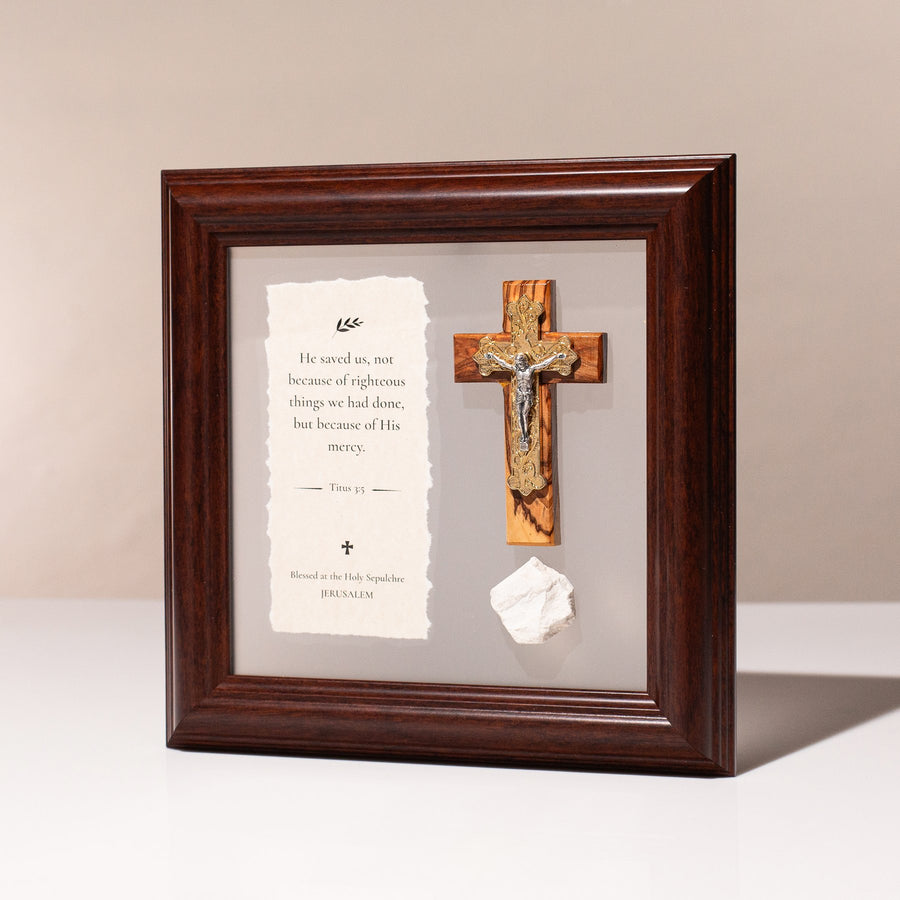
Featured piece
Holy Land Prayer Altar
A handcrafted altar from the Holy Land, bringing together Scripture, Holy Land olive wood, an olive wood crucifix and authentic Jerusalem stone.
Choosing a Cross for Jewelry or a Gift: Matching Design to Meaning
Start with the person who will wear it and what they would want the cross to say. If you or the person you're choosing for is Catholic or Orthodox and wants to keep the Passion close, a crucifix is the natural choice. The figure of our Lord on the cross keeps His physical sacrifice in view every time the wearer touches it in prayer. A plain Latin Cross suits a Protestant or non-denominational believer, and it's the right choice when you don't know the recipient's tradition well. Protestants, Catholics, and non-denominational Christians all recognise it. It makes no doctrinal claim beyond the cross itself.

Heritage can matter as much as denomination. The Celtic Cross fits a wearer with Irish, Scottish, or other Celtic roots, and it also suits someone drawn to the way its ring brings the Christian cross together with older visual traditions of those lands. The same reasoning applies to a tattoo, though a tattoo stays with the wearer far longer than a pendant does. Choose the design whose meaning the wearer would still be glad to explain years from now.
Carrying the Types of Crosses
Many Christians wear a cross so that our Lord's Passion stays close through the ordinary hours of the day, whichever of these shapes they were first taught to pray before. Our Gold Cross Pendant is made in 14K yellow gold and set with a Jerusalem stone, so the cross you wear carries a little of the Holy Land with it.
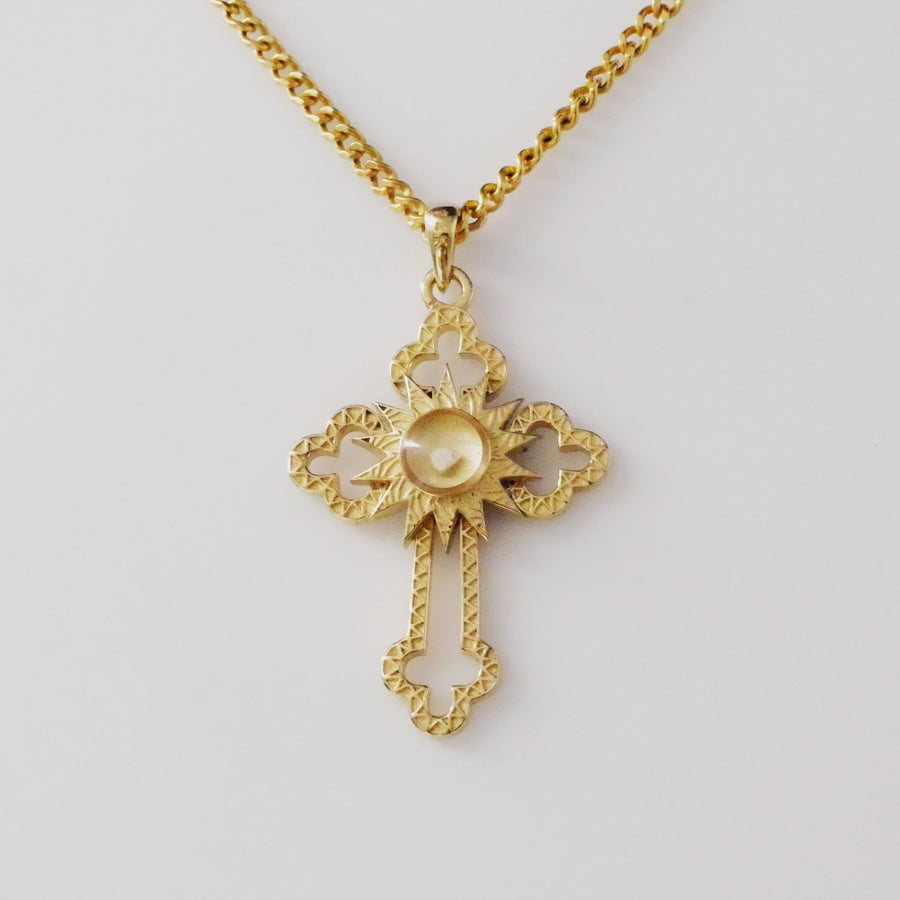
Featured piece
Gold Cross Pendant
A cross in 14K yellow gold, set with a piece of authentic Jerusalem stone.
$4,285View the Cross Pendant
Frequently Asked Questions
What cross appears on most national flags?
The Scandinavian or Nordic Cross. An off centre Latin cross on a coloured field. Appears on the flags of Denmark, Sweden, Norway, Finland, and Iceland. The Saltire (diagonal white cross on blue) appears on Scotland's flag and within the Union Jack.
Is the inverted cross a Satanic symbol?
No. The inverted cross is historically St. Peter's Cross. It is associated with Peter's request to be crucified upside down as an act of humility. It is not a diabolical symbol.
What is the difference between a cross and a crucifix?
The plain or empty cross emphasises the Resurrection and is the dominant Protestant form. The crucifix emphasises the Passion and Christ's physical sacrifice and is preferred in Catholic and Orthodox traditions.
What does the Chi Rho symbol have to do with the cross?
The Chi Rho is formed from the first two Greek letters of Christos (ΧΡ) superimposed, and was used as a Christian monogram before the Latin cross became the dominant symbol.
What is the Ash Wednesday cross and why is it marked on the forehead?
On Ash Wednesday, a priest or minister marks a cross of ash on a worshipper's forehead while saying "Remember that you are dust, and to dust you shall return". A liturgical act of penitence opening Lent, practiced across Catholic, Anglican, Lutheran, and some other Christian traditions.
What are different types of crosses and which are the most notable?
Notable Christian crosses include the Latin Cross, the most widely recognised Christian symbol. The four armed Greek Cross. The ringed Celtic Cross. The three bar Eastern Orthodox Cross. And the Jerusalem Cross.
A cross gives up its name only when you look at it closely. The next time one catches your eye, count its bars, check whether the lowest one slants, and study how the ends of the arms are shaped. Then notice where you found it, because a church wall, a coat of arms, and a flag each point to a different tradition. If you are choosing a cross to wear or give, start with the wearer's faith and heritage, and pick the design whose meaning they would gladly explain years from now.