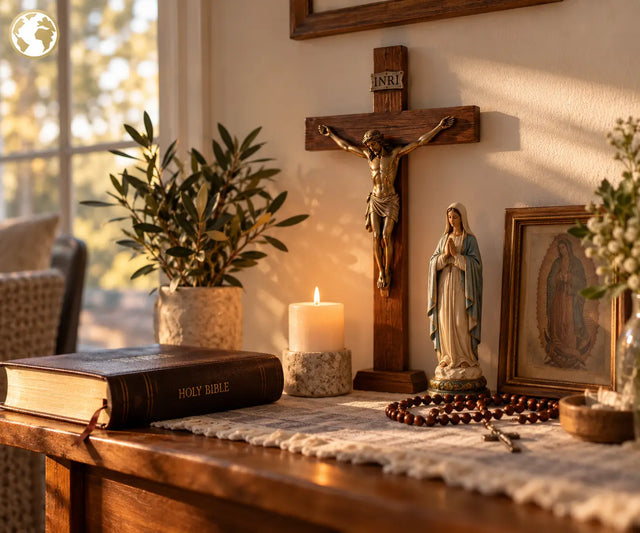
You've cleared a wall in the living room, or a corner of the bedroom you'd like to keep for prayer, and you're trying to decide what belongs there. Religious home decor covers several distinct kinds of piece, including crucifixes and crosses, sacred art prints and canvases, statues, holy water fonts, scripture wall art, rosary holders, door blessings, and candles, and choosing well means matching three things at once: what the piece is for, the room it will live in, and the style of that room. Each kind does a different job, so a crucifix gives a room its spiritual focal point, a holy water font sets a small daily blessing at the front door, and a scripture piece keeps one passage in front of you as you go about your day.
A modern room and a traditional one can both hold a crucifix, just not the same crucifix. The right piece sits naturally in the space and means something to the person who prays near it.
Key Takeaways
- A crucifix shows our Lord's body on the cross, while a bare cross does not, and the choice reflects theological emphasis.
- For a modern or minimalist room, look for neutral palettes and clean lines, such as Biblical narrative canvas or a simple cross.
- Warm or traditional rooms suit a carved walnut or oak crucifix, a Florentine plaque, or a framed sacred art print.
- Put a holy water font by the entryway, a crucifix on the living room wall, and a small icon by the bed.
- Match a milestone gift to the occasion, choosing a crucifix for a baptism or a Sacred Heart plaque for a wedding.
Crucifixes, Crosses, and Sacred Art: The Core Item Categories
Each of the main categories does a different job in prayer, so it helps to know what each one is for before you start comparing finishes and sizes.
- Crucifix: A crucifix shows our Lord's body on the cross, which keeps His Passion in view and usually makes it the spiritual focal point of the room.
- Cross: A bare cross carries the sign of the cross without the figure of Christ, and it often sits well on a smaller wall or in a hallway.
- Sacred art print or canvas: A print or canvas shows a scene from Scripture or a devotional image like the Sacred Heart, and it's made to hang on a wall where you'll see it every day.
- Statue: A statue gives you a figure of our Lord or a saint to set on a shelf, a table, or a home altar where you pray.
- Holy water font: A font hangs by the door so you can bless yourself with holy water each time you come and go.
Decide what you want the piece to do in your prayer first, and the right category usually follows.

Pilgrims have always wanted to leave something of themselves in these places. In one hall in Bethlehem, they still can.
The Hall of Faith · Bethlehem
A name on the wall, where Christianity was born
Within the Church of the Nativity complex, names are engraved on golden plaques, beside those of Pope Benedict XVI and Pope Francis.
Take partNo payment. 30 seconds.
Matching Religious Decor to Your Interior Style
When you're unsure, let the wood and wall colour decide. The wall colour, the wood, and the metal finishes will usually point you toward one kind of piece and away from another. That's a more reliable guide than choosing by subject alone.

| Interior style | What the room already has | Pieces that suit it |
|---|---|---|
| Modern minimalist | Neutral walls, clean lines, very little ornament | A Biblical narrative canvas in a neutral palette, or a simple cross with no added decoration |
| Rustic farmhouse | Painted or natural wood, linen, muted colour | A plain wooden cross, or scripture wall art on wood or canvas |
| Traditional ornate | Dark wood, rich colour, carved or gilded detail | A walnut or oak crucifix, or a Florentine plaque |
The neutral canvas works in a spare room because it shows a scene from Scripture without bringing strong colour into a space built on restraint. The walnut or oak crucifix and the Florentine plaque belong to an older, more decorative register, so they sit comfortably beside warm wood and deeper tones.
Start with what's already in the room, because a carved walnut crucifix on a stark white wall and a pale canvas against dark panelling will each look like they were borrowed from another house.
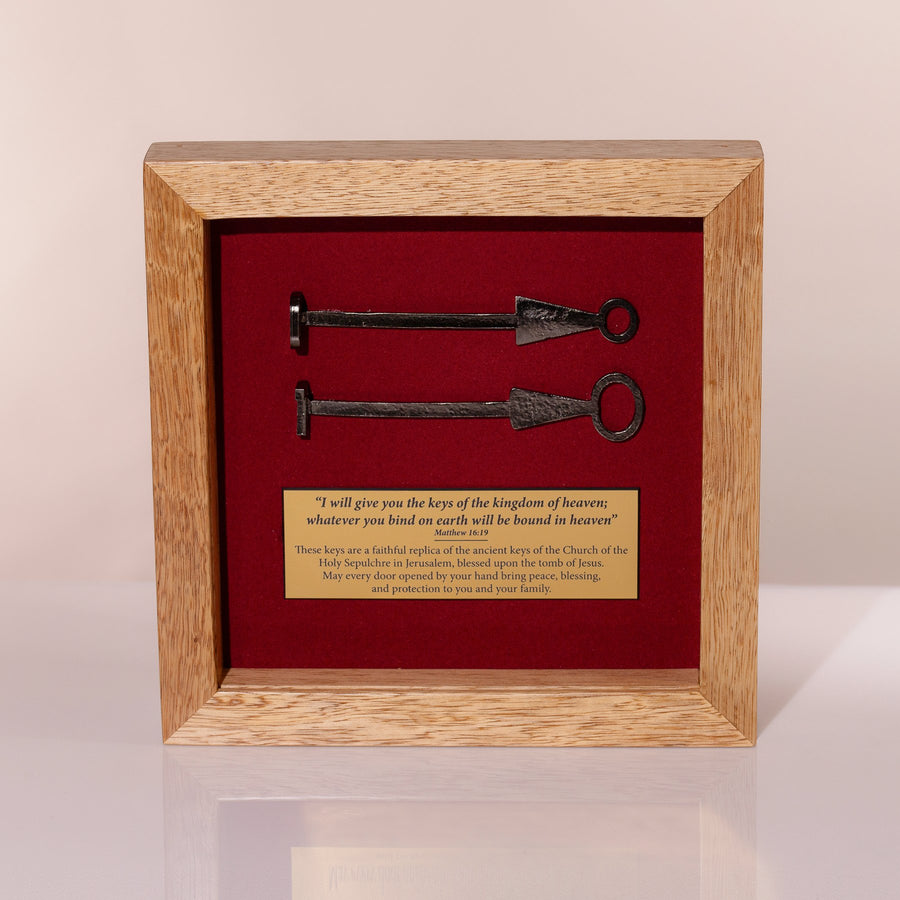
Featured piece
Holy Sepulchre Keys
A replica of the ancient Keys of the Holy Sepulchre. Rested upon the Tomb of Christ to receive its blessing.
Room by Room: Entryway, Living Room, and Bedroom
Each room asks for a different kind of piece, depending on what happens there and who is likely to see it.

- Entryway: A holy water font or a door blessing by the front door gives you a small ritual to keep each time you come and go.
- Living room: A crucifix or a large sacred art print works best as the one focal point on the main wall, where family and guests will see it.
- Bedroom: A small framed icon or scripture piece by the bed or on a nearby wall sits close enough for your first and last prayers of the day.
The more private the room, the smaller and more personal the piece can be.
Choosing Religious Decor as a Faith Milestone Gift
A baptism, a confirmation, and a wedding each mark a different moment in a life of faith, so each one suits a different kind of piece.
- Baptism: A saint statue or a small crucifix for the child's room is the usual choice, because the child grows up with it nearby long before they can name it.
- Confirmation: A personal devotional object such as a rosary holder, an icon, or a scripture piece fits the occasion, since the newly confirmed can keep it in their own space and pray with it on their own.
- Wedding: A household blessing piece, like a Sacred Heart plaque or a framed nuptial scripture, suits the couple well, because it belongs to the home they now share.
Whichever occasion you're buying for, a short handwritten note with the name and date of the sacrament gives the family something to remember the day by each time they see the piece.
Carrying the Religious Home Decor
Religious home decor for a prayer corner can be as simple as one piece that brings several of these elements together. Our Holy Land Prayer Altar is a small altar with Scripture on parchment, an olive wood crucifix and a Jerusalem stone in one frame, sized to sit quietly wherever you've chosen to pray.
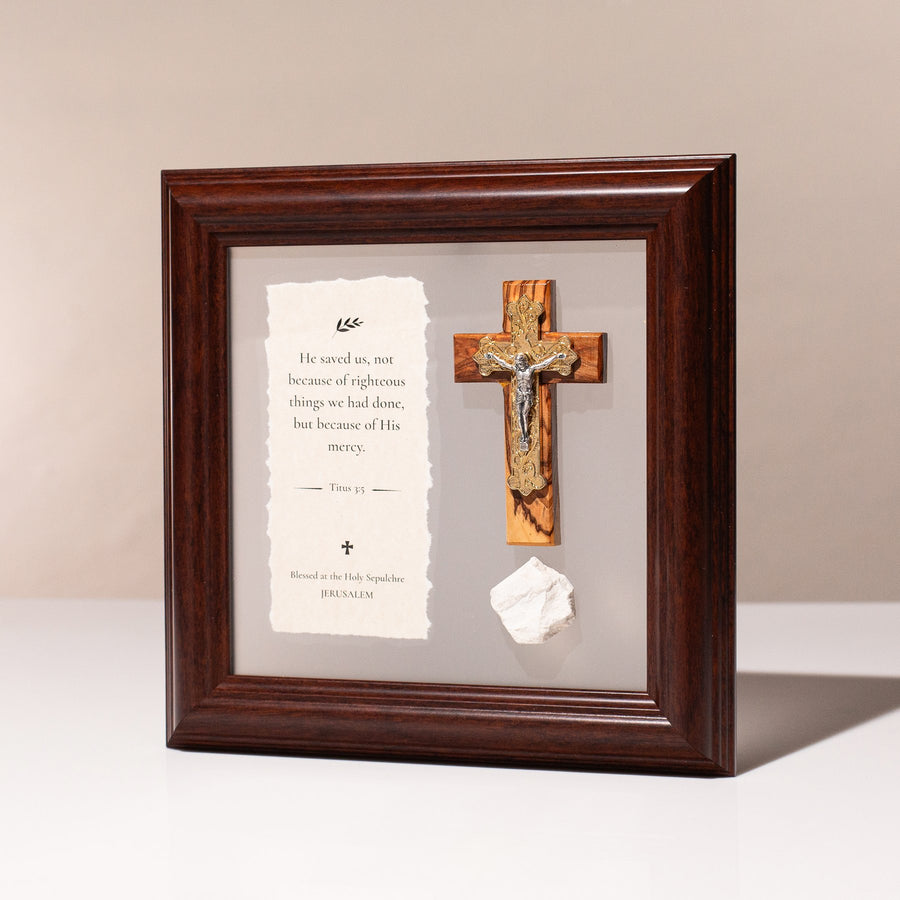
Featured piece
Holy Land Prayer Altar
A handcrafted altar from Bethlehem, bringing together Scripture, Holy Land olive wood, and authentic Jerusalem stone. A place in your home set apart for prayer, reflection, and the presence of God.
Frequently Asked Questions
What religious decor is most traditional for a Catholic home?
A crucifix, which depicts Christ's body on the cross, is the standard devotional form in Catholic homes.
Where can I buy Catholic or Christian home decor online?
Melior Mundus carries Christian home pieces made in the Holy Land, including the Holy Land Prayer Altar, the Holy Land Prayer Stone, the Holy Land Stone Trio and framed artifacts such as the Holy Sepulchre Keys. Each arrives with a Certificate of Authenticity. See the Home Altar collection.
How do I keep religious decor from looking out of place in a modern interior?
Choose pieces in neutral palettes, such as beige, grey, and natural wood, with clean lines. Large format Biblical narrative canvas art and minimalist crosses integrate into contemporary interiors more readily than ornate gilded or heavily textured pieces.
What distinguishes traditional Catholic devotional objects like the San Damiano Crucifix and Sacred Heart from general religious decor?
Traditional Catholic devotional objects each carry a specific iconographic identity and historical origin.
What is the difference between a crucifix and a cross for home display?
A crucifix depicts Christ's body on the cross and is the standard devotional form in Catholic and many Anglican homes. A bare cross represents the Resurrection and is more common in Protestant traditions. The choice reflects theological emphasis as much as aesthetic preference.
Is it appropriate for a Protestant or non Catholic Christian to display crucifixes or statues at home?
Displaying a crucifix or statue is a matter of personal theological conviction, not a universal Christian rule. Many Protestant traditions favour scripture art and crosses over threedimensional devotional objects, while Anglican, Lutheran, and Orthodox households commonly display icons or carved crosses without doctrinal conflict.
Religious home decor is easier to choose once you start from the space rather than the shelf. Before you buy, stand in the room and note its wall colour, its wood, and its metal finishes, then decide whether the piece should anchor the room or sit quietly near where you pray. Pick the category that does that job, and choose the finish that already matches what surrounds it. If you are giving it as a gift, add a short handwritten note with the name and date of the sacrament.